Sigismund Francis of Tyrol
Sigismund Francis of Tyrol was a Habsburg archduke who in the years 1662-1665 ruled in Tyrol and in the so-called Further Austria. As the last male member of the Tyrolean branch of the house, he died without descendants, so the Tyrolean lands passed directly under the rule of Emperor Leopold I.
Sigismund Francis of Tyrol was born in 1630 in Innsbruck as the younger son of Leopold V and Claudia de' Medici. The Tyrolean branch of the Habsburgs had its own court and administration in Innsbruck in the 17th century and administered not only Tyrol but also part of the Habsburg dominions in the west of the empire. However, Sigismund Francis was for a long time not prepared as a secular ruler – in the dynastic strategy an ecclesiastical career was often planned for younger sons, since it brought prestige and income without dividing the inheritance.
Already by the mid-1640s he obtained significant ecclesiastical offices: he became a bishop, or rather the holder of episcopal sees (for example in Augsburg, later in Gurk and Trent). For this period it was not exceptional that high spiritual offices were occupied by members of ruling families and that they were to a considerable extent political and material positions. Sigismund Francis thus came to know the workings of ecclesiastical institutions and the administration of more extensive holdings, which could later prove useful even in secular rule.
The turning point came at the end of 1662, when, after the death of his elder brother Ferdinand Charles, he took over the rule in Tyrol and in Further Austria. He entered a situation in which the Habsburg lands were recovering from long decades of war and in which the centralising policy of the Viennese court was being asserted ever more strongly. Tyrol, however, had its own traditions, a specific administration and economic ties to the Alpine area, and the Innsbruck court represented an important regional centre.
History
Sigismund Francis is usually described as more capable and practical than his brother, but his rule lasted only briefly. Nevertheless, it is significant in that it represented the last stage of a more independently acting Tyrolean Habsburg line. In 1665 he entered into marriage with Hedwig of Palatinate-Sulzbach, but shortly thereafter he died. Since he left no heir, the male line of the Tyrolean Habsburgs became extinct and the entire territory passed directly under the rule of Emperor Leopold I, who assumed direct control of the Tyrolean administration.
The consequences of this transition were long-term. Tyrol did not lose its economic importance nor its regional peculiarities, but the political centre of gravity shifted ever more towards Vienna. For the Habsburg Monarchy this meant a further step towards firmer governance of the lands "from the centre", and for Innsbruck the end of the era in which its own archduke with dynastic representation resided here. Sigismund Francis thus remains in history above all as the last link of one branch of the house and as a sovereign whose short rule closed an important chapter of the Alpine Habsburg lands.
The name of Sigismund Francis of Tyrol is known among numismatists mainly thanks to the coins struck during his short reign in the years 1662-1665. Tyrol had a tradition of high-quality minting and an important role was played here by the mint at Hall, which was among the most significant minting workshops in the Alpine area. In circulation, both silver coins of higher value and smaller denominations for everyday payments were used.
Coinage and collector significance
For collectors, the most attractive are above all the silver thalers and their fractions, which bear the sovereign's portrait and titulature and at the same time typical Habsburg heraldry. In addition, gold coins intended rather for representation, storage of value and larger payments were also struck in the Tyrolean setting. Among small circulation coinage one encounters denominations in kreuzers, which were practical and common for the country's economic life.
The collector value of the Tyrolean strikes of Sigismund Francis arises from a combination of several factors: the short duration of his rule, the more limited time window of issues and also the general popularity of 17th-century Habsburg coins. With particular pieces, what matters above all is the preservation of the relief, the legibility of the legends and the state of the surface. With larger silver coins the quality of the edge and any traces of circulation or improper cleaning, which can substantially reduce collector appeal, is also a frequent topic.
For thematic collections Sigismund Francis is also interesting as a "boundary of the epoch": his coins are linked to the end of the Tyrolean Habsburg branch and at the same time foreshadow the firmer integration of Tyrol into the more centralised Habsburg composite state. Therein lies their charm – they are not only handsome strikes but also a material record of the moment when the dynastic and administrative map of Central Europe was changing.
In our auction and shop
- Code: RX-Z-014
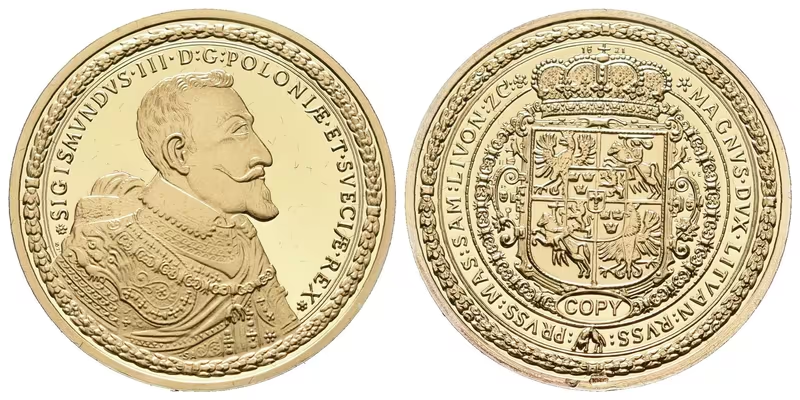
Polsko, Taler - Zikmund III. Vasa, polský a švédský král - portrét a královský erb, replika
Polské království (1587-1632) Taler - Zikmund III. Vasa, polský a švédský král - portrét a královský erb Ag (.925), 25 mm (10 g), BU, v kapsli. Stav mince odpovídá fotografii. Jedná se o druhotný prodej. (Možná oxidace, atd.. ! - VIZ FOTOGRAFIE !)
Skladem 1 ks - Code: XH099
99. Aukce - Dukáty Zikmunda Lucemburského
Aurea Numismatika 99. Aukce - Dukáty Zikmunda Lucemburského Praha - 05.06.2021
Skladem (>5 ks) - Code: SPOL89-B1621
Polsko, 2 Denár 1621
Polsko, Zikmund III. Vasa, 1587 - 1632 2 Denar 1621, Vilnius, Kop.3411 (R!), pěkná zachovalost a patina, ned.
Skladem 1 ks - Code: SPOL89-D1613
Polsko, Groš 1613, Krakov
Polsko, Zikmund III. Vasa, 1587 - 1632 Cu Grosz (Groschen) 1613, Krakov, var., Kop.801
Skladem 1 ks