4 ducat
The 4 ducat, or quadruple ducat, is a gold coin worth four ducats which in our lands belonged rather to representative and exceptional issues than to everyday circulation. In the Habsburg era it appears from the end of the 16th century, and the quadruple ducat was later restruck as a restrike as well.
In our lands the 4 ducat appears for the first time under Habsburg rule during the reign of Rudolf II, with a documented issue from 1589. The very beginning already indicates its character: the quadruple ducat was not a coin intended for ordinary purchases, but rather for larger payments, gifts, ceremonial occasions and the storage of value in the form of "large gold". Higher-value gold coins were moreover usually handled more carefully than small change, and could therefore be preserved more often in better condition — provided of course they were not later melted down.
It is typical of older Bohemian and Moravian quadruple ducats that they were often not a completely "new" type with their own dies. In very limited numbers they were produced as off-strikes from dies of other denominations, most often from the dies of the 1/4 thaler. Such a solution was practical: the mint did not need to prepare a completely new artistic conception and could use an existing engraving that was already proven and ready for work. From the collector's point of view this is interesting in two respects. It explains why some quadruple ducats may carry the composition and style of a "silver" coin transferred to gold, and it shows that these were issues produced rather occasionally and in small numbers.
In larger numbers the quadruple ducats are associated only with the later period of the last Austrian emperors. Issues are recorded under Francis II and Ferdinand V, with the quadruple ducat most prominently associated on a broader scale with the name of Franz Joseph I. It was precisely in the 19th century that gold denominations were increasingly understood not only as a practical means of payment, but also as a representative object and at the same time a means of storing value well suited to gifts or ceremonial occasions. The quadruple ducat thus appears at this time as a "great ducat" with a clear signal of prestige.
History
A specific chapter is the quadruple ducat with the year 1915. It is reported that its mintage is taking place at the Vienna mint as a restrike up to the present day. This is essential information for identification: the year itself need not mean that the coin actually originates from the time of the First World War. In practice it is a type which, thanks to tradition and demand, is repeatedly restruck later, so that it appears on the market often as a modern investment or collector issue based on the historical model.
The 4 ducat was historically linked with higher payments and with representation. Compared with single ducats the quadruple ducat is markedly more "ceremonial" already by its size and value, and therefore appeared more often in settings where prestige was emphasised: in official gifts, rewards, or as part of property reserves. At the same time, higher gold denominations were more sensitive to fluctuations in confidence in the currency and to the economic situation — which is why they were struck rather in certain periods and often in smaller numbers than ordinary circulation coinage.
When identifying older quadruple ducats it is worth bearing in mind the mentioned practice of off-strikes from dies of other denominations, in particular the 1/4 thaler. Artistic similarity to a silver model need not therefore be an "error", but on the contrary a trace of how the coin came into being. With later Habsburg quadruple ducats the ruler and the year are important, as well as awareness that some types (especially those with the year 1915) occur as restrikes. For collectors this means a clear division between historical pieces and modern restrikes, which may be attractive for their availability and condition, but which have a different story from coins actually circulating at the time.
Use, identification and collecting context
In terms of preservation, it is worth observing in particular an intact surface and sharp details of the relief on quadruple ducats. With gold there is no risk of corrosion as with less noble metals, but very common problems are unskilled cleaning, scratches from unsuitable storage or small grooves from handling. With representative gold coins a natural surface and a clean, "unfatigued" relief are usually more valued than an unnatural lustre after intervention. With restrikes collectors often also follow whether it is a piece of normal production or an execution intended more for the collector market.
In our auction and shop
- Code: Z98B-1915B
4 Dukát 1915 - novoražba
František Josef I. (1848 - 1916) 4 Dukát 1915 - novoražba Au 0,986 (13,96 g), Ves. 48, ilustrační foto
Skladem 1 ks - Code: Z98B-1872
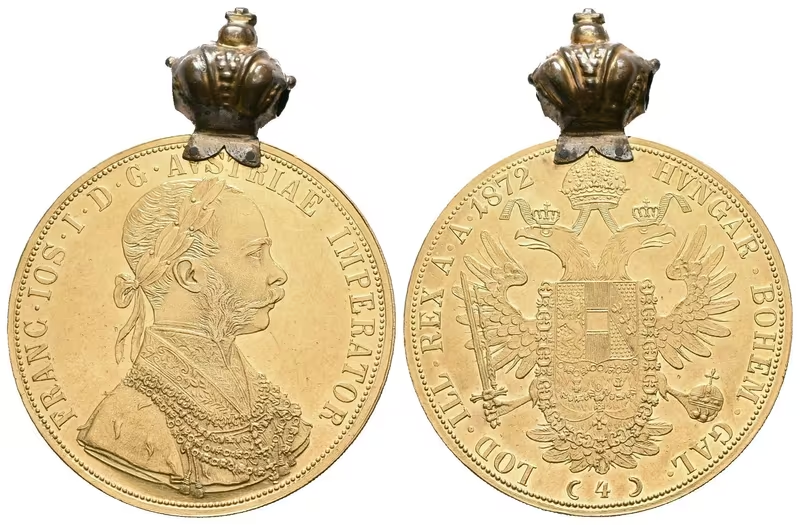
4 Dukát 1872
František Josef I. (1848 - 1916) 4 Dukát 1872 (raženo s ročníkem 1872 A dohromady 24 590 kss), Ves. 48, dobová korunka se zlaceného kovu, rysky v ploše, pěkná zachovalost
Skladem 1 ks - Code: Z98B-1861
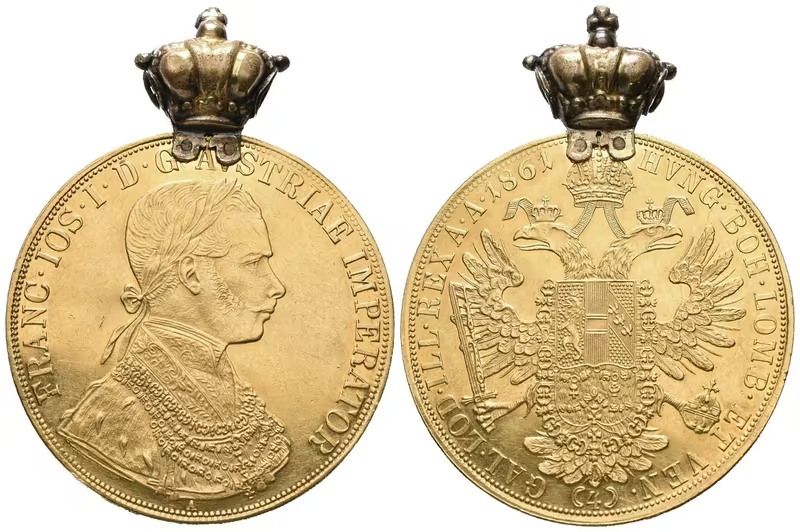
4 Dukát 1861 A
František Josef I. (1848 - 1916) 4 Dukát 1861 A (raženo pouze 7 664 ks), Ves. 45, dobová korunka se zlaceného kovu, nep. zvlněn, pěkná zachovalost
Skladem 1 ks - Code: Z98B-1859
4 Dukát 1859 A
František Josef I. (1848 - 1916) 4 Dukát 1859 A (raženo pouze 13 129 ks), Ves. 44 (celková hmotnost 14,37 g), velmi vzácný ročník, dobová korunka ze 14 ct zlata, luxusní zachovalost aukční cena v této zachovalosti bez korunky 350 000 - 500 000 Kč
Skladem 1 ks