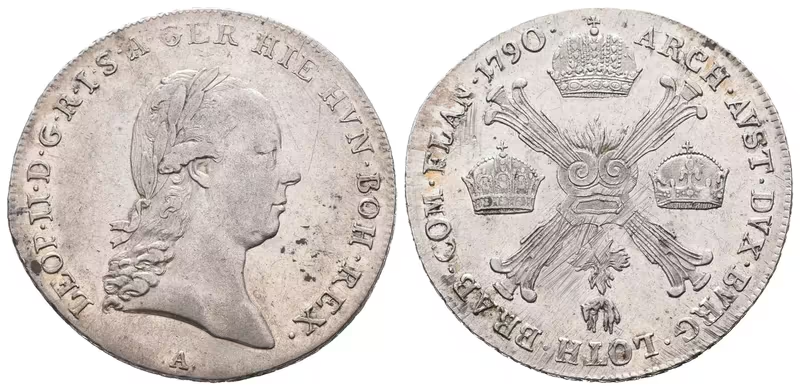
4 thaler
The 4 thaler, or quadruple thaler, is an exceptionally large silver coin worth four thalers, struck rather as a representative piece than for everyday circulation. Because of its large format and weight of around 115 g, it ranks among the rarest thaler multiples and is often classed almost among unique pieces.
The 4 thaler came into being as the highest stage of the thaler multiples, intended to allow the sovereign to pay out or present a large value in a single coin and at the same time to demonstrate the prestige and the minting capabilities of the state. In practice such a coin was not used in everyday payments in the market or in the inn — it was "great silver" intended for court and official use, for ceremonial occasions, gifts to important persons or as a stored value in treasuries. For this reason quadruple thalers were struck only exceptionally and in small numbers.
In the Czech lands the quadruple thaler appears chiefly at the turn of the 16th and 17th centuries, when the thaler became a firm pillar of circulation and accounting, and when the importance of representative issues was at the same time growing. It is most often associated with the period of the reign of Rudolf II, when quadruple thalers were struck in Kutná Hora with the years 1603 and 1604. This time is typical of large silver issues: the Prague court was a cultural and political centre, and the coin could play the role of a "portable symbol" of the sovereign's power.
Another exceptional phase is associated with Matthias (1611–1619), under whom a Prague issue from 1619 is recorded. Shortly afterwards came quadruple thalers under Ferdinand II (1619–1637), this time from Olomouc with the years 1621 and 1622. From the collector's point of view, what is interesting about this sequence is that the quadruple thaler is not tied to a single minting centre: it appears at various mints, and each issue thus carries a slightly different "local" execution and minting handwriting.
History
In the middle of the 17th century the quadruple thaler is also recorded under Ferdinand III (1637–1657). Issues are reported in Jáchymov from the years 1641 and 1644, and further in Brno in 1648. This is a period in which the long-term tensions and shifts in economic conditions are reflected even in coinage; it is precisely this that makes it all the more striking that the quadruple thaler was nevertheless reserved only for exceptional issues, not for "filling up the circulation".
As a late and very rare echo, the quadruple thaler is also recorded under the reign of Charles VI (1711–1740), specifically from Wrocław in 1722. This late episode shows that although the tradition of large thaler multiples gradually weakened, it was occasionally turned to as a representative format when it made sense from the point of view of court symbolism or the prestige of the mint.
Overall, the quadruple thaler ranks by its rarity practically among the unique pieces. This is not only a matter of small mintages, but also of the fact that large silver coins were often melted down — their very weight and high silver content made them an attractive store of metal. Every surviving piece is therefore a valuable testimony to the place that representative issues had in the economy and political culture of the Habsburg Monarchy.
Parameters, appearance and collecting value
The 4 thaler is characterised by its extreme size and weight of around 115 g, that is four times that of the ordinary thaler. The large format made very impressive artistic work possible: a portrait of the sovereign, rich heraldry and long legends that on smaller coins appear cramped. With such large issues exceptional care for composition is moreover often evident — the quadruple thaler was meant to make an impression even on someone who knew nothing about coins.
In identification and valuation the mint and year are crucial (for example Kutná Hora 1603–1604, Prague 1619, Olomouc 1621–1622, Jáchymov 1641 and 1644, Brno 1648, Wrocław 1722). Given that these are coins ranking among the exceptionally rare, even apparent details decide: the legibility of legends, the quality of the relief, possible traces of metal testing, and above all the state of the surface. With large silver coins a natural patina is valued; careless cleaning is very visible on broad surfaces and can significantly reduce collector value.
The quadruple thaler is often collected as the "pinnacle" of the thaler series — either within one sovereign, or as an example of the highest multiple within a given monetary tradition. Because of its exceptional nature, however, it is not a coin a collector would routinely "add"; it is rather a piece that defines an entire collection: with a single coin it can tell the story of prestige, power and the value of silver in the early modern period.
In our auction and shop
- Code: NASAS48-C1542
Sasko, 1/4 Tolar 1542
Sachsen, Johann Friedrich der Großmütige (1541 - 1547) 1/4 Tolar 1542, Freiberg (7,29 g), Keilitz 206, Keilitz/Kohl 135, pěkná zachovalost, patina, pěkně vyražený, drobné vady střížku
Skladem 1 ks - Code: NASAS49-C1552
Sasko, 1/4 Tolar 1552
Sachsen, Moritz (1541/47 - 1553) 1/4 Tolar 1552, Freiberg (7,31 g), Keilitz/Kahnt 17, pěkná zachovalost, patina, lehce ned. a rysky
Skladem 1 ks - Code: MA039-1858A.4
Tolar spolkový 1858 A
František Josef I. (1848 - 1916) Tolar spolkový (Vereinsthaler) 1858 A - Vídeň, Ves. 39, patina, zbytky lesku, rysky a drobné hranky
Skladem 1 ks - Code: M9031-1790A