5 kreuzer
The 5 kreuzer is a small silver coin of the Austrian kreuzer system, struck in the 19th century chiefly for everyday circulation. It is distinguished by its small diameter and low weight, and in popular speech it became known as the "fiver" (pětník).
The 5 kreuzer belongs to the typical "small silver" of the late kreuzer period, when the Habsburg Monarchy placed emphasis on practical circulation coinage for everyday payments. While the higher silver denominations served more often for larger transactions and the storage of value, the 5 kreuzer was a coin that people actually used when making ordinary purchases — at the market, in artisan workshops, and for smaller services. For this very reason such coins were struck in large quantities and had to be readily "legible", both in size and in value, in the context of the prices of the time.
Mintage of the 5 kreuzer in this form is associated with the year 1858 and with the Austrian mints, in particular Vienna and Venice. This is important information for collectors, because it shows that the issue arose within the wider area of the monarchy: the coin could circulate across a large territory and at the same time could differ in minor marks and the "handwriting" of individual mints. In practice, with small denominations one often encounters the fact that even small differences in details (the shape of the lettering, small marks, the style of the eagle or shield) form separate varieties for collectors that can be systematically searched for.
In the middle of the 19th century the way the state worked with metal in circulation coinage was also changing. Small silver coins had to remain usable and trustworthy, but at the same time the economics of mintage had to be addressed — how much metal it was still reasonable to put into coins that wore out quickly and frequently changed owners. The 5 kreuzer is therefore a good example of a denomination whose parameters changed over time without changing the value itself expressed by the number. Such shifts tend to be a response to price developments, the availability of metal, and the effort to keep the monetary system practically functional.
With the 5 kreuzer it is reported that from 1858 it was struck from silver with a weight of 1.333 g and a diameter of 16 mm. This is a very small "silver disc" that could easily get lost in circulation among other small values, but at the same time was clearly distinguishable, thanks to its metal and colour, from copper or otherwise coloured denominations. The small diameter also meant that the coin was sensitive to wear: the legend and the fine details of the relief disappear more quickly in a small format than on larger coins, because they touch fingers and the edges of pockets or cash boxes the most.
History
The year 1867 is considered a milestone, since it is reported to be the year of the last mintage of the 5 kreuzer, and at the same time a lower weight of 0.952 g is mentioned. This very reduction is essential for understanding the denomination: it shows that even within a single name the state could adjust the "metal aspect" of the coin. For collectors, the year 1867 is therefore not only the end of a certain phase, but also a moment that helps to distinguish types by their parameters. In practice, when identifying the 5 kreuzer, it is worth taking note not only of the year, but also of the overall impression of the coin — small silver of a lower weight may feel different in the hand and often also differs in the quality of the mintage in detail.
Alongside the official name, the popular term "pětník" (fiver) is firmly attached to the 5 kreuzer. Such nicknames arose naturally: people named coins according to value and common use, often more simply than the official terminology did. For numismatics this is valuable, because it reminds us that a coin was not just a "product of the mint", but an everyday object that lived in language and in customs. For small denominations this is doubly true — it is precisely these that most affected everyday life, and therefore their own vocabulary and practical experience built up around them.
From a numismatic point of view the 5 kreuzer is attractive above all because of its clear identity: a small silver denomination that can be classified relatively easily by year and mint. For basic orientation the parameters given help — a diameter of 16 mm and a weight of 1.333 g for the issues from 1858, or a lower weight of 0.952 g for the final mintage of 1867. Even if the collector does not always have the possibility to weigh the coin, the difference often shows at least intuitively in comparison with other small silver issues of the same period.
When identifying the 5 kreuzer it is good to watch three things: the year, the mint of origin, and the state of the surface. With small coins, preservation is crucial, because the legibility of the legends and small details is quickly lost. One often encounters coins on which the denomination is still clearly visible, but the rest of the relief is softly worn. Conversely, pieces with sharp lines and legible inscriptions look markedly "livelier" and have higher collector value. With silver coins the patina also plays a role: natural darkening is common and often even desirable, while aggressive cleaning can damage the surface and erase fine structures.
Parameters, identification and collecting use
The Vienna and Venice mints give the 5 kreuzer an interesting "geography". A collector can build a series by mint location or by year, and alongside this seek out small varieties in execution. With small denominations the typology tends to be rich: dies wore out quickly, were changed more often, and differences arose in detail that are very rewarding for specialised collections. The popular name "pětník" can then add a cultural dimension to a collection — it is not just a coin as metal, but also a trace of everyday speech and the values that people reckoned with.
The 5 kreuzer is therefore suitable both for a collection of 19th-century kreuzer coinage and as a complement to the broader theme of Habsburg issues. It is a coin that attracts not only by its "rarity", but above all by the fact that it well illustrates the practical side of currency: a small denomination that had to withstand circulation, be easily recognisable, and at the same time be economically bearable for the state and the mint.
In our auction and shop
- Code: MA078-1864A
5 Krejcar 1864 A
František Josef I. (1848 - 1916) 5 Krejcar 1864 A - Vídeň, Ves. 78, krásná zachovalost, patina, lesk
Skladem 1 ks - Code: MA084-1859M
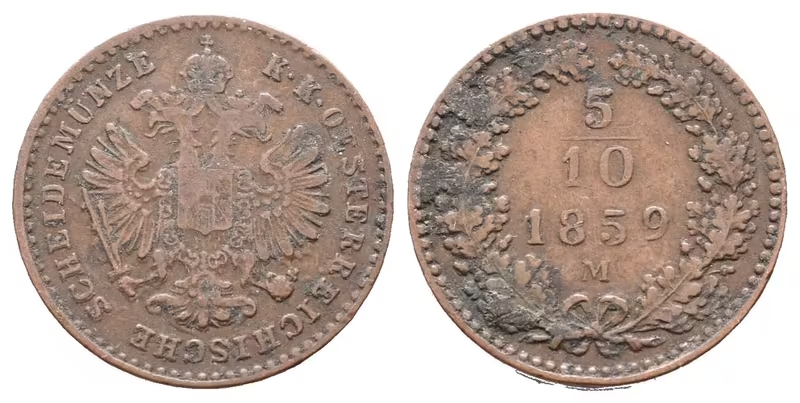
5/10 Krejcar 1859 M
František Josef I. (1848 - 1916) 5/10 Krejcaru 1859 M, Milán, Ves. 84, patina, rysky
Skladem 1 ks - Code: MA084-1859V
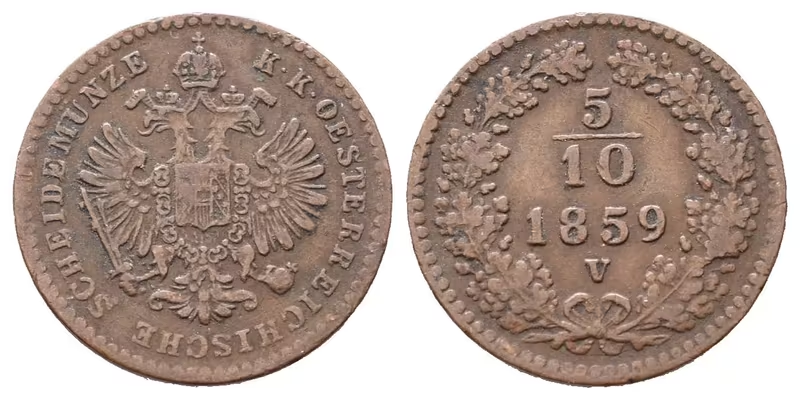
5/10 Krejcar 1859 V
František Josef I. (1848 - 1916) 5/10 Krejcaru 1859 V, Benátky, Ves. 84, patina, rysky
Skladem 1 ks - Code: MA084-1860A
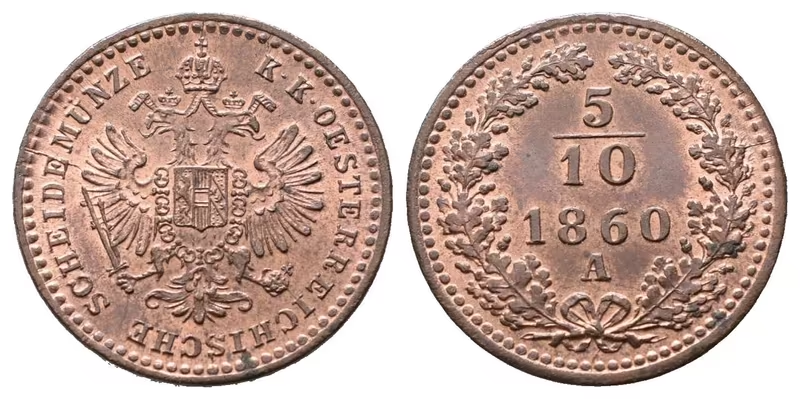
5/10 Krejcar 1860 A
František Josef I. (1848 - 1916) 5/10 Krejcaru 1860 A, Ves. 84, krásná zachovalost, lesk, jemná patina
Skladem 1 ks