Adelaide of Burgundy
Adelaide (Adelheid) of Burgundy was a notable sovereign of the 10th century, who became Queen of Italy and later Holy Roman Empress alongside Otto I. Her life story brings together dynastic politics, the crisis of power in Italy and the consolidation of the Holy Roman Empire, and she therefore belongs among the best-known women of the early Middle Ages.
Adelaide of Burgundy (c. 931/932–999) came from the Burgundian royal house and from her youth was part of high dynastic politics, in which marriage became a tool of alliance as well as of claims to the throne. She was married to Lothair II of Italy, and so entered the very centre of the struggle for power in northern Italy. After Lothair's death the situation escalated dramatically: Margrave Berengar of Ivrea seized power and sought to consolidate his position by forcing Adelaide into marriage with his son. When she refused, she was imprisoned, and her fate became a political question to which power beyond Italy also responded.
The turning point came with her connection to the East Frankish (later Holy Roman) King Otto I. After escaping from prison, Adelaide turned to him for help, and their marriage in 951 had far-reaching consequences: Otto gained support for his Italian ambitions and Adelaide, in turn, obtained protection and the opportunity to exercise her royal status. This opened the way to the consolidation of Ottonian power in Italy and later to the imperial crown. In 962 Otto I was crowned emperor and Adelaide became empress — that is, a sovereign who stood at the very centre of the emerging Holy Roman Empire.
Adelaide's role, however, was not merely ceremonial. In the early Middle Ages, female sovereigns were expected to build networks of loyalty, to support ecclesiastical institutions and to act as mediators in negotiations. Adelaide excelled at precisely this "soft" exercise of power: she was known for her support of monasteries, for founding and endowing ecclesiastical institutions, and for her care for the representation of the dynasty. Her influence is also evident in the fact that after the death of Otto I she did not disappear from politics but remained an important support of the house. During the reign of Otto II and later she played a significant role in dynastic relations and in the resolution of disputes, and after the death of Otto II she participated in securing the succession for the young Otto III, while the early phase of his rule was marked by regency cooperation among the women of the dynasty.
History
Adelaide's story also reflects the tension between Italy and the north that was typical of the 10th century. Italy was for the Ottonian sovereigns a source of prestige and legitimacy, but also a permanent problem, because local families, bishops and urban centres competed there. As a former Queen of Italy, Adelaide lent personal and dynastic depth to the Ottonian claim to Italian rule. Later in life she concentrated more on religious and charitable activities, and her memory was so strong in ecclesiastical circles that she is venerated as a saint. She died in 999, and her cult contributed to her becoming not only a historical but also a symbolic figure: a sovereign who had passed through political violence, who managed to assert herself, and who at the same time linked power with religious patronage.
For the history of the early Middle Ages, Adelaide is also important as a reminder that the legitimacy of rule rested not only on armies but also on family ties, marriages and the ability to create a stable circle of supporters. Her life's course — from Burgundian princess to Queen of Italy and on to empress — shows how fundamental women could be in dynastic politics, especially at a time when European states were still being formed and power was fragile, personal and often bound up with crises.
Adelaide of Burgundy has gone down in history above all as a sovereign who helped to connect the Italian world with the Ottonian empire and strengthened the legitimacy of Otto I's rule in Italy. In practice this meant that her person functioned as a dynastic "bridge": she lent support to claims to rule where military force alone did not suffice, and at the same time helped to stabilise relations with ecclesiastical institutions, which were key for early medieval administration. Her activity is often recalled in connection with her support of monasteries and her charity, which in the era before modern state administration was one of the most effective ways of building the authority and public reputation of a ruling house.
Significance for medieval power and numismatic context
From a numismatic point of view Adelaide is not usually associated with "personal" strikes of her own, as we know them from later centuries when sovereigns commonly appear on coins by portrait. In the 10th century, coins in the imperial and Italian setting were as a rule designated by the name of the ruler or of the mint, and the wives of sovereigns appear on circulating coinage only exceptionally. Even so, Adelaide's story is useful for the collector and the enthusiast of coins as a historical framework: her age is one of the denarius in circulation, of the development of mints, and of the growing importance of royal titles in inscriptions. Anyone collecting early medieval strikes from Italy and the Holy Roman Empire will often encounter types connected with the accession of Ottonian power and with the consolidation of imperial authority after 962 — that is, with the period in which Adelaide stood at the centre of events.
In practice her name can also be valuable in the study of provenance and the history of particular minting regions. Political upheavals, such as the fall of Berengar's power and the strengthening of Ottonian influence, were usually reflected in territorial administration as well as in the stability of circulation. For an understanding of early medieval coins, knowledge of the political context is often more important than the "beauty" of the strike: small silver denarii are inconspicuous at first sight, yet in their legends and in their links to changes of power they bear exceptionally strong witness to their age.
In our auction and shop
- Code: SLUC-D1916
Lucembursko, 25 Centimes 1916
kněžna Marie-Adelaïde (1912 - 1919) 25 Centimes 1916, KM.29, pěkná zachovalost a patina
- Code: SAUST-N1995
Austrálie, 5 Dollars 1995 - Charles Todd
Elizabeth II. (1952 - 2022) 5 Dollars 1995 - 85. výročí úmrtí Charlese Todda Ag 0,925, 38,9 mm (35,79 g), Proof Charles Todd byl slavný australský průkopník telekomunikací a astronomie. Zasloužil se o výstavbu Overland Telegraph Line, spojující Austrálii…
- Code: SAUST-N1995A
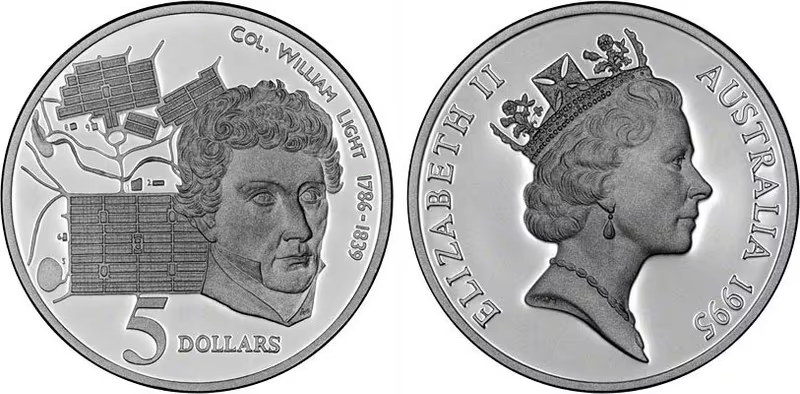
Austrálie, 5 Dollars 1995 - Wiliam Light
Elizabeth II. (1952 - 2022) 5 Dollars 1995 - Plukovník William Light Ag 0,925, 38,9 mm (35,79 g), Proof Plukovník William Light byl prvním generálním Surveyorem v Jižní Austrálii. Jeho návrh města Adelaide je mnohými považován za prototyp ideálního plánu…