Elizabeth I
Elizabeth I was Queen of England and Ireland from the House of Tudor, who reigned from 1558 to 1603. Her era is associated with the consolidation of the Anglican Church, the naval rise of England and a cultural flourishing, and in numismatics it stands out for its rich and easily identifiable coinage.
Elizabeth I came to the throne after a turbulent period of religious and dynastic disputes. She was the daughter of Henry VIII and Anne Boleyn, and her very origin placed her in a delicate position: part of society regarded her as a legitimate heiress, while others questioned her standing on account of the circumstances of her father's marriage. After the death of her half-brother Edward VI and the subsequent reign of Mary I Tudor, England found itself exhausted by religious conflicts and by international isolation. Elizabeth's accession in 1558 therefore represented, for many, the hope of more stable and more pragmatic policies.
The new queen's fundamental task was to settle religious affairs. Elizabeth pushed through the so-called Elizabethan Religious Settlement, which restored the Protestant direction of the Anglican Church but sought to avoid extremes and to maintain the unity of the kingdom. In practice, this meant a long-running tension: a Catholic opposition continued to exist, while some Protestants demanded more radical reform. Elizabeth, however, excelled in her ability to balance and to make use of compromise where it was possible, and firmness where the safety of the state was at stake.
In foreign policy she had to contend with powerful rivals, in particular Spanish and French politics. The conflict with Spain gradually intensified and culminated in 1588 in the Spanish Armada's attempted invasion. The failure of this expedition became a powerful symbol: it bolstered the prestige of England, reinforced the image of the queen as protector of the realm, and supported the naval ambitions that in the following decades contributed to the spread of English influence overseas.
History
The question of the succession was also a significant theme of Elizabeth's reign. The queen never married, by which she preserved her political independence and the ability to use proposals of marriage as a diplomatic instrument. At the same time, however, this generated uncertainty and strengthened various factions at court. Linked to this is the long-running dispute with Mary, Queen of Scots, who represented an important alternative for Catholics. After a series of crises Mary was executed in 1587, which worsened relations abroad, but for Elizabeth it brought the removal of a constant threat of internal conspiracy.
Internally, Elizabeth's era brought not only political stabilisation but also a cultural flourishing. It is associated with the period of the English Renaissance, the development of theatre and literature, and a strengthening of the country's self-confidence. At the same time, however, England also grappled with economic difficulties, price inflation and social tensions, which called for administrative measures, for example in the area of poor relief. Elizabeth I died in 1603 and was succeeded by James I Stuart, bringing the Tudor dynasty to an end. Elizabeth's image as the 'Virgin Queen' and as the ruler of a golden age, however, became one of the most enduring symbols of English history.
Elizabeth I is extraordinarily interesting for coin collectors because her reign falls within a period in which the coin functioned as an everyday bearer of state authority and propaganda. English 16th-century strikes often bear the queen's portrait, titulature and state emblems, and it is precisely thanks to these that they are easily recognisable. For collecting practice it is important that coins from this period exist in a whole range of denominations and finishes — from small change up to higher silver and gold pieces, which were used for larger payments or as representative strikes.
The coins of Elizabeth I and their collector significance
In the coins of Elizabeth I, the quality of the strike and the legibility of detail play a major role. For older hand-struck pieces, it is common to encounter irregular flans, displacement of the strike and incomplete legends. The coins may nevertheless be entirely genuine and period — for these very 'imperfections' are part of the technology. Collector value is attached to specimens with a well-readable titulature, a fine portrait and preserved emblems, since these enable precise identification of the type and sometimes assignment to specific stages of the reign.
For the period of Elizabeth I, the theme of trust in the currency is also important. In the 16th century England was addressing the consequences of the debasement of coinage in the preceding decades, and a stable coinage was one of the pillars of state authority. For this reason, too, Elizabethan strikes are regarded as valuable material for the study of economic policy: they show how the state worked with metal, how it expressed its sovereignty, and how it sought to keep the currency acceptable to merchants and to the ordinary population alike.
In our auction and shop
- Code: ZSTRI-2014
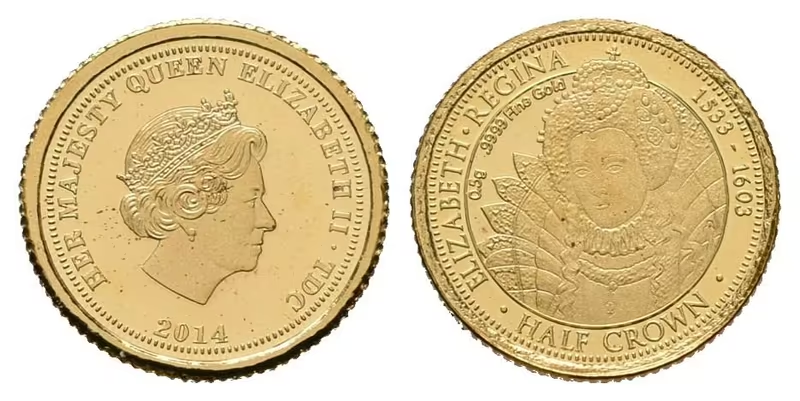
Tristan da Cunha, 1/2 Crown 2014 - Královna Alžběta I.
1/2 Crown 2014 - Anglická královna Alžběta I., Au 0,9999, 11 mm (0,5 g), kapsle, PROOF Z cyklu Nejmenší zlaté mince světa Tristan da Cunha je skupina sopečných ostrovů na jihu Atlantského oceánu vzdálená asi 2 800 km od břehů Afriky a 3 200 km od Jižní…
- Code: XF01-ENG
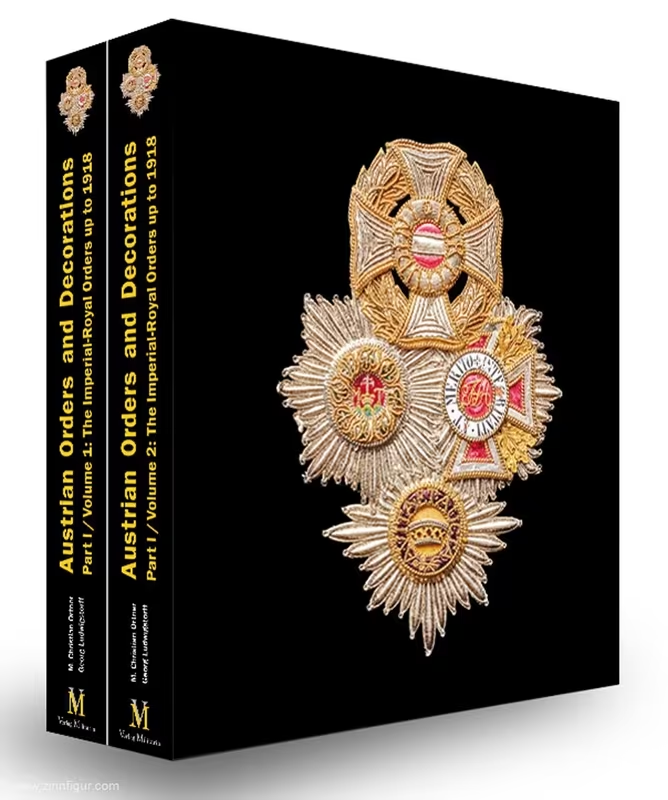
Austrian Orders and Decorations, Part I: The Imperial-Royal Orders up to 1918
Ortner, M. Christian, Ludwigstorff, Dr. Georg Austrian Orders and Decorations. Part I: The Imperial-Royal Orders up to 1918 Anglické vydání, 2 svazky, 832 str. Řády a vyznamenání Starého Rakouska jsou fascinujícím oborem studia a výzkumu dodnes,…
- Code: Q98-1867KORA
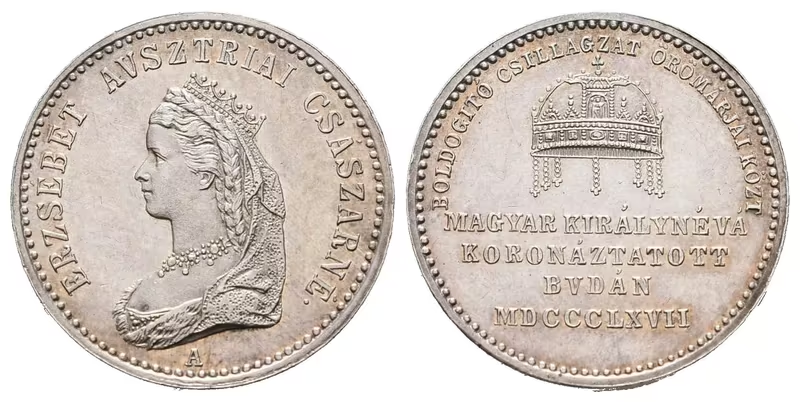
AR Žeton 1867 - Korunovační
František Josef I. (1848 - 1916) AR Malý žeton 1867 (Scharff, Leisek) - Ke korunovaci Alžběty na uherskou královnu 5. 6. 1867 v Budapešti. Portrét se závojem zleva, opis / Uherská koruna, pod ní 4-řádkový maďarský nápis, opis. Nov.C7b Ag 20 mm (3,32 g),…