Aquileia
Aquileia is an ancient city in north-eastern Italy by the Adriatic Sea, founded as a Roman colony and later a significant metropolis at a crossroads of trade routes. It became famous for its wealth, early Christianity and also because in late antiquity it hosted an important imperial mint.
Aquileia was founded in 181 BC as a Roman colony whose task was to protect the north-eastern border of Italy and at the same time to open a safe corridor to the Alpine passes and further into the Danube area. Its position between lowland, rivers and coast gave it an advantage for trade as well as for military logistics: land routes from the Apennine Peninsula converged here as did routes heading to the Balkans and Pannonia. At the time when Rome was turning into an empire, Aquileia became a natural hub where caravans, shipping and state administration met.
In the imperial era Aquileia prospered thanks to trade and crafts. Goods from the eastern Mediterranean flowed across the Adriatic, while raw materials and products of the Alpine and Danubian regions flowed in from the interior. The city was strategically important as well: northern Italy was repeatedly the place from which defence against pressures from beyond the Alps was organised, and Aquileia in such situations turned into a firm point of supply and the gathering of troops. At the same time it was a city with a distinctive urban culture which could measure itself against the most significant settlements of northern Italy.
In the 3rd and 4th centuries, in a period of transformations of the Roman state and more frequent crises, the role of Aquileia became more pronounced still. Northern Italy was nearer to threatened borders, and so the presence of the army and the imperial administration grew here. From this environment also comes one of the reasons why the city later became the seat of a mint: the state needed a reliable source of currency for pay and for the functioning of the economy in regions which were key for defence.
History
Alongside secular power the importance of Aquileia also grew in Christian history. The city became an early ecclesiastical centre, and in late antiquity an important church institution associated with the patriarchate developed here. To this day Aquileia is known especially for its basilica with extensive mosaics, which rank among the most valuable monuments of early Christianity in Europe. These mosaics are not only a work of art but also testimony to the wealth and cultural self-confidence of the city in a period when the ancient world was gradually changing.
A great turning point was brought by the 5th century. Aquileia became a victim of the war upheavals of late antiquity and in 452 was destroyed during the campaign of the Huns led by Attila. Although life returned to the area, the city never regained its former standing. Part of the population moved to safer places in the lagoons and on the coast, which in the long run is sometimes associated also with the rise of new settlements in the Venetian area. In the early Middle Ages Aquileia found itself in a space of clashes between new powers, and its importance shifted more into the ecclesiastical and administrative sphere than into the role of a great commercial metropolis.
Even so, Aquileia did not disappear from the map of history. Its ecclesiastical tradition, monuments and former glory have made it a place that returns in Italian and European memory as a symbol of the "great city of the north" that stood on the edge between Roman Italy and the world beyond the Alps. Archaeological finds to this day recall the extent of ancient urbanism, the wealth of the houses and the commercial character of the city, which for centuries was one of the key points of the northern part of the Roman world.
The Aquileia mint and coins
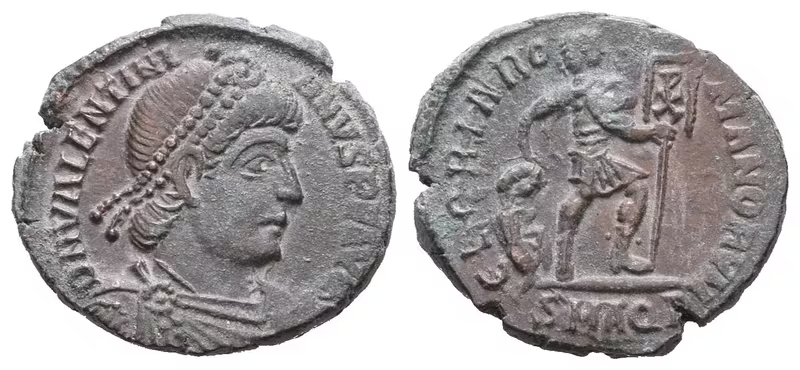
Aquileia has a direct and well-documented relationship with numismatics thanks to the late Roman imperial mint that functioned here in late antiquity. In practice this was an instrument of state power: minting coins in northern Italy made it possible to supply circulation rapidly and to secure pay for the army and officials in regions where it was necessary to respond to military threats. The mint struck mainly the ordinary currency of late Rome, typically bronze and copper denominations, which occur in great quantities and are popular with collectors precisely because of the possibility of studying types, portraits and the development of imperial propaganda well.
For identifying these coins the mint marks in the exergue (lower part of the reverse) are key, often in the form of abbreviations referring to Aquileia. It is important to take note also of the workshop marks, because large mints worked in several "operations" and individual workshops were marked by letters. From a single location there may thus exist a whole range of variants of the same type, differing in small details in the legend, in the marks or in the execution of the portrait.
Coins from Aquileia tend to be attractive to collectors also because they can be collected systematically: by emperor, by mint marks, by reverse motifs or by period. With bronze strikes the preservation of the surface and a stable patina are essential, because harsh cleaning easily wipes away the fine lines and worsens the legibility of the marks. A well-centred piece with a clear exergue and a legible titulature is therefore usually substantially more valuable than an ordinary, heavily circulated specimen. The Aquileia mint thus makes it possible to link the history of a great Roman metropolis with a specific, tangible source — a coin that actually circulated at a time when the empire was trying to maintain stability on its borders.
In our auction and shop
- Code: BE155-0014.20
Valentinianus I., nummus, Aquileia, RIC IX 14
Valentinianus I. (364 - 375) mincovna Aquileia, stojící císař se zajatcem a Christogramem, RIC IX 14
Skladem 1 ks - Code: BE158-CD262
Gratianus, maiorina
Gratianus (367 - 383), maiorina - mincovna Aquileia, stojící císař s Viktorií a klečící ženou RIC 262
Skladem 1 ks - Code: SITAAQI-A1402
Itálie - Aquilea, Denár b.l.
Itálie - Aquilejský patriarchát, Antonio II. Panciera, 1402 - 1412 Denár b.l., Rodový znak ve štítu, opis / Orel hledící vlevo, opis. Bernard.67 (0,58 g), patina, excentrický
Skladem 1 ks - Code: SITAAQI-A1402.1
Itálie - Aquilea, Denár b.l.
Itálie - Aquilejský patriarchát, Antonio II. Panciera, 1402 - 1412 Denár b.l., Rodový znak ve štítu, opis / Orel hledící vlevo, opis. Bernard.67 (0,51 g), patina, lehce olámaný
Skladem 1 ks