Bimetallic Coin
A bimetallic coin is a coin composed of two different metals, most often of an outer ring and an inner centre, which are firmly joined during striking. This method of construction increases resistance to counterfeiting and allows easy distinction of value by colour and material.
The bimetallic coin appears as a response to two long-standing needs of monetary circulation: the practical distinguishability of coins and protection against counterfeits. Already in earlier periods, coinage sought to distinguish values by size, weight and image, but with the growth in the number of denominations and the spread of modern machinery for counterfeiting it became desirable to add a technical barrier. Joining two different alloys into one coin is technologically more demanding than striking a coin from a single metal, and therefore this procedure naturally makes illegal imitation more difficult.
The idea of combining metals in a coin is not entirely new, but the real boom of bimetallic coins is linked chiefly with the 20th century and the period after the Second World War, when the economy and the material composition of coinage were substantially transformed. Precious metals gradually disappeared from everyday coins and were replaced by cheaper alloys. At the same time, however, states needed to maintain confidence in coins of higher values, which could no longer be "backed" by silver or gold content. Bimetallic coinage in this situation became an elegant solution: a coin looks distinctive, is well recognisable and is technically more complex.
A significant impulse for the spread of bimetallic coinage was also the rise of automated payments and machine processing of coins. During the 20th century the number of coin-operated machines, turnstiles and sorting devices grew, which recognise coins by dimensions, weight and electromagnetic properties of the metal. The combination of two alloys allows the creation of a coin's "signature", which can be reliably measured, and thereby the scope for misuse is reduced. For this reason bimetallic coins have gradually become the standard for higher circulating denominations in many countries, especially where there was a need to clearly distinguish "large" values from small change.
History
In the European space bimetallic coinage asserted itself markedly also with modern monetary systems, where higher denominations were intended for frequent use and at the same time had to be secure and long-lastingly durable. The bimetallic construction also made it possible to work with the visual identity of the currency: the ring and the centre give the coin a characteristic "face" which can be easily remembered and quickly recognised in circulation even by touch. In recent decades bimetal has been used not only for circulating coins but also for commemorative and collector strikes, because it allows attractive combinations of colours and contrasts.
A bimetallic coin typically consists of two parts: an outer ring and an inner core. During striking these parts are mechanically joined so that they form a single firm whole, which does not fall apart in ordinary use. Most often, alloys of differing colour are combined (for example a "yellow" ring and a "silver" centre), which markedly improves orientation in the wallet. For some modern coins, special layered materials are also used, which increase security and the stability of properties.
A great advantage is the possibility of setting the coin to have unique physical parameters. Two different alloys react differently to a magnetic field and to electrical conductivity, which is practical for machine recognition. For this reason bimetallic coins are often deployed for denominations widely used in vending and transport systems. At the same time they are more difficult to counterfeit so as to imitate not only appearance but also measurable properties.
Construction, materials and practical use
From a numismatic point of view, bimetal is also interesting aesthetically. The contrast of two metals allows the highlighting of a motif, emblem or denominational value and the creation of a modern, easily legible design. For this reason bimetallic coins are often applied also for commemorative issues, where a striking visual impression is expected, but at the same time the practical construction suitable for circulation is preserved. In modern coinage, bimetal therefore represents a fusion of technical security and user-friendliness: a coin that is recognised quickly and is more difficult to imitate convincingly.
In our auction and shop
- Code: ZC509
2000 Kč 2019 - 100. výročí čs. koruny
Česká republika (1993 - ) Mimořádné a bimetalové ražby 2000 Kč 2019 - 100. výročí zavedení československé koruny, autor Jiří Hanuš, Aurea C509, etue, certifikát Au 0,986 (3,49 g), Ag 0,925 (31,103 g), 40 mm (34,59 g), raženo 7 200 ks (běžná kvalita)
Skladem 1 ks - Code: ZC501.A
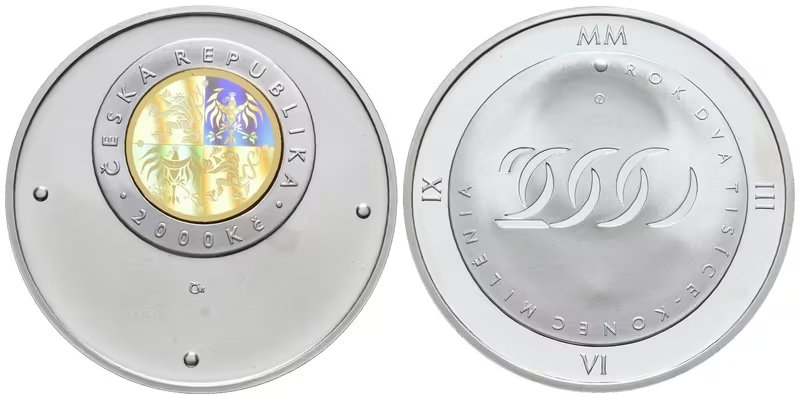
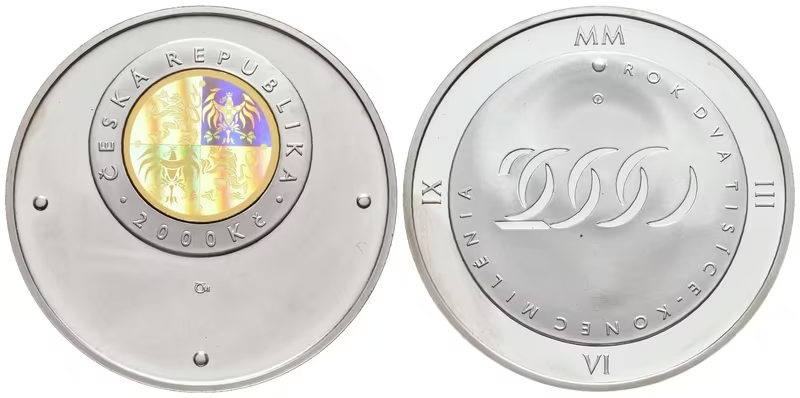
2000 Kč 2000 - Rok dva tisíce - konec milénia
Česká republika (1993 - ) Mimořádné a bimetalové ražby zlatých mincí 2000 Kč - Rok 2000 - konec milénia, autor Otakar Dušek, Aurea C501, etue, bez certifikátu, matové averzní pole, nep. oxidační tečka a skvrnka u hrany na reverzu Ag 0,999 (31,1 g), Au…
Skladem 1 ks - Code: ZC501.1
2000 Kč 2000 - Rok dva tisíce - konec milénia
Česká republika (1993 - ) Mimořádné a bimetalové ražby zlatých mincí 2000 Kč - Rok 2000 - konec milénia, autor Otakar Dušek, Aurea C501, etue, bez certifikátu, skvrnka u hrany na reverzu na 8 hod., jinak bezvadná Ag 0,999 (31,1 g), Au 0,9999 (3,111 g),…
Skladem 1 ks - Code: ZC501-PROOF
2000 Kč 2000 - Rok dva tisíce - konec milénia, PROOF
Česká republika (1993 - ) Mimořádné a bimetalové ražby zlatých mincí 2000 Kč 2000 - Rok 2000 - konec milénia, autor Otakar Dušek, Aurea C501, etue, certifikát, PROOF, zcela neznatelná skvrnka, téměř bezchybná zachovalost Ag 0,999 (31,1 g), Au 0,9999…
Skladem 1 ks