French Republic
The French Republic is the political system of France existing in five periods from 1792 to the present day, which replaced monarchical institutions with democratic and republican principles founded on popular sovereignty. The French Republic is in numismatics significant for its revolutionary coins with allegorical motifs of Marianne, modern francs, and…
The First French Republic (1792-1804) arose from the French Revolution, which in 1792 overthrew the monarchy and proclaimed a republic founded on the principles of liberty, equality, and fraternity. The revolutionary Convention first executed King Louis XVI and Queen Marie Antoinette, but the republic quickly found itself in conflict with the European monarchies, which feared the spread of revolutionary ideas. The Jacobin domination (1793-1794) under the leadership of Robespierre introduced the Reign of Terror against the enemies of the revolution.
After the end of the Terror came the period of the Directory (1795-1799), which contended with political instability and economic crisis. The young General Napoleon Bonaparte gained popularity through military successes and in 1799 carried out a coup d'etat. The Consulate (1799-1804) gradually concentrated power in Napoleon's hands, until in 1804 he had himself crowned emperor, by which the First Republic came to an end.
The Second French Republic (1848-1852) arose from the February Revolution, which overthrew King Louis Philippe and introduced universal male suffrage. The first and only president was Louis-Napoleon Bonaparte, nephew of the emperor. The republic faced an economic crisis and political polarisation between conservatives and socialists. The Paris uprising of June 1848 was suppressed bloodily.
Louis-Napoleon gradually strengthened his power and in 1851 carried out a coup d'etat. A year later he had himself proclaimed emperor as Napoleon III, by which the Second Republic ended and the Second Empire arose. This period lasted until the Franco-Prussian War of 1870, when Napoleon III capitulated at Sedan and Paris proclaimed a republic.
The Third French Republic (1870-1940) was the longest republic in French history. It began dramatically with the Paris Commune in 1871, when radical socialists briefly took over the capital. After the suppression of the Commune the republic stabilised and became a parliamentary democracy with the president as head of state and the prime minister responsible to parliament.
History
The Third Republic underwent a series of crises - Boulangism in the 1880s, the Dreyfus Affair at the turn of the century, and the First World War, which it won but at enormous cost. The interwar period was characterised by political instability and economic problems. The republic ended in 1940 with German occupation and the rise of the collaborationist Vichy regime.
The Fourth Republic (1946-1958) was restored after the liberation from Nazi occupation. The provisional government led by General Charles de Gaulle prepared a new constitution, but de Gaulle withdrew from politics on account of disagreement with the political system. The Fourth Republic faced decolonisation wars in Indochina and Algeria, which ultimately led to its crisis and fall.
The Fifth French Republic arose in 1958 with the return of Charles de Gaulle to power during the Algerian crisis. De Gaulle pushed through a new constitution strengthening the powers of the president and resolved the Algerian War by granting independence. The Fifth Republic is characterised by strong presidential power, a stable political system, and a French leading role in European integration.
The Fifth Republic has undergone significant changes - the events of May 1968, the modernisation of the economy, the building of nuclear forces, and an active foreign policy. France became a founding country of the European Communities and later of the European Union. The current Fifth Republic is a stable parliamentary democracy with a semi-presidential system.
The revolutionary coinage of the First Republic introduced entirely new motifs replacing monarchical symbols with republican allegories. In place of royal portraits, Marianne - the symbolic figure of the French Republic with a Phrygian cap - appeared on the coins, or allegorical figures representing Liberty, Equality, and Fraternity. The revolutionary calendar was even used on some coins instead of the Christian dating.
Republican French coinage
The franc system introduced under the Consulate became the foundation of French coinage for the next two centuries. Napoleon I established that the franc consisted of 20 sous or 100 centimes, with the 5-franc thaler becoming the basic silver coin. This system was adopted by most of the world, and the franc became a model for many national currencies, including the Belgian franc and the Swiss franc.
Under the Third Republic French coinage attained a high artistic level with beautiful motifs of Marianne, allegorical figures, and modern portraiture. Commemorative coins were struck celebrating significant events, scientific advances, and cultural achievements of the republic. The French silver francs and gold Napoleons of this time were among the highest-quality European coins.
The current Fifth Republic continues the republican coinage tradition with motifs of Marianne, the French rooster, and national symbols. After the introduction of the euro in 2002 the French national coins bear traditional motifs, including Marianne, the tree of life, and the motto "Liberte, Egalite, Fraternite". The French euro coins thus continue a two-hundred-year tradition of republican symbolism.
In our auction and shop
- Code: SFRA-Z1992New
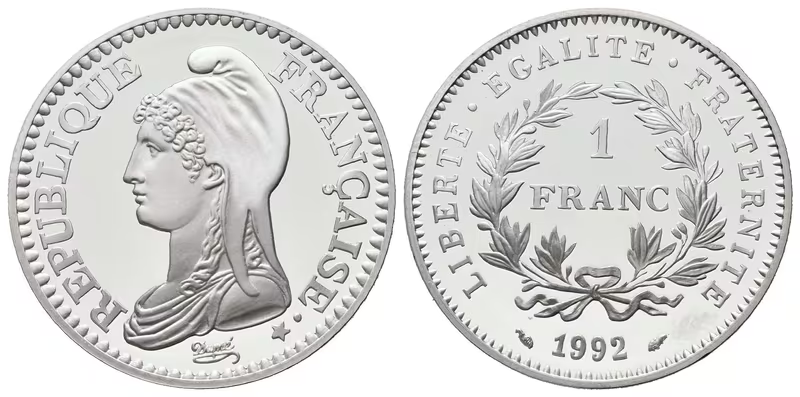
Francie, 1 Franc 1992 - Marianne, 200. výročí první francouzské republiky
Francouzská republika (1958-dosud) 1 Franc 1992 - Marianne, 200. výročí první francouzské republiky, KM# 1004 Ag (.900), 28 mm (15,5 g), v kapsli. Stav mince odpovídá fotografii.
Skladem 1 ks - Code: ZD-2020VAL
Sada mincí 2020 - Válečný rok 1940
Česká republika (1993 - ) Sada čtyř mincí 2020 (Lubomír Lietava) - Válečný rok 1940 4x Au 0,9999, 16 mm (3,11 g), náklad 300 ks, certifikát, plechová etue, PROOF Ucelená sada čtyř zlatých mincí České mincovny z volného cyklu Válečný rok připomíná 80.…
- Code: ZSFRA-91F1905
Francie, 20 Frank 1905
Francie, III. republika (1871 - 1940) 20 Frank 1907 Au 0,900, 21 mm (6,4516 g), KM. 847 Francouzský 20 franc Marianne Coq byla měna vydávaná za Třetí republiky v letech 1899 až 1914 , v ryzosti 900/1000 Au (21,6 kt), váze 6,45 g a průměru 21 mm . Celková…
- Code: ZSFRA-91F1909
Francie, 20 Frank 1909
Francie, III. republika (1871 - 1940) 20 Frank 1909 Au 0,900, 21 mm (6,4516 g), KM. 847 Francouzský 20 franc Marianne Coq byla měna vydávaná za Třetí republiky v letech 1899 až 1914 , v ryzosti 900/1000 Au (21,6 kt), váze 6,45 g a průměru 21 mm . Celková…