Frederick William II of Prussia
Frederick William II of Prussia (1744–1797) was the Prussian king of the House of Hohenzollern who reigned from 1786 to 1797 after the death of Frederick II the Great. His era was marked by the upheavals of the French Revolution, wars against revolutionary France, and territorial gains in the partitions of Poland.
Frederick William II of Prussia was born on 25 September 1744 in Berlin as the son of Prince Augustus William of Prussia and Louise of Brunswick-Wolfenbüttel. He ascended the Prussian throne on 17 August 1786 after his uncle Frederick II the Great, with whom he is often compared. Whereas Frederick II left the image of a monarch-general and a strict administrator, Frederick William II appeared more as a ruler who leaned on a circle of advisers and devoted more attention to the court, ceremony, and cultural interests. The internal workings of the state therefore depended to a considerable extent on how well discipline could be maintained in the administration and the army, which was one of the foundations of Prussian power.
His reign began at a time when Europe stood on the threshold of fundamental changes. Enlightenment reform ideas met with a conservative reaction, and into this in 1789 erupted the French Revolution. It gradually grew into a military conflict that transformed international relations as well as the conduct of politics. In an effort to stop the revolutionary development in France, Prussia allied with Austria and other powers and entered the War of the First Coalition. For Frederick William II this meant combining traditional power-political objectives with a new, hard-to-read type of threat that was both ideological and military.
An important component of his foreign policy was eastern and east-central Europe. Prussia took part in the partitions of Poland and expanded its dominions with further territories, which strengthened its strategic position but at the same time brought new administrative and social challenges. The enlarged state had to be integrated and provided with administration, a tax system, and security, in a situation where Europe was rapidly polarising. The military commitments in the west and the expansion in the east "pulled at" each other for attention and resources.
History
In the mid-1790s Prussia withdrew from the conflict with revolutionary France by a separate Peace of Basel (1795). This step is often interpreted as a pragmatic effort to free its hands and concentrate on its own interests, especially in the east. At the same time, however, it shows that the monarch's policy was less consistent than under Frederick II and that Prussia was seeking a balance between great-power ambitions and the real possibilities of the state.
Frederick William II died on 16 November 1797 in Potsdam. He was succeeded by Frederick William III of Prussia, who had to face the Napoleonic era in its full force. From a historical point of view, the reign of Frederick William II is often assessed as a transitional period: Prussia still benefited from the institutional and military legacy of the "great king", but at the same time the limits of the system began to appear, exposed as it was to a new type of European crisis.
Frederick William II represents a type of ruler in whose case it is important, for an understanding of the period, to follow not only personal traits but also the functioning of Prussian institutions. In the late 18th century Prussia ranked among the best-organised states of Central Europe, relying on a professionalised army, a dense network of officials, and a relatively efficient collection of taxes. At the same time, however, social tensions, the impact of long wars, and the new revolutionary "language" of politics gradually showed that stability was not to be taken for granted. The monarch had to react to a rapidly changing international environment without losing control of the internal workings of the country.
The monarch, the state, and coins of his time
From a numismatic point of view, his reign falls within a period when Prussian monetary affairs rested on the thaler-based monetary tradition and on a mixture of silver and gold denominations. In circulation, silver thalers and their fractions as well as smaller coins for everyday payments were used; higher payments and state finances often also relied on gold strikes. Coins of his time usually bear the ruler's portrait and titulature, while the reverse uses the state coat of arms and the denomination. For collectors, a broad spectrum of variants by mint, year-date, and minor differences in engraving or legends is typical.
The strikes of Frederick William II are also of interest as a "document of the period": they reflect the end of the old European order before the Napoleonic upheavals while at the same time embodying the continuity of Prussian representation, which prided itself on state symbolism and on emphasising the legitimacy of the Hohenzollern dynasty. With individual pieces it pays to observe especially the legibility of the titulature, the quality of the portrait, and the precise identification of the denomination, because these elements often determine whether the coin is an ordinary circulation issue or a type more sought after on account of its year-date or variant.
In our auction and shop
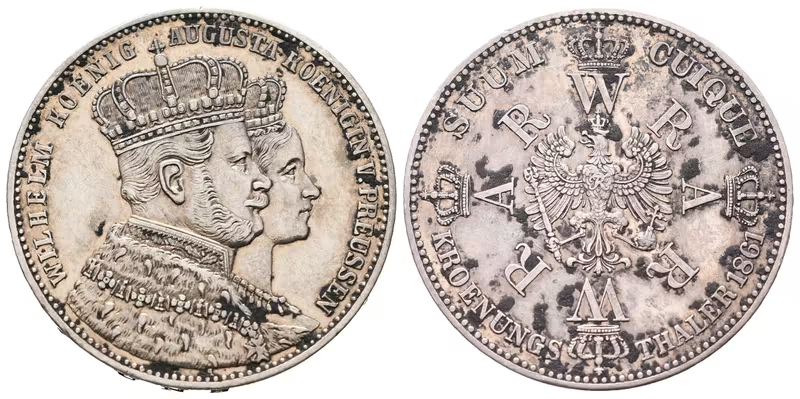
- Code: NAPRU97-B1861
Prusko, Tolar 1861 - Korunovační
Pruské království, Friedrich Wilhelm IV. (1840 - 1861) Tolar 1861 A - Ke korunovaci Viléma a Augusty Sasko-Výmarské, KM.488, Dav.778, tmavá patina, rysky, oběh