Gaius Cassius Longinus
Gaius Cassius Longinus was a Roman politician and general of the late Republic, known as one of the main instigators of the assassination of Gaius Julius Caesar in 44 BC. After Caesar's death he led the resistance, together with the other "liberators", against the triumvirs, struck his own coins for the army, and, following the defeat at Philippi in 42 BC…
Gaius Cassius Longinus came from an important Roman family and even in his youth worked his way up among the capable officers and administrative officials of the Republic. He came to wider notice mainly as commander of eastern campaigns and as a man with markedly republican convictions, who regarded the concentration of power in the hands of one man as a threat to the traditional order. In the last decades of the Republic, Rome was indeed struggling with a long series of civil conflicts in which political contestation was increasingly decided by the force of armies and by the personal ambitions of commanders.
Cassius operated at this time in an environment where loyalty to the Republic often mingled with personal ties and pragmatic alliances. After Caesar's rise, part of the aristocracy felt squeezed out of decision-making and perceived Caesar's position as a step toward monarchy, even though the republican institutions were formally preserved. Cassius belonged to those who were convinced that intervention was necessary. In the preparations for the assassination he became one of the chief organisers, and together with Marcus Junius Brutus he gave the conspiracy the shape of a "defence of liberty" that was to be acceptable even to wavering senators. The assassination of Caesar on the Ides of March in 44 BC, however, did not lead to the restoration of peaceful conditions; on the contrary, it opened a further phase of civil wars.
After Caesar's death, Cassius and Brutus sought to gain political and military support outside of Rome itself, especially in the East, where it was possible to gather resources and an army more quickly. Against them a power coalition of Caesar's heirs and adherents gradually formed, known as the Second Triumvirate. In practice it was a clash of two legitimising narratives: Cassius and his allies presented themselves as defenders of the Republic against tyranny, while the triumvirs leaned on Caesar's legacy, on control of Italy, and on strong armies. Cassius in the eastern provinces obtained significant resources — not only political but also financial — and thereby built up a base for a decisive campaign.
History
The culmination of the conflict was the battles of Philippi in 42 BC, where the armies of Cassius and Brutus clashed with the armies of Mark Antony and Gaius Octavius (Octavian). In the first phase of the fighting the situation developed confusingly: while on one wing the "liberators" had success, elsewhere they suffered losses, and in the ensuing confusion conflicting reports spread. Cassius, convinced that defeat was inevitable, chose suicide. Brutus still continued the resistance for a short time, but after the second battle of Philippi his hope too came to an end. The death of Cassius thus symbolically closed one of the last great republican alternatives and significantly accelerated the transition to an imperial form of government.
In the historical image Cassius is sometimes depicted as the colder, harder, and more practical counterpart of Brutus — a man who could organise, raise money, and wage war, but who was also able to act uncompromisingly. It was precisely this combination that made him a key figure of the last civil wars of the Republic. Although his political project ended in defeat, he left a marked imprint on Roman history: he shows how, in the late Republic, the ideology of "liberty" intermingled with military reality and how close Rome at that time was to a continual violent resolution of disputes.
Cassius is important not only as a conspirator against Caesar but also as a capable organiser of an eastern power base. To maintain an army he needed a steady supply of money, and so his activity also left its mark on minting. In the years after Caesar's death, silver denarii were struck in the East bearing the names and titles of the leaders of the "liberators"; these coins had a practical purpose — to pay the army and secure supplies — and at the same time a political meaning, because they expressed propagandistically who laid claim to legitimate power. On Cassius's strikes one encounters his name in the legends, sometimes also with motifs that allude to the Republic, to military authority, or to the "restored order".
Politics, military matters, and numismatic context
For numismatics Cassius is also of interest because his coins belong to the "battlefield" minting of the civil wars. Such issues often arose quickly, in the field or in provincial conditions, and may exhibit greater stylistic variability, differences in the quality of the dies, or in the flans. Even so, they are an exceptionally valuable source: the coin is here tangible proof of how a political conflict turned into a struggle for resources and how money functioned as an instrument of war as well as a means of legitimation. In the case of Cassius, these strikes complement his historical role well — not as a theorist of the Republic but as a man who attempted to enforce the republican programme by force and finance at a time when the future of Rome was being decided on the battlefield.
In our auction and shop
- Code: ZSPAL-2009
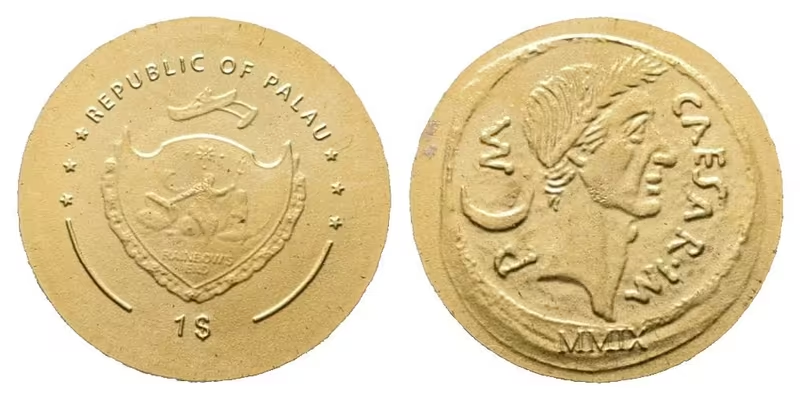
Palau, 1 Dollar 2009 - Julius Caesar
1 Dollar 2009 - Gaius Julius Caesar, replika stříbrného denáru Au 0,999, 11,8 mm (0,5 g), kapsle Z cyklu Nejmenší zlaté mince světa
- Code: BE002-0056
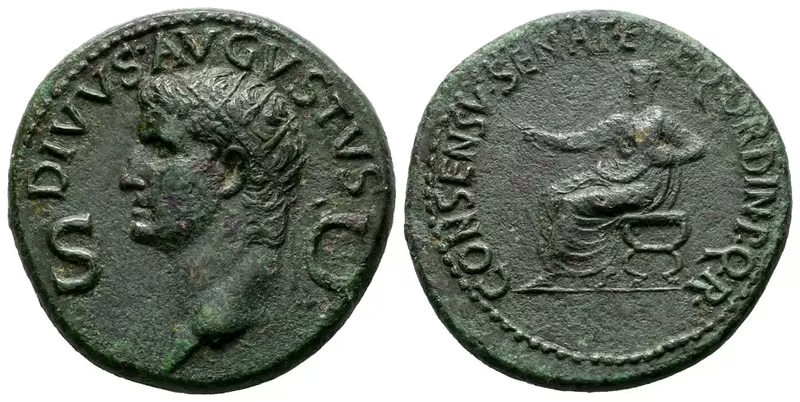
Augustus, Dupondius, RIC. 56
Augustus (27 př. Kr. - 14 po Kr.) Dupondius, Rv: CONSENSV SENAT ET EQ ORDIN P Q R, sedící Augustus (?) zleva na kurulském křesle drží větvičku, posmrtná ražba za Caliguly, RIC.56 (Gaius), zelená patina