Herennia Etruscilla
Herennia Etruscilla was a Roman empress, wife of Emperor Trajan Decius and mother of Emperors Herennius Etruscus and Hostilian. She bore the title Augusta from 249 to 253 and her portrait appears on numerous coins, especially antoniniani with the motif of the goddess Pudicitia.
In full Herennia Cupressenia Etruscilla, she came probably from the senatorial family of the Herennii, whose ancestors had settled in Etruria. The exact date and place of her birth are not known, but her birth is estimated to the beginning of the 3rd century. To the future emperor Gaius Messius Quintus Trajan Decius she married presumably before the year 230, and bore him two sons—the elder Herennius Etruscus and the younger Hostilian.
Herennia received the title Augusta in September 249, when her husband defeated Emperor Philip I the Arab and became ruler of the Roman Empire. This period fell into the so-called Crisis of the Third Century, when the empire was beset by protracted civil wars, incursions of barbarian tribes and economic decline connected with the debasement of the currency. Decius attempted to restore the traditional Roman religion and in 250 issued an edict ordering all inhabitants to sacrifice to the Roman gods, which provoked the first systematic persecution of Christians. In the same year the so-called Plague of Cyprian broke out, an epidemic probably of smallpox, which decimated the population of the empire over two decades.
In 251 the Goths under King Cniva invaded Roman territory. Trajan Decius together with his son Herennius Etruscus marched against the invaders, who after sacking Philippopolis were retreating with their booty back across the Danube. In June 251 the two armies clashed at the Battle of Abritus (near present-day Razgrad in Bulgaria). The Gothic warlord Cniva lured the Romans into marshy terrain in the valley of the Beli Lom river, where they suffered a crushing defeat. Both Trajan Decius and his son Herennius Etruscus fell in the battle—they thus became the first Roman emperors to fall in battle against an external enemy.
History
After the tragedy at Abritus Trebonianus Gallus, governor of Moesia, was proclaimed emperor by the soldiers. In order to secure popular support and legitimacy, he left Herennia Etruscilla in the position of Augusta and elevated her younger son Hostilian to co-emperor. Hostilian, however, died as early as July 251, probably from the consequences of the plague. Herennia survived both the epidemic and the political upheavals of the following years and remained Augusta until 253, when the reign of Trebonianus Gallus ended. Of her further fate the sources are silent.
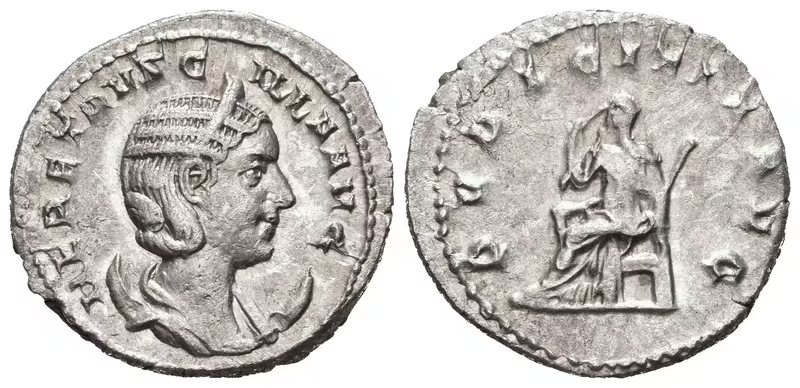
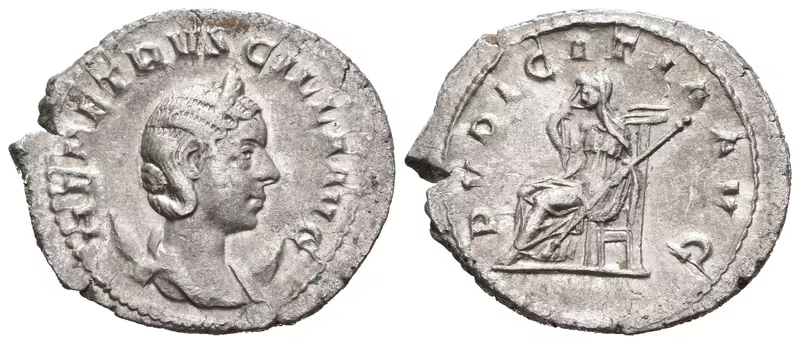
Although we know little of the life of Herennia Etruscilla, her coins are relatively common and accessible in price even to beginning collectors. Issues bearing her portrait arose in the Roman mint and in provincial mints, especially in Alexandria. The most common type is the silver antoniniani with the portrait of the empress on the obverse, where she is depicted with a diadem and bust on a crescent—the typical sign of the antoniniani.
On the reverse of most of her coins appears the goddess Pudicitia (the personification of modesty and decency), shown as a veiled woman, seated or standing, lifting the veil from her face with her right hand and holding a sceptre in her left. The inscription PVDICITIA AVG emphasised the traditional virtues which were expected of an empress. Other reverse motifs include the goddess Juno with peacock, Uberitas (abundance), Concordia (concord) and Victoria.
Numismatic significance
The legend on the coins from Rome gives only the abbreviated name HER ETRVSCILLA AVG, but the Alexandrian billon tetradrachms provide valuable epigraphic evidence of her full name. The Greek inscription ΕΡ ΚΟΥΠ ΑΙΤΡΟΥCΚΙΛΑ contains the abbreviation ΚΟΥΠ referring to the cognomen Cupressenia, derived from the Latin cupresseus ("of cypress"). The cypress was the symbol of the goddess Juno, patroness of marriage.
In our auction and shop
- Code: BE080-0059B.1
Herennia Etruscilla, antoninian, RIC 59b
Herennia Etruscilla (249 - 251) mincovna Řím, raženo 250 n. l., Rev. sedící Pudicitia stahující závoj z obličeje a držící žezlo, RIC 59b
Skladem 1 ks - Code: BE080-0059BRecommended
Herennia Etruscilla, antoninian, RIC 59b
Herennia Etruscilla (249 - 251) mincovna Řím, raženo 250 n. l., Rev. sedící Pudicitia stahující závoj z obličeje a držící žezlo, RIC 59b
Skladem 1 ks - Code: BE080-0055
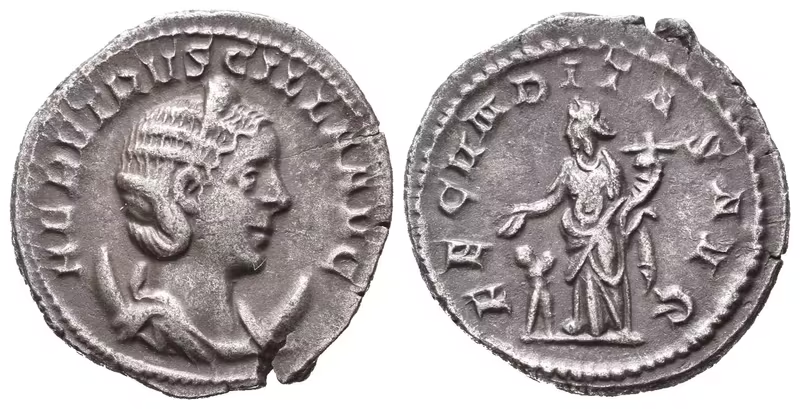
Herennia Etruscilla, Antoninian, RIC 55
Herennia Etruscilla (249 - 251) mincovna Řím, raženo 249-251 n. l., Rev. FECVNDITAS AVG, stojící Fecunditas s rohem hojnosti, držící ruku nad dítětem, RIC 55
Skladem 1 ks