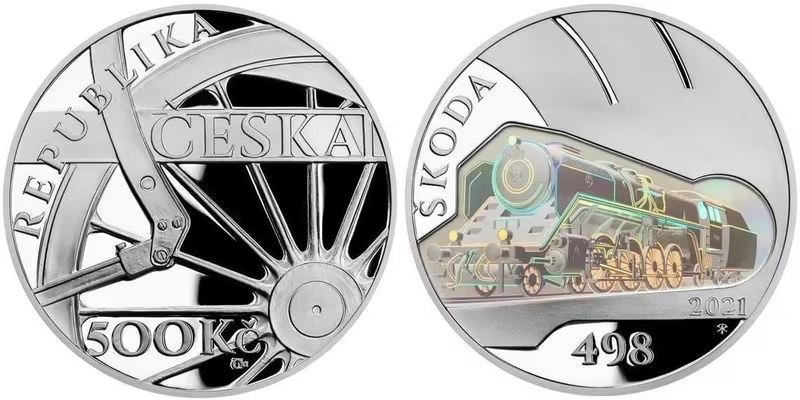
Holographic strike
Holographic strike is a modern technology for finishing the surface of coins and medals, in which fine microstructures (most often by laser) are created in the metal which on the incidence of light create a three-dimensional or "moving" optical effect. It is used mainly as an attractive design element and at the same time as a security protection against…
The holographic strike follows on from the long tradition of coinage innovations, the aim of which was to improve appearance and at the same time make imitation more difficult. Already in the Middle Ages a coin had security elements indirectly - for example, prominent heraldry, a specific style and controlled parameters of weight and fineness. With the development of modern machine mints in the 19th century the precision of striking increased significantly and techniques for working with the surface (fine polishing, matting, various background textures) were gradually added. In the 20th century, the need to protect circulating currency and collectors' issues against ever more sophisticated forgeries was added, which opened the way to technological security elements known from banknotes and documents.
It was in this context that optically variable elements began to assert themselves in numismatics - those that cannot be faithfully imitated by ordinary engraving or casting and which are easily verifiable by the naked eye. Holographic effects work with the fact that light is reflected from extremely fine structures in various directions, and the human eye then perceives a change of motif when the coin is tilted. At first these were rather experiments and occasional issues, but holographic motifs gradually became a prominent element of modern commemorative coins and medals, especially of series that are meant to attract attention by their design and at the same time offer a higher degree of protection.
In specialist language a distinction is sometimes made between "holography" in the strict physical sense and the broader designation for optically variable microstructures. In numismatic practice the term holographic strike usually means precisely the application of micro-engraved structures into the metal (or into an inserted element) which create a three-dimensional impression, colour transitions or apparent motion of the motif. Important is the result: the effect is striking, repeatable and at the same time technologically demanding to forge.
History
The basis of a holographic strike is the creation of a very fine microstructure on the surface. In practice laser engraving is often used, which is able to produce microscopic "grooves" and surfaces in precise directions in metal (or in the die or insert). These structures then function similarly to a diffraction grating: they disperse light and create effects that change according to the angle of incidence and observation. That is why the motif "flows" when tilted, changes brightness, colour or apparently transitions between two images.
The holographic element can be designed directly in the relief, as a flat textured part of the field, or as a separate insert combined with the strike. With collectors' issues it is often used to highlight a particular detail (for example, a star, an emblem, a portrait element) and at the same time as a security element, since a precise microstructure is hard to imitate. For quick verification of authenticity it is advantageous that the effect is visible without aids: it is enough to tilt the coin towards the light.
From the point of view of numismatic description, holographic strike is listed as a specific technology of execution. It can also affect the handling of the coin: a surface with microstructure is more sensitive to wear and improper cleaning, since damage can disturb the optical effect. Therefore with such strikes emphasis is placed on protective capsules, original packaging and careful handling.
Principle, execution and use
In practice it is important not to confuse a holographic strike directly in the metal of a coin (for example the Czech National Bank's silver 500 Kč 2021 Škoda 498 Albatros) with a holographic security sticker on a paper document: AUREA Numismatika affixes to its certificate of authenticity and expert opinion a numbered holographic seal that is irreversibly destroyed upon any attempt at removal, complementing the embossed Czech lion seal, a photograph of the individual specimen and the document's serial number. For further details see the article The AUREA Holographic Seal: What It Does and How to Recognise a Genuine Certificate (/serie/ochrana-pravosti/holograficka-plomba-aurea).
Related artefacts currently at auction
- Code: MCZ131-PROOF
500 Kč 2021 - Parní lokomotiva Škoda 498 Albatros, PROOF
Česká republika (1993 - ) Slavné dopravní prostředky 500 Koruna 2021 - Parní lokomotiva Škoda 498 Albatros, autor Asamat Baltaev, Aurea C231, etue, certifikát, PROOF Ag 0,925 s hologramem, 40 mm (25 g), raženo 5 700 ks (běžná kvalita), 12 000 ks (proof)
Skladem 1 ks