Innsbruck
Innsbruck is the capital of Tyrol in western Austria, lying in the valley of the river Inn between Alpine massifs. It became renowned as a former Habsburg residence, a gateway to the Alpine passes and a centre of trade and tourism; in the region it is also linked to silver mining and coinage.
Innsbruck arose at a strategic spot where it was possible to cross the river Inn and at the same time to control important Alpine communications. From here its name is also explained as "bridge across the Inn" (Inn + Brücke). In the Middle Ages the original settlement at the crossing gradually developed into a town that profited from trade and tolls on routes leading via the Brenner Pass to Italy. In the 13th-14th centuries Innsbruck established itself as an important administrative centre of Tyrol, and its standing was strengthened by its position at the crossroads of routes between the German and Italian areas.
A fundamental flourishing came with the Habsburg era. The town became one of the key points of dynastic policy and in the late Middle Ages and early modern period the court often resided here. Innsbruck is strongly associated with Maximilian I, who made the town into an important residential and representational scene. Among its icons is, for example, the "Goldenes Dachl" (Golden Roof) in the historic core, which recalls the court culture and the ambition to present power in urban space. Alongside representation, this also concerned practical administration of the country: Innsbruck was the place from which the affairs of Tyrol were managed, levies were collected and defence was coordinated in the Alpine environment.
In the 16th century Tyrol relied on the extraordinarily profitable silver mining in the area around Schwaz. This "silver boom" had wider European consequences: it increased the flow of metal to mints, strengthened the financial possibilities of the Habsburgs and supported the development of regional centres. Innsbruck profited from this as an administrative and commercial hub, even though the actual striking of important silver denominations often took place in nearby mint workshops of Tyrol. In this period the cultural backdrop of the town was also strengthened, and buildings arose that today complete its historical face, including links to Ambras Castle associated with collecting and representation.
History
The modern era brought alternations of prosperity and shocks. Although the town's commercial role remained important, European wars and changes of transport routes left their mark on safety and economy. A symbolic chapter is the year 1809, when Tyrol became the scene of resistance against Napoleonic domination and Andreas Hofer entered history. Innsbruck was in these events the natural political and logistical centre, in which both local identity and the pressure of great-power interests were reflected.
In the 19th century the town modernised, transport and later tourism developed, which gradually made Innsbruck into an "Alpine metropolis". In the 20th century its international image was significantly strengthened thanks to winter sports: Innsbruck hosted the Winter Olympic Games (1964 and 1976) and became one of the symbols of Alpine sports infrastructure. Today Innsbruck is at the same time a university town, the administrative centre of Tyrol and an important gateway to the Alps, where historical layers are linked with modern life.
Innsbruck is known for its compact historical core with Gothic and Baroque buildings, imperial traces and the distinctive backdrop of the Alps. Alongside the Golden Roof, the most important sites include the Court Church with the monument to Maximilian's era and Ambras Castle, which recalls the Renaissance culture of collecting. Its location also plays an important role: Innsbruck remains a transport hub where travel, trade and tourism naturally meet.
Significance of the town, monuments and numismatic connections
From the numismatic point of view Innsbruck is interesting especially as the "administrative backdrop" of an area that had an extraordinary significance for the silver economy of central Europe. Tyrolean silver from around Schwaz contributed to the striking of large silver coins in the thaler circle and shared in the fact that the Habsburg lands could in the early modern period keep pace with the rising demands of trade and state finances. For collectors this means that when studying Habsburg and Tyrolean strikes it pays to perceive Innsbruck as a centre of decision-making from where extraction, metal procurement and the regional economy were supervised. In practice the "Innsbruck" context then often stands behind coins that today we value for their silver content, the quality of their strike and their historical story of the Alpine country.
When Innsbruck appears in descriptions of collections and auctions, this is also thanks to local museums and collecting traditions that preserve the records of Tyrolean economy and Habsburg representation. The town thus represents a good starting point for understanding the link between mining, state administration and coins: without silver and without the organisation of its flow, neither stable currency nor the strikes that today belong among sought-after numismatic items would have come into being.
In our auction and shop
- Code: SRAK2-D1970A
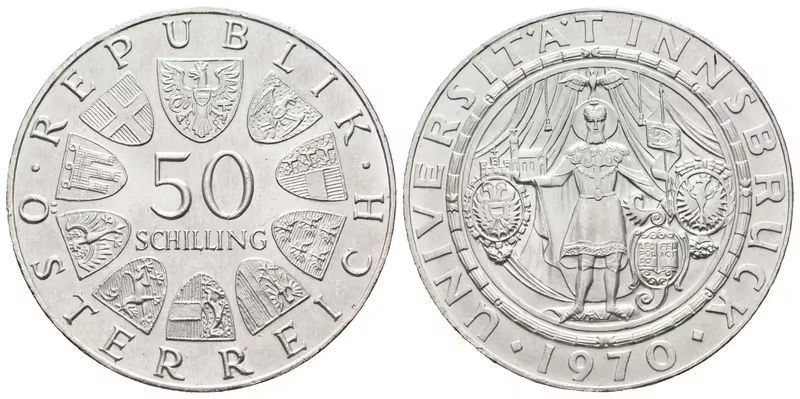
Rakousko, 50 Schilling 1970 - Univerzita Innsbruck
II. republika (1945 - ) 50 Schilling 1970 - K 300. výročí univerzity v Innsbrucku, KM.2908, ražební lesk Ag 0,900, 33,5 mm (20 g)
- Code: Q98-1884N2
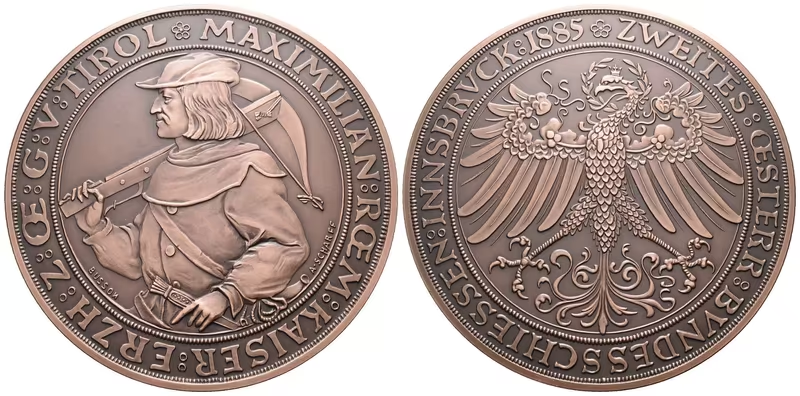
AE medaile 1885/2024 - II. rakouské spolkové střelby v Innsbrucku
František Josef I. (1848 - 1916) AE Medaile 1885/2024 (A. Busson, Anton Scharff) - II. rakouské spolkové střelby v Innsbrucku. Císař Maximilian I. v loveckém oděvu s kuší, opis / Tyrolská orlice, opis Patinované Cu 100 mm (872 g), náklad pouze 100 ks,…
- Code: Q98-1884N4
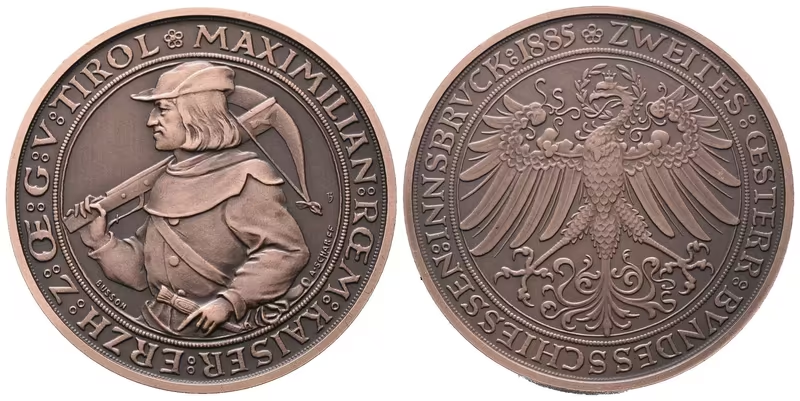
AE medaile 1885/2024 - II. rakouské spolkové střelby v Innsbrucku
František Josef I. (1848 - 1916) AE Medaile 1885/2024 (A. Busson, Anton Scharff) - II. rakouské spolkové střelby v Innsbrucku. Císař Maximilian I. v loveckém oděvu s kuší, opis / Tyrolská orlice, opis Patinované Cu 37 mm (23,6 g), náklad 500 ks, hrana…
- Code: Q98-1884N1
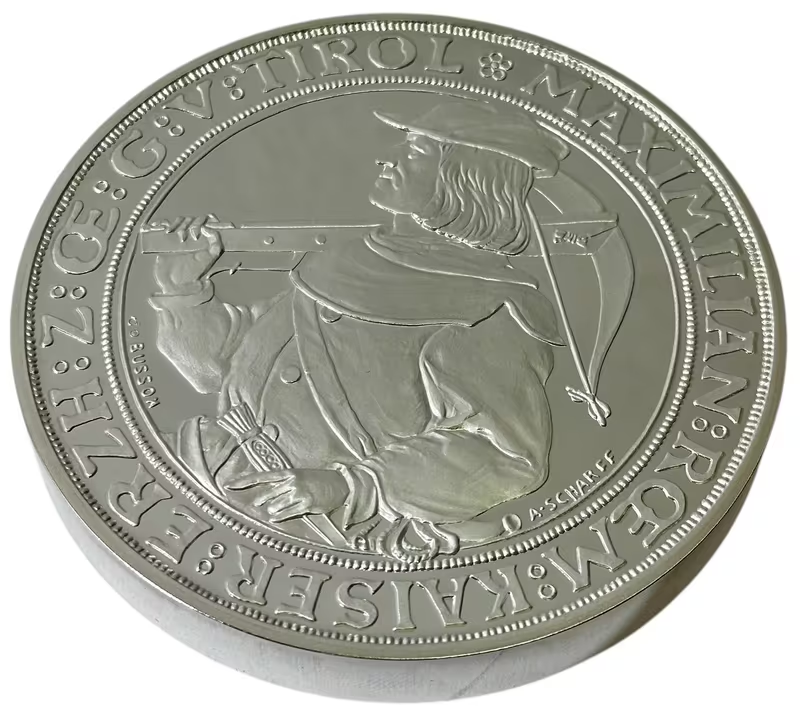
AR medaile 1885/2024 - II. rakouské spolkové střelby v Innsbrucku
František Josef I. (1848 - 1916) AR Medaile 1885/2024 (A. Busson, Anton Scharff) - II. rakouské spolkové střelby v Innsbrucku. Císař Maximilian I. v loveckém oděvu s kuší, opis / Tyrolská orlice, opis Ag 0,999, 100 mm (1000 g), náklad pouze 150 ks, hrana…