Isabella II of Spain
Isabella II (Spanish Isabel II, in full María Isabel Luisa de Borbón y Borbón-Dos Sicilias) was born on 10 October 1830 in the Royal Palace in Madrid as the eldest daughter of King Ferdinand VII and his fourth wife Maria Christina of the Two Sicilies. Her birth provoked a constitutional crisis, since she was the first female successor to the Spanish thron…
In order to secure his daughter's succession, Ferdinand VII issued shortly before her birth the Pragmatic Sanction, which abolished the Salic law introduced by the Bourbons at the beginning of the 18th century. This law excluded women from succession. The king's brother, the infante Carlos (Don Carlos), refused to recognise the new regulation and declared himself the rightful heir to the throne.
After the death of Ferdinand VII on 29 September 1833 the three-year-old Isabella was proclaimed queen. Her mother Maria Christina took on the regency, while Don Carlos unleashed the first of the so-called Carlist Wars (1833-1840), which were to determine the future of the Spanish monarchy. The Carlists, supported by conservative and clerical circles especially in the Basque Country and Catalonia, fought for a traditional absolutist monarchy. The Liberals standing behind Isabella championed a constitutional system.
After the defeat of the Carlists in 1839 General Baldomero Espartero, the most successful commander of the Isabelline forces, was appointed regent in place of Maria Christina, who had to go into exile. Espartero's rule, however, lasted only until 1843, when he was overthrown by a military coup led by Generals Leopoldo O'Donnell and Ramón María Narváez. The new government had the thirteen-year-old Isabella declared of age, and on 10 November 1843 she took over the rule.
The education of the young queen was considerably neglected - she allegedly could hardly read. She was, however, considered charming and graceful. On 10 October 1846 she married her cousin Francisco de Asís de Borbón, a shy and effeminate man who disappointed her. The day after the wedding he moved out of the queen's chambers and his place was taken by the first of a series of lovers, General Francisco Serrano.
Isabella II's personal rule (1843-1868) was marked by constant political instability, alternation of Moderate and Progressive governments and military coups (pronunciamientos). The queen relied above all on the conservative Generals Narváez and O'Donnell. The relatively stable period of the so-called Década Moderada (1844-1854) brought a certain economic development - construction of railways, expansion of industry and modernisation of infrastructure. In 1850 the Royal Theatre in Madrid was solemnly opened, and in 1866 the queen laid the foundation stone of the National Library.
The last ten years of Isabella's reign were marked by economic crisis, growing social discontent and opposition from Liberals, Republicans and Democrats. The scandalous reputation of the queen's private life undermined the prestige of the monarchy. In September 1868 the Glorious Revolution (La Gloriosa) broke out, led by Generals Prim, Serrano and Admiral Topete. Isabella fled to France and on 25 June 1870 abdicated in favour of her son Alfonso XII, who came to the throne in 1875 after the fall of the First Spanish Republic.
Isabella II spent the rest of her life in Parisian exile. Spain's defeat in the war with the USA in 1898 affected her deeply. She died on 9 April 1904 in Paris at the age of 73. She remains the only reigning queen (reina reinante) of a united Spain.
Coinage during the reign of Isabella II
The period of Isabella II's reign was from the numismatic point of view extraordinarily dynamic. Spain passed through three monetary systems during 35 years, which was reflected in a rich range of coins of various denominations, types and mints.
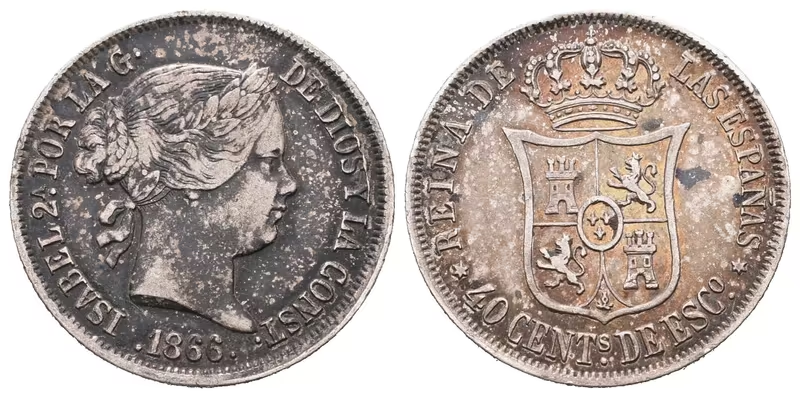
The Kingdom period (1833-1848) continued the coinage system inherited from Ferdinand VII. The basic unit remained the real de vellón, with 1 real being divided into 34 maravedís. Copper coins were struck in denominations of 1, 2, 4 and 8 maravedís, silver coins in denominations of 1, 2, 4, 10 and 20 reales, gold as 80 reales. The first coins with the portrait of the young queen bore on the obverse the inscription "ISABEL II POR LA GRACIA DE DIOS Y LA CONST." (Isabella II by the grace of God and the constitution) and on the reverse "REINA DE LAS ESPAÑAS" (Queen of the Spains). The portrait was created by the court engraver Mariano González Sepúlveda.
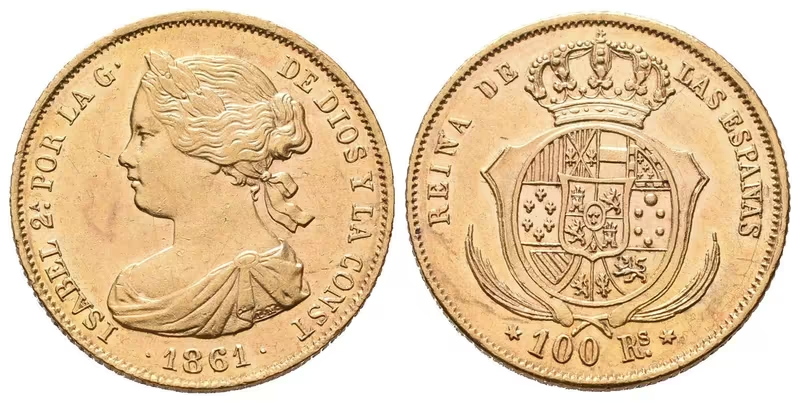
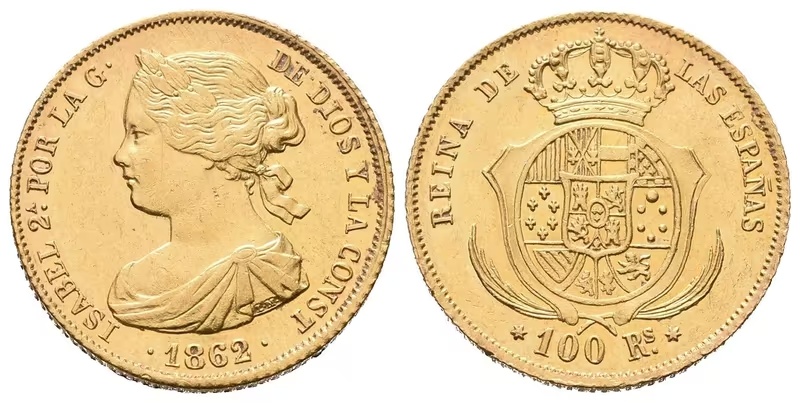
The first decimal period (1848-1864) brought the transition to a decimal system following the French model. The real remained the basic unit, but was newly divided into 100 céntimos. In 1850 a gold coin of 100 reales was introduced, known as the "doblón de 100 reales" - this was the first and only Spanish coin to bear in its legend the popular designation "doblón". These coins of weight 8.5 grams of gold of fineness 900/1000 were struck at the mints of Madrid, Seville and Barcelona. They are distinguished by the number of points of the stars on the reverse: six-pointed stars indicate Madrid, seven-pointed Seville and eight-pointed Barcelona.
The second decimal period (1864-1868) introduced a new basic unit - the escudo, which equalled 10 reales and was divided into 100 céntimos de escudo. The silver escudo replaced 10 reales, 2 escudos replaced 20 reales. Gold coins were struck as 2, 4 and 10 escudos. The ten-escudo gold coin corresponded to the value of the earlier 100 reales. Copper coins were struck by the French firm Oeschger, Mesdach & Cía. of Strasbourg, whose initials OM appear on the reverse.
During Isabella II's reign several mints operated: Madrid (the main mint, marked with a six-pointed star), Seville (seven-pointed star), Barcelona (eight-pointed star), Segovia (three-pointed star, especially copper coins) and Jubia in Galicia (four-pointed star). After the revolution of 1868 a new monetary system based on the peseta, which replaced the escudo in the ratio 1 escudo = 2.5 pesetas, was introduced by decree of 19 October.
Among the most collectible coins of Isabella II are the gold doblones de 100 reales of 1850-1851 with the inscription "DOBLON", the gold 10 escudos of 1868 with the date in the stars and the silver 20 reales, which due to their high silver content were massively exported abroad for melting.
In our auction and shop
- Code: SSPAN93-C1866
Španělsko, 40 Centimo 1866
Španělsko, Isabella II., 1833 - 1868 40 Centimos de Escudo 1866, KM.628, krásná zachovalost, patina, zbytky lesku, drobné rysky
Skladem 1 ks - Code: ZSSZPA-78G1861
Španělsko, 100 Real 1861
Španělsko, Isabela II. (1833 - 1868) 100 Real 1861 Au 0,900, 22 mm (8,34 g), KM. 605.3
- Code: ZSSZPA-78G1862
Španělsko, 100 Real 1862
Španělsko, Isabela II. (1833 - 1868) 100 Real 1862 Au 0,900, 22 mm (8,34 g), KM. 605.3