Henry IV of France
Henry IV of Navarre (1553–1610), the first French king of the Bourbon dynasty, ruled France from 1589. As "Good King Henry" he ended the religious wars with the Edict of Nantes, restored prosperity and laid the foundations of French absolute monarchy.
Henry was born in Pau as the son of Antoine de Bourbon and Jeanne d'Albret, Queen of Navarre. He was raised as a Calvinist in Béarn, far from the Parisian court. His mother, a convinced Huguenot, was preparing him as the leader of the Protestants. In 1572 he married Margaret of Valois, sister of King Charles IX — the marriage was to reconcile Catholics and Huguenots. The wedding ended in a massacre — the Massacre of Saint Bartholomew on 24 August 1572 deprived the Protestants of their leaders. Henry survived only by converting to Catholicism, and for three years was a prisoner of the court.
In 1576 he escaped, returned to Protestantism and became leader of the Huguenots. After the death of Francis of Anjou in 1584 he became heir to the throne, but the Catholic League refused to recognise him. When Henry III was assassinated in 1589, Henry of Navarre became king, but had to conquer his own kingdom. The battles of Arques and Ivry demonstrated his military genius, but Paris held out. "Paris is worth a Mass" — in 1593 he converted to Catholicism (for the fourth time!), in 1594 he entered Paris. The Edict of Nantes in 1598 granted the Huguenots religious freedom and ended 40 years of wars.
History
With his minister Sully, Henry restored a devastated France. "A chicken in every pot on Sunday" symbolised prosperity. He drained marshes, built roads, bridges and canals. The Pont Neuf and the Place Royale (des Vosges) beautified Paris. He supported the colonisation of Canada (Quebec 1608). He planned a European union against the Habsburgs. On 14 May 1610 he was stabbed by Ravaillac, a Catholic fanatic. The whole of France mourned his death. "Good King Henry" remained the most popular French monarch — a pragmatist who placed the welfare of the country above dogma.
Henry IV reformed French coinage after the chaos of the religious wars. He restored the quality of the coins debased during the conflicts. His écu d'argent (silver shield) with the fleur-de-lis cross became the standard commercial coin. The henri d'or (gold Henry) competed with the Spanish doubloons. The design combined French fleurs-de-lis with Navarrese chains — a symbol of unification. The portrait with the laurel wreath recalled the Roman emperors.
Henry IV and French coinage
Interesting are the regional variants — coins for Béarn, Navarre, and the newly annexed provinces. Each mint had its mark — Paris A, Lyon D, Bayonne L. Henry struck the first French coins for the colonies — for New France. His douzain (12 deniers) with the monogram H was the most widespread small coin. The quality of striking reflected the economic restoration — from rough wartime issues to artistic works. Henry also struck propagandist medals — Hercules slaying the hydra (the League), the Gallic rooster defeating the Spanish lion. After his death commemorative coins were struck with the inscription "Father of the Fatherland". His coinage reforms laid the foundation of the system that lasted until the Revolution. The henri d'or remained a favourite commercial coin throughout the 17th century.
In our auction and shop
- Code: RX-FRAN022
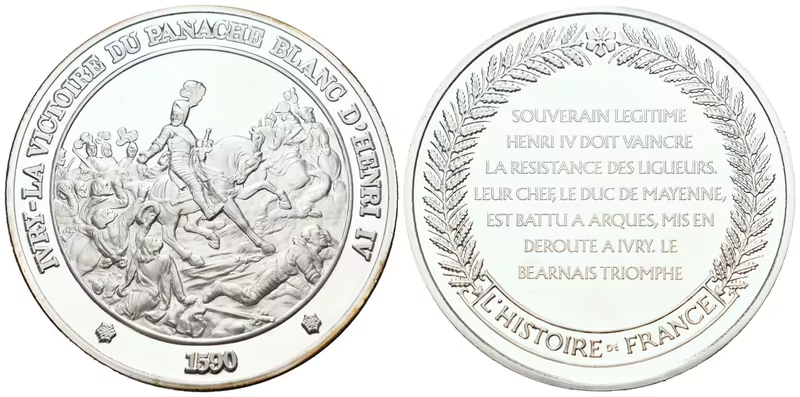
Francie - AR Medaile b.l. - Ivry
Ivry - 1590 Ag 0,800, 44 mm (cca. 37 g) Na minci se nachází Francouzský punc ryzosti. V originální kapsli. Medaile je ze série 'Historie Francie v medailích' - Na některých mincích jsou viditelné stopy patiny aj. - Viz. obrázek. L'Histoire de France,…
- Code: RX-FRAN027
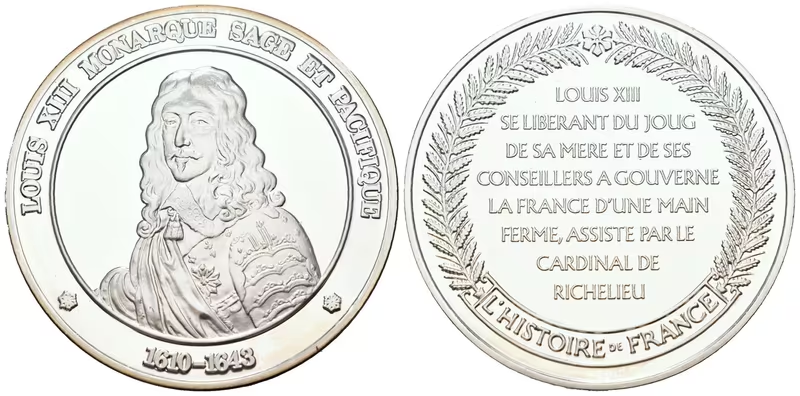
Francie - AR Medaile b.l. - Louis XIII
Louis XIII - 1610-1643 Ag 0,800, 44 mm (cca. 37 g) Na minci se nachází Francouzský punc ryzosti. V originální kapsli. Medaile je ze série 'Historie Francie v medailích' - Na některých mincích jsou viditelné stopy patiny aj. - Viz. obrázek. L'Histoire de…
- Code: RX-FRAN023
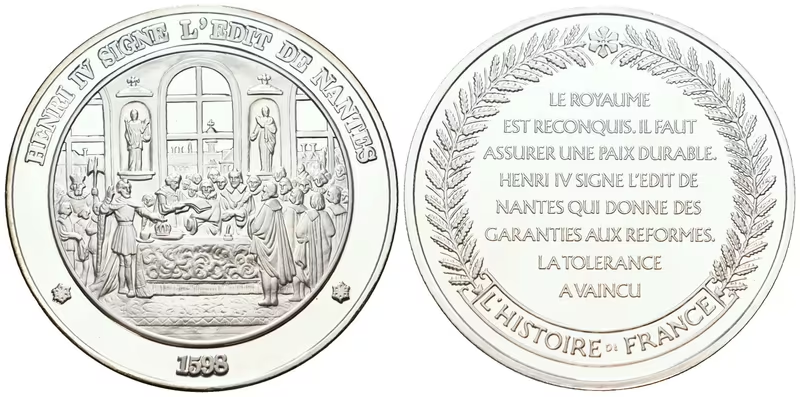
Francie - AR Medaile b.l. - Signature de l'Edit de Nantes
Signature de l'Edit de Nantes - 1598 Ag 0,800, 44 mm (cca. 37 g) Na minci se nachází Francouzský punc ryzosti. V originální kapsli. Medaile je ze série 'Historie Francie v medailích' - Na některých mincích jsou viditelné stopy patiny aj. - Viz. obrázek.…
- Code: RX-FRAN025
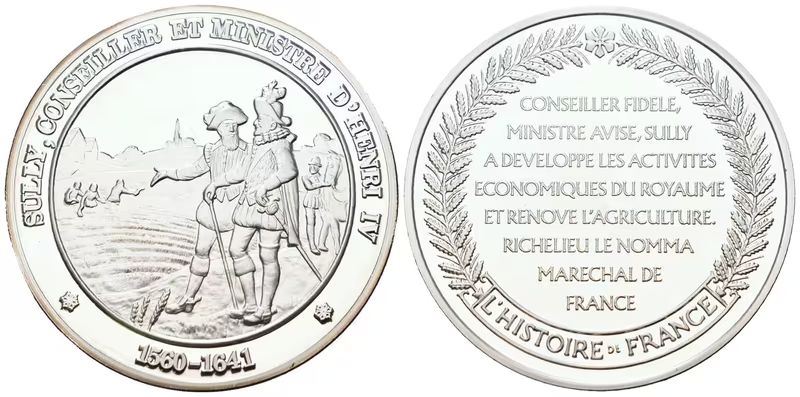
Francie - AR Medaile b.l. - Sully
Sully - 1560-1641 Ag 0,800, 44 mm (cca. 37 g) Na minci se nachází Francouzský punc ryzosti. V originální kapsli. Medaile je ze série 'Historie Francie v medailích' - Na některých mincích jsou viditelné stopy patiny aj. - Viz. obrázek. L'Histoire de…