John Frederick of Brunswick-Lüneburg
John Frederick of Brunswick-Lüneburg (1625–1679) was Duke of Brunswick-Lüneburg of the Hanoverian line, who ruled in Calenberg and laid the foundations of the later Hanoverian power. His high-quality thalers struck in Clausthal from Harz silver are among the most beautiful German Baroque coins of the seventeenth century.
John Frederick was born in Herzberg as the third son of Duke George of Brunswick-Lüneburg. He received a thorough Protestant education at the University of Helmstedt, where he studied theology, law and mathematics. As a younger son he was not originally destined to rule, so he entered military service and fought in the last years of the Thirty Years' War. After the Peace of Westphalia in 1648 he travelled through Europe, visiting France, Italy and the Netherlands, where he studied modern methods of administration and warfare. In Venice he met important scholars and artists, which influenced his later patronage.
In 1665 he unexpectedly inherited the Duchy of Calenberg after the death of his brother George William. John Frederick inherited a country devastated by the Thirty Years' War and burdened with debt. He immediately launched extensive reforms — he reorganised the administration on the French model, supported the resettlement of devastated areas and founded manufactories. He paid particular attention to the development of mining in the Harz, where he modernised the mines and smelting works. He introduced a mercantilist economic policy, supported domestic production and restricted imports. His reform of the judiciary and the establishment of an appellate court at Celle modernised the legal system.
History
John Frederick was also an important builder and patron. He had the palace at Hanover rebuilt in the Baroque style and founded a court orchestra and theatre. He supported scholars including Gottfried Wilhelm Leibniz, who later served his son. In 1676 he converted to Catholicism, which provoked a scandal in Protestant Brunswick but secured him the support of the emperor. His conversion also made it easier for his youngest son Ernest Augustus to obtain the rank of elector. John Frederick died in 1679 at Augsburg on a journey to Italy. His reforms laid the foundations of the later Hanoverian power.
John Frederick devoted great attention to coinage as a source of revenue and a means of representation. He controlled the rich silver mines of the Harz, particularly at Clausthal and Andreasberg, which supplied high-quality silver for minting. His main mint at Clausthal used the most modern technologies, including water-powered striking machines. He struck a wide range of denominations from small groschen to representative multiple thalers.
Coinage of John Frederick
His thalers are among the artistic high points of Baroque coinage. The obverse shows the duke's portrait in a wig and armour, the reverse a complex coat of arms with a wild man as shield-bearer — the symbol of the Harz. Some thalers bear allegorical scenes celebrating mining — the goddess Abundantia with a horn of plenty or a view of the mine workings. John Frederick also struck rare gold ducats and multiple ducats as diplomatic gifts. The quality of his coins was so high that they were accepted throughout Germany. After his conversion, some coins bore Catholic symbols, which is unique among Brunswick strikes. His coinage reform standardised the weight and fineness, which facilitated trade. During his reign the Clausthal mint struck coins to a value of over a million thalers.
In our auction and shop
- Code: RX-Z-027
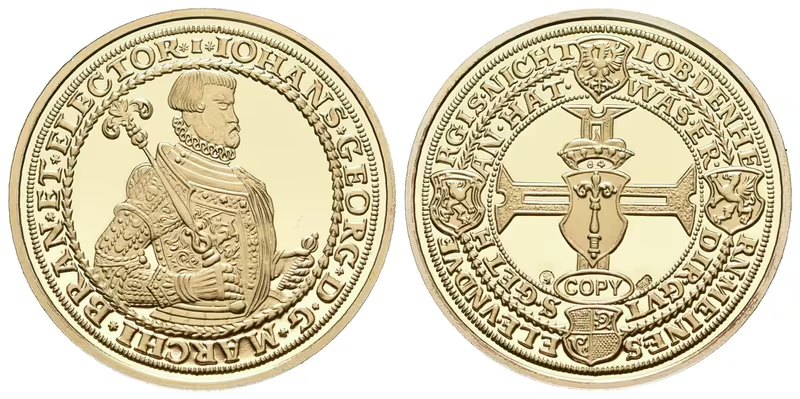
Německo (Braniborsko), 10 Dukátů (Portugaleser) 1584 - Kurfiřt Johann Georg I., pozlacená stříbrná replika
Braniborské kurfiřtství - Johann Georg I. (1571-1598) 10 Dukátů (Portugaleser) 1584 - Portrét kurfiřta Johanna Georga I. / ornamentální kříž s braniborskými erby, replika Ag (.925), pozlaceno, 25 mm (10 g), v kapsli. Stav mince odpovídá fotografii. Jedná…
Skladem 1 ks - Code: MCZ137
200 Kč 2022 - Gregor Johann Mendel
Česká republika (1993 - ) 200 Koruna 2022 - 200. výročí narození Gregora Johanna Mendela, autor Zbyněk Fojtů, Aurea C237, kapsle, bez certifikátu, běžná kvalita Ag 0,925, 31 mm (13 g), raženo 6 700 ks (běžná kvalita), 12 800 ks (proof)
Skladem (>5 ks) - Code: MCZ137-PROOF
200 Kč 2022 - Gregor Johann Mendel, PROOF
Česká republika (1993 - ) 200 Koruna 2022 - 200. výročí narození Gregora Johanna Mendela, autor Zbyněk Fojtů, Aurea C237, etue, certifikát, PROOF Ag 0,925, 31 mm (13 g), raženo 6 700 ks (běžná kvalita), 12 800 ks (proof)
Skladem (>5 ks) - Code: MCSS-1429
Salzburg, Fenik se čtyřrázem
Salzburg - biskupství, Johann II. von Reisberg (1429 - 1444) Pfennig se čtyřrázem, CNA A 55, pěkná zachovalost a patina
Skladem 1 ks