Klippe
A klippe is a coin struck on a square or polygonal flan instead of the usual circle. Most often these were donative or emergency pieces produced in limited mintage, and today they are prized for their unusual shape.
The name klippe (Czech klipa) comes from the German term Klippe, which became established in numismatics for coins struck on angular or polygonal flans. In practice this was a deviation from the “norm”, since most circulating coins had a circular shape: they were easier to strike, easier to measure, and behaved predictably in circulation. The klippe, on the contrary, looked striking at first glance, and precisely for this reason was suited to cases where it was necessary to distinguish quickly an extraordinary issue or to emphasise the ceremonial character of a strike.
The oldest klippes in the European context are associated with the north, especially Scandinavia at the end of the 10th century, where early angular strikes appear. In later centuries klippes are also attested in other lands, but for a long time they remained isolated cases rather than a common minting standard. This type became more clearly established only in the early modern period, when large silver denominations spread across central Europe and at the same time there was a strong demand for representative strikes for gifts, rewards and ceremonial occasions.
A distinctive chapter is formed by klippes in the Alpine and southern German area. In some ecclesiastical and secular centres they were struck with enthusiasm, because they combined an effective appearance with the relatively simple preparation of flans. A square or polygonal shape could be cut from a metal strip or sheet, and it was not necessary to achieve such a precise circular edge as with circulating coins. For the issuer this was a practical advantage; for the recipient, on the contrary, it was a clear message: he had not received an “ordinary” coin but something exceptional.
History
In the Czech lands klippes are most often associated with the thaler family and with the period when large silver coins became the basic instrument of larger payments and of representation. Angular thalers and their fractions appear especially in the 16th and 17th centuries and are perceived as pieces intended rather for gift-giving, or for exceptional situations, than for ordinary circulation at the marketplace. In the Habsburg setting, klippes are known from a number of periods, often involving very limited strikes which are therefore rare today.
The production of klippes was not bound to one ruling court or one mint. At various times they appear with large silver denominations and with some smaller values too, though the latter tend to be more readily available than thaler klippes. Angular strikes could also arise during pressures of supply and logistics: when it was necessary to put money quickly into circulation and the mint worked with what it had at its disposal, the atypical shape could be one of the usable solutions. In such cases the klippe has the character of an “emergency coin”, while at other times of a “ceremonial gift”.
With Habsburg strikes klippes are associated especially with thaler multiples and with periods when the coin also fulfilled a representational function. Various sources mention klippes connected with rulers from Ferdinand I to the early 19th century, with later pieces considered exceptionally rare. From the collector’s point of view, it is important that the klippe is not a “separate denomination” but a peculiarity of shape and production: it can exist as a thaler, half-thaler, quarter-thaler or as a multiple, and acquires meaning only in connection with a specific issue, year and mint.
Shape, production and collector identification
A klippe is recognised by its angular or polygonal flan, most often a square, although hexagonal or octagonal shapes can also occur. Regularity is important: with a genuine klippe the shape tends to be intentional and reasonably symmetrical, while randomly deformed or subsequently clipped coins have an “uneven” perimeter that does not correspond to the typical flan cut. With older pieces it is common for the die not to cover the edge perfectly and for part of the legend to be weaker, because a circular die has to “fit” into the angular metal.
In production, klippes were often prepared from a metal strip or sheet, from which angular pieces were cut and then struck. This can leave typical traces on the edges: fine irregularities from cutting, sometimes also a slight bevelling. With large silver denominations the weight and conformity with the given standard are also assessed, because the klippe was not to be “any arbitrary piece of metal” but a coin corresponding to the specific weight and purity of its issue.
For the collector it is key to distinguish a genuine klippe from later modifications. Suspicious is when the image is too “sunk” relative to the edge, when the edge is markedly ground down, or when the shape seems to have been subsequently reduced to remove damage. With more valuable pieces, it pays to monitor also the agreement of style, legend and details with verified examples of the given type. Klippes tend to be sought-after not only for their rarity but also for their aesthetics: a square coin acts like a small “numismatic object” between a coin and a medal, and that is precisely what makes it an attractive part of a collection.
In our auction and shop
- Code: 61269
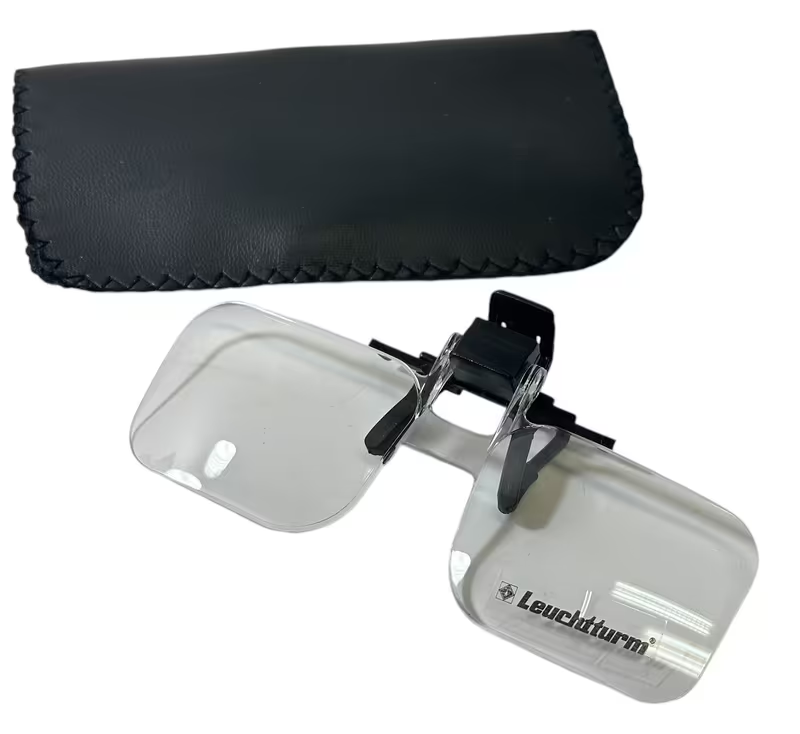
Lupa - klip na brýle, Leuchtturm
Lupa - klip na brýle. Nasazovací klip na brýle, zvětšení 2x. Plastové čočky, ochranný černý obal.