Cologne Mint
The Cologne Mint is the name for the minting operation in Cologne on the Rhine, where from the early Middle Ages coins were struck for the needs of the archbishopric and later of the city itself. Thanks to its position on the Rhine, Cologne long ranked among the most important minting centres of the Rhineland.
The beginnings of Cologne minting are connected with the growing importance of Cologne in the 10th century. The bishops, and later the archbishops, of Cologne received minting privileges from the German-Roman rulers, which in practice meant the right to organise striking and to enjoy revenue from it. The earliest period is associated with Archbishop Bruno I, under whom early medieval silver denarii (pfennigs) were struck at Cologne. These coins often bore Christian symbols (the cross) and inscriptions referring to Cologne as a significant ecclesiastical centre. The mint was at the same time not only a “coin workshop” – it was part of a broader system of power: control over the circulating coinage facilitated the collection of fees, supported markets and reinforced the prestige of the archiepiscopal see.
In the High Middle Ages Cologne became one of the key cities on the Rhine. Across the river flowed goods between the North Sea, the Dutch ports and the interior of the Empire, which increased the need for reliable small change. Cologne strikes therefore spread also beyond the immediate surroundings, and their pictorial and inscriptional ornamentation developed according to the customs of the time. For the 12th–13th centuries, typical are denarii and bracteates with ecclesiastical motifs and signs of power (for example a crosier, cross, stylised architecture), which allow the coin to be quite well attributed to archiepiscopal authority. In the same period the importance of Cologne weights and monetary customs also established itself in the Rhineland – especially the Cologne mark as an important standard for weighing precious metals and for minting practice in a wider area.
History
A special chapter is represented by the dual tradition of coinage in Cologne itself. Alongside the archiepiscopal strikes, civic autonomy was gradually asserting itself. After the consolidation of self-government at the end of the 13th century, the city could strike its own coins, so that in Cologne two minting authorities with differing interests – the ecclesiastical ruler and the city council – could coexist side by side. This could be reflected in the titulature, in the appearance of the coats of arms and in the purposes for which the coins were intended. In the early modern period Cologne coinage then adapted to changes in Imperial standards and to the growing importance of larger silver denominations. Despite changes in monetary systems, Cologne remained, thanks to its position and trading role, a place where high-quality circulation and trust in coins were of exceptional importance.
For the collector the Cologne Mint is interesting both for the breadth of periods and for the types of strikes. In the earliest stages, small silver denarii (pfennigs) and later bracteates predominate; with these it is worth following above all the motif (cross, ecclesiastical insignia, stylised buildings), the form of the lettering and the abbreviations in the legends. With medieval pieces the state of preservation and legibility tend to be essential, since a thin flan and long circulation use often lead to the wearing away of details. With early modern strikes one more often encounters better-legible titulature and a more complex heraldic arrangement, which will indicate whether it is an issue of the archbishopric (Electoral Cologne) or a civic strike.
Strikes, marks and collector orientation
In practice a three-layer collector sorting helps: (1) who issued the coin (archbishopric vs. city), (2) what denomination and monetary area it represents (small silver coins, later higher silver values), and (3) what period and style of striking corresponds to the year or typology. With many Cologne coins, the “language of symbols” applies – ecclesiastical motifs emphasise spiritual authority, while civic coats of arms recall the self-government and economic strength of Cologne. Cologne strikes are therefore valuable not only as a collector’s object but also as a source for the history of trade on the Rhine: the coin here was not merely a means of exchange but also a calling card of who at any given moment held the regalian right and the responsibility for the quality of the circulating coinage.
In our auction and shop
- Code: SCOOK90-X2014
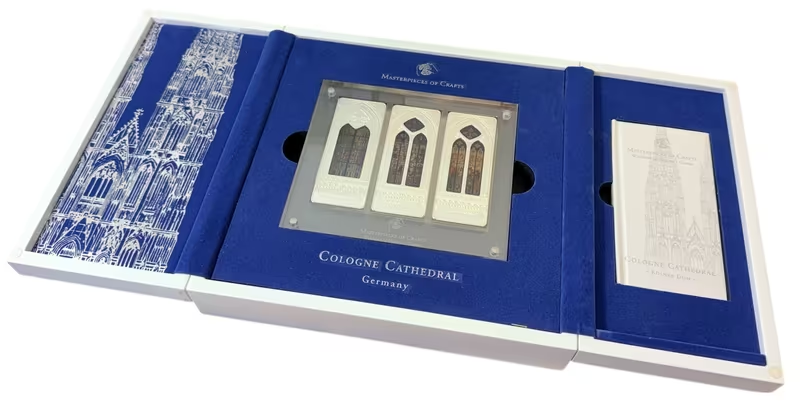
Cookovy ostrovy, 20 Dollars 2014 - Kolínská katedrála
Cookovy ostrovy, Elizabeth II. (1952 - 2022) 20 Dollars 2014 - Vitrážová okna Kolínské katedrály, ze série Masterpieces of Crafts 3x Ag 0,999, 100 x 40 mm (3x 93,3 gramů), 3x 3 Oz, etue, certifikát a letáček, vyraženo 999 ks, reprezentativní podsvícená…