Lisbon
Lisbon is the capital of Portugal, at the mouth of the river Tagus into the Atlantic Ocean, and one of the most important historical ports of Europe. Renowned as a centre of overseas exploration and trade, in numismatics it is important for the long tradition of Portuguese coinage and the role of the state mint.
The location of Lisbon is one of its greatest advantages: the deep estuary of the Tagus provides a natural harbour which makes it possible to control the coastal routes and connections to the interior. The area was already settled in antiquity and long functioned as a trading hub between the Mediterranean and the Atlantic. In different periods, various powers held influence here and the city gradually took on elements of ancient and later mediaeval urban culture. Mediaeval Lisbon was markedly transformed after the Christian conquest in the 12th century, when it became one of the key points of the emerging Portuguese state and an important centre of trade and administration.
Lisbon's true "global" significance, however, was acquired in the 15th and 16th centuries during the Portuguese overseas expansion. From the port, expeditions set sail along Africa, to India and to Brazil, and the city became a centre of trade in spices, gold and other commodities. With wealth, the need for reliable money also grew: the state financed fleets, fortresses and overseas administration, and the port economy required quality circulating coinage both for large payments and for the rapid exchange in markets. Lisbon was then transformed into a metropolis in which the court, bankers, merchants and crafts connected with the sea all met.
History
The modern period also brought dramatic turning points. A fundamental event was the earthquake of 1755, which struck the city severely and led to extensive rebuilding. Lisbon gained new districts and a more modern urban form, which is to this day among the characteristic features of the centre. In the 19th century the city developed as the administrative and industrial centre of the state, while in the 20th century it passed through Portugal's political changes and gradually became a modern European metropolis with a significant cultural and tourist infrastructure.
For centuries Lisbon was the heart of the Portuguese economy, and its role as a port is reflected in the history of money. In the time of the overseas discoveries and colonial trade, a stable currency was crucial for the financing of expeditions, the payment of crews and the purchase of goods in foreign ports. Portuguese coinage therefore worked with striking gold and silver denominations, which were accepted even outside Portugal itself, and the motifs on the coins often emphasised the legitimacy of the sovereign and the country's maritime ambitions.
The port, the currency and numismatic context
For collectors Lisbon is also interesting as a centre of state administration, from which monetary reforms were directed and where representative coinage came into being. In numismatics, with Portuguese coins one follows especially the year, denomination, ruler and the style of state symbols, which change over time. With modern issues, there is added also the euro period, in which Portugal builds on its own tradition of motifs but within the common European currency.
In our auction and shop
- Code: SPORT-O1994B
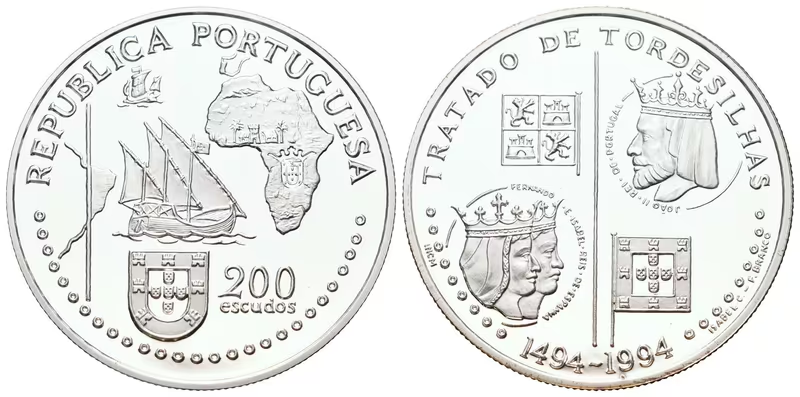
Portugalsko, 200 Escudos 1994 - Tordesillaská smlouva
Portugalská republika (1911-2001) 200 Escudos 1994 - 500. výročí Tordesillaské smlouvy, KM# 671a Ag (.925), 36 mm (26,5 g), proof, v kapsli. Emise: 13 000 ks. Mincovna: Lisabon - Portugalsko. Autor: Isabel C., F. Branco. Série: "Portugalské objevy 5".
- Code: SPORT-O1994C
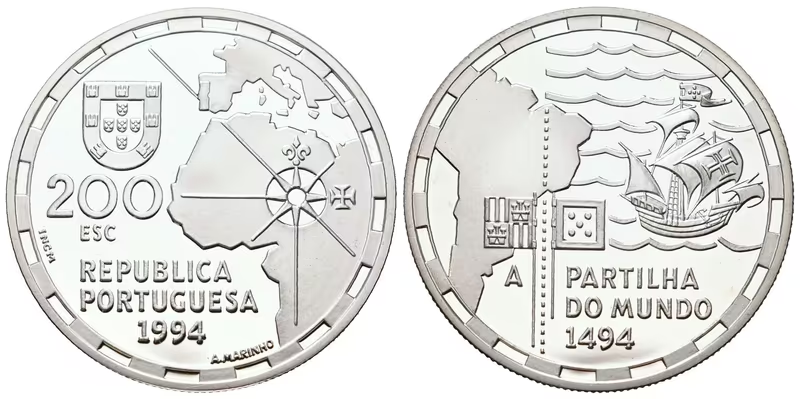
Portugalsko, 200 Escudos 1994 - Rozdělení světa
Portugalská republika (1911-2001) 200 Escudos 1994 - 500. výročí tzv. Rozdělení světa (mezi Španělskem a Portugalskem), KM# 672a Ag (.925), 36 mm (26,5 g), proof, v kapsli. Emise: 4 000 ks. Mincovna: Lisabon - Portugalsko. Autor: António Marinho. Série:…
- Code: SPORT-O1995A
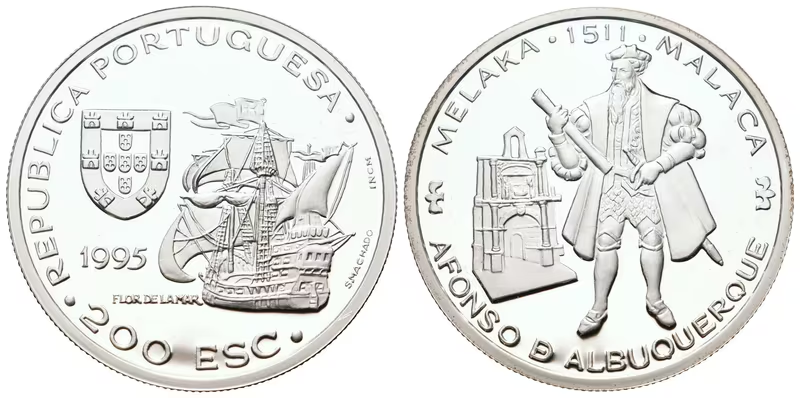
Portugalsko, 200 Escudos 1995 - Afonso de Albuquerque
Portugalská republika (1911-2001) 200 Escudos 1995 - Afonso de Albuquerque, KM# 681a Ag 0,925, 36 mm (26,5 g), proof, v kapsli. Emise: 20 000 ks. Mincovna: Lisabon - Portugalsko. Autor: Raul Machado. Série: "Portugalské objevy 6".
- Code: SPORT-O1995B
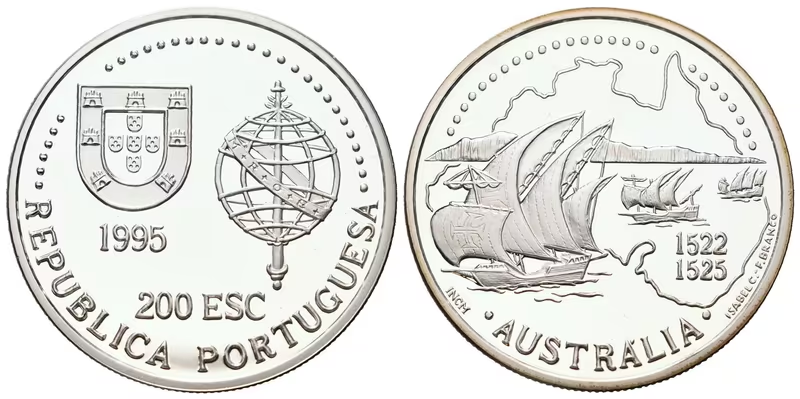
Portugalsko, 200 Escudos 1995 - Austrálie
Portugalská republika (1911-2001) 200 Escudos 1995 - Objevení Austrálie portugalskými mořeplavci, KM# 684a Ag 0,925, 36 mm (26,5 g), proof, v kapsli. Emise: 10 000 ks. Mincovna: Lisabon - Portugalsko. Autor: Isabel Carriço, Fernando Branco. Série:…