Merovingians
The Merovingians were the first major dynasty of Frankish kings, who ruled approximately from the end of the 5th to the middle of the 8th century. They laid the foundations of the early medieval state of the Franks and their era is associated with the spread of Christianity, the emergence of royal administration and with some of the earliest Frankish coins.
The Merovingians (in Latin often Merovingi) are usually derived from a semi-legendary ancestor named Merovech, but the actual historical rise of the dynasty is linked only with the end of the 5th century. Merovingian power was born at the time of the collapse of the West Roman state structure in Gaul, when Germanic elites asserted themselves in its territory and new kingdoms emerged. The Franks at the same time were not a unified "nation", but a federation of groups and retinues that gradually united under a single royal authority. The Merovingian rulers were able to take advantage of a situation in which Roman administration was weakening while Roman institutions, towns and the Church still provided a framework for the functioning of power.
The key figure of the dynasty is considered to be Clovis I (reigned 481/482–511), who united a significant part of the Frankish groups and extended his territory over a large part of Gaul. His conversion to Christianity in its Nicene form was of fundamental importance, as it facilitated his cooperation with the Gallo-Roman elite and the bishops and distinguished his kingdom from some neighbours who adhered to Arianism. The Merovingian monarchy was personal and dynastic: the kingdom was often divided among heirs, which led to repeated periods of partition and reunification. In the sources we therefore encounter the names of partial units, such as Neustria and Austrasia, which in different periods played different roles.
In the 6th and 7th centuries the Merovingian state relied on a network of magnates, royal officials and above all on ecclesiastical institutions. The kings made gifts to monasteries, supported bishoprics and made use of written administration, though to a much narrower extent than late Rome. The court was at the same time a centre of representation: the king presented himself as rex Francorum and his legitimacy rested on family tradition, military success and the ability to maintain the loyalty of the elites. A significant high point of the Merovingian epoch is often cited as the reign of Dagobert I († 639), after which it became ever more apparent that real executive power was shifting to the highest officials of the court.
History
It was at this time that the influence grew of the office known as the mayor of the palace (maior domus), who originally ensured the running of the court but gradually took over also military and political direction. The Merovingian kings of the 8th century are sometimes designated in historiography as "do-nothing kings" — such an assessment is, however, simplistic; rather, it captures the fact that dynastic prestige remained, while decision-making was concentrated among the powerful families of the mayors of the palace. The most important of these was the Carolingian family: Charles Martel and after him his son Pepin III the Short. In 751 the last Merovingian king was deposed and Pepin became king of the Franks, which began the era of the Carolingians. The Merovingians did not vanish from history at once, but their rule as the dynastic framework of the Frankish state ended and the centre of power shifted to a new royal line.
The Merovingian kingdom was not a "state" in the modern sense, but it was able to take up the Roman legacy and reshape it into early medieval conditions. An important role was played by the Church, which provided educated personnel, administrative continuity and a legitimising language. Merovingian culture is associated with the development of monasteries, with Latin literacy and also with a striking artistic style in metalwork (jewellery, brooches, the decoration of arms), in which Roman and "barbarian" motifs intermingle.
From the numismatic point of view the Merovingian period is interesting above all for early Frankish coinage. Gold long predominated in circulation, and typical are the smaller gold coins, especially the tremissis, which continue the late Roman-Byzantine tradition. Merovingian issues often bear the name of the mint and sometimes also the name of the moneyer or the responsible person, which helps to trace regional centres and commercial ties. It is precisely the variety of local issues that shows that the economy was not uniformly "centralised" but functioned through a network of towns and regions, which had their own needs and customs.
State, culture and coinage
In the course of the 7th and 8th centuries monetary conditions gradually changed and, with the rise of the Carolingians, the emphasis on silver issues and more uniform monetary standards asserted itself. Merovingian coins thus stand at the transition between the late antique world of gold circulation and the medieval world in which silver and a differently organised administration assert themselves on a broader scale. For an understanding of the early history of Europe the Merovingians are therefore important not only politically but also as testimony to the transformation of commerce, power and money after the fall of the Western Roman Empire.
In our auction and shop
- Code: RX-FRAN001
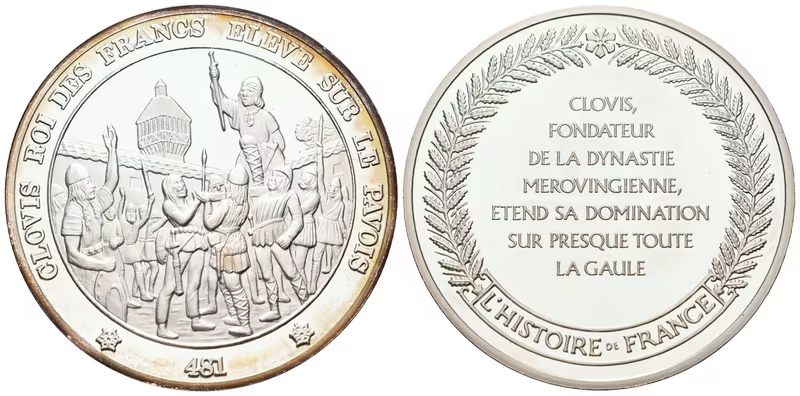
Francie - AR Medaile b.l. - Clovis
AR Medaile b.l. - Clovis (481 - 511) Ag 0,800, 44 mm (cca 37 g), francouzský punc ryzosti, pův. kapsle Medaile je ze série Historie Francie v medailích ( Médaille L'Histoire de France) Chlodvík I. také Hlōdowig, Chlodovech či Clovis byl franský král z…