Thessaloniki Mint
The Thessaloniki Mint (Salonica) was an important minting centre of the Roman and Byzantine empires, known especially for striking bronze coins and, in some periods, also gold issues. Its mint marks (e.g.
The Thessaloniki Mint follows from the exceptional importance of the city of Thessaloniki in late antiquity. Salonica lay on the main transport arteries of the Balkans and was a support of Roman administration in the area of Macedonia. It is for this reason that minting activity developed here already in the period of the Roman Empire, and the city ranked among the key mints of the eastern part of the empire. In the late Roman period, when the coinage system was gradually centralised and a number of mints were closed, Thessaloniki maintained its importance longer than many other cities.
For Byzantine monetary history, Salonica is important also because it belonged to the last active mints before the great reform of Emperor Anastasius I at the end of the 5th century. The reforms at that time transformed especially the bronze coinage (new denominations and a clearer system of marking), and Thessaloniki ranks among those places where the new "Byzantine" monetary world was put into practice in this process. In the following centuries, the empire's mint network expanded and contracted again according to the military situation; Salonica was particularly active in the striking of copper, which was indispensable for ordinary circulation in cities and military centres.
An important chapter is formed by the 6th and the beginning of the 7th century. In this period bronze coins (for example folles and their fractions) were struck at Salonica for the needs of the Balkan provinces, and sometimes also gold, which was key for state finances and the army. As a result of the upheavals of the 7th century - wars, losses of territory and overburdening of the state administration - provincial mints were closed, and the activity of Thessaloniki was interrupted in the early Byzantine period. In numismatics this turning point is manifested not only by a change in the availability of certain types but also by the way the main weight of striking gradually shifted to Constantinople.
History
Several centuries later, Thessaloniki again came to the fore as a provincial minting centre. In the Late Byzantine period the city became the principal provincial mint of the empire, and its issues are commonly encountered especially among copper issues. This "second era" is interesting for collectors and historians, as it shows how the empire sought to supply circulation with coins outside the capital and how regional needs were reflected in the range of denominations. In some periods (and according to who controlled the city), the types and style of striking could also change, but the mint designation remains a key guide for determining origin.
Overall, the Thessaloniki Mint is an example of a long-lasting minting tradition that responded to the political and military situation. When it was necessary to supply the Balkans with small currency, Salonica functioned as a practical striking centre; in times of crisis, on the contrary, its role narrowed or was interrupted. For numismatics it therefore has exceptional value: it links late Roman coinage with the early and late Byzantine system, and allows one to follow the transformations of the state "directly on the coin".
The Thessaloniki Mint is recognised on coins chiefly by marks in the exergue or in the field of the reverse. In the Roman and late Roman period Latin abbreviations were used, where one often encounters forms such as TES and combinations of it with other letters (for example with the designation of the workshop). In the Byzantine period Greek forms of the marks may also appear, reflecting the linguistic change of the administration and minting customs.
Mint marks and identification of issues
Most frequent are bronze denominations intended for circulation (the follis and its fractions), which bear a large value letter or numeral and at the same time, thanks to the mint mark, make it possible to determine precisely where they were struck. For some periods one finds in catalogues that the mint is identified precisely by these marks (e.g. TES, or other variants), because the artistic type itself could have been similar across the empire. For practical identification it is therefore good to follow three things: (1) legibility of the mint mark, (2) style and titulature (for dating), (3) the value designation and denomination, which will indicate whether it was a standard circulating coin or a specific issue.
Thessalonian issues are valued also because they often appear in finds from the Balkans and the Aegean region. In combination with historical events (reforms, the closing and reopening of mints), they thus form comprehensible material for anyone who wants to understand how the Byzantine currency functioned in practice outside Constantinople.
In our auction and shop
- Code: BE145-AT289
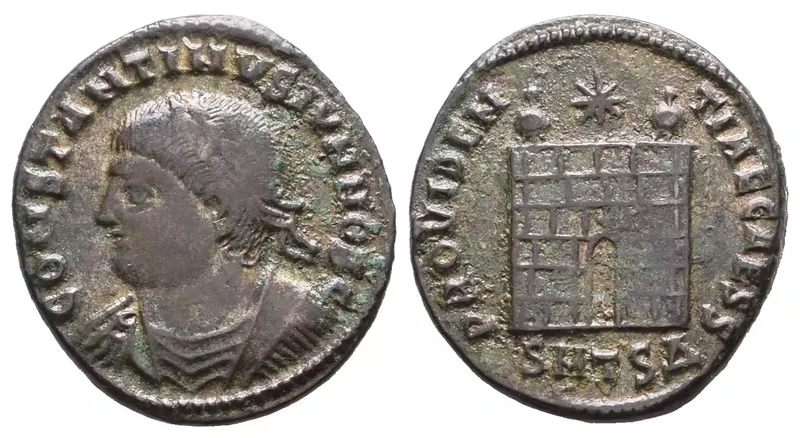
Constantinus II., follis
Constantinus II. (316 - 337), follis - mincovna Tessalonica, brána se dvěma věžemi, uprostřed hvězda RIC 289
Skladem 1 ks - Code: BE136-AT61B
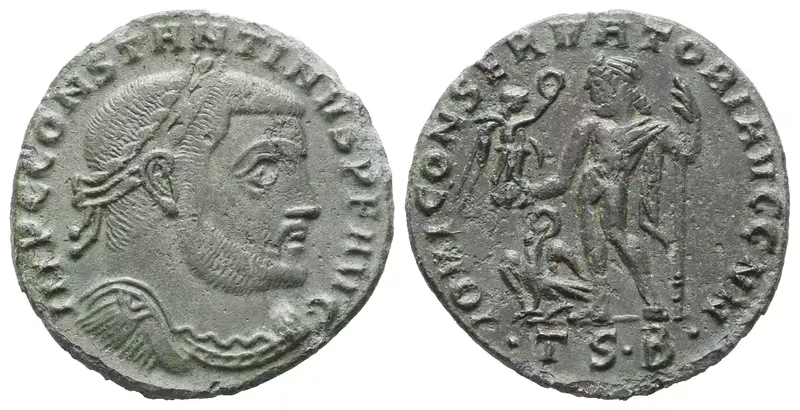
Constantinus I., follis
Constantinus I. (306 - 337), follis - mincovna Thessalonica, rok 312 - 313, stojící Jovi s Viktorií a orlem u nohou RIC 61b
- Code: BE145-AT163
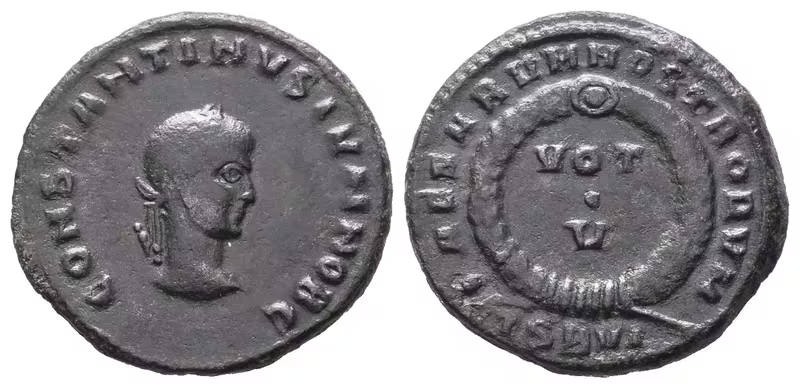
Constantinus II., follis
Constantinus II. (316 - 337), follis - mincovna Thessalonica, malá busta / VOT V ve věnci, raženo 321 RIC VII 163