Kingdom of Norway
The Kingdom of Norway is a Scandinavian kingdom existing from the 9th century to the present day, formed through the unification of the Norwegian tribes and renowned for the Viking expansion across northern Europe, Iceland, Greenland and America. The Kingdom of Norway is significant in numismatics for its distinctive medieval coinage, particularly the bra…
The Kingdom of Norway emerged during the 9th and 10th centuries through the unification of the scattered Norwegian tribes under the rule of Harald Fairhair (872-930), who became the first king of all Norway after his victory at the Battle of Hafrsfjord around 872. Harald managed to unify numerous local chieftains and petty kings who had until then ruled separate fjords and valleys. Those unwilling to submit to his rule often emigrated to Iceland, the Faroe Islands or other North Atlantic colonies.
The Viking expansion period (9th-11th centuries) represented the golden age of Norwegian power and influence. Norwegian Vikings, led by exceptional navigational skills and advanced shipbuilding technology, colonised Iceland (874), Greenland (982) and around the year 1000 reached the coast of North America under the leadership of Leif Erikson. At the same time, they conducted raids and founded settlements throughout northern Europe - in Ireland, Scotland, northern England and Normandy.
A fundamental change in Norwegian history was the Christianisation under Olaf II Haraldsson (1015-1028), later canonised as St Olaf. Olaf forcibly suppressed pagan cults, had Christian churches built and introduced Christian law. Despite his death at the Battle of Stiklestad in 1030, his Christianising work took hold and St Olaf became the patron saint of Norway. His tomb in Trondheim became an important pilgrimage site in northern Europe.
In the 12th and 13th centuries, an independent Norway reached the peak of its power under the Sverre dynasty, particularly under Haakon IV the Old (1217-1263) and Magnus VI the Lawmender (1263-1280). The Kingdom of Norway at that time encompassed not only the mainland territory but also Iceland, Greenland, the Faroe Islands, Shetland, Orkney and the Hebrides. Magnus VI issued an extensive code of law that unified Norwegian law and remained the foundation of the legal system for centuries.
History
The end of Norwegian independence came in 1380, when after the extinction of the male line of the Norwegian royal dynasty Margaret I ascended to the throne, who already ruled Denmark and later also Sweden. Thus arose the Kalmar Union (1397), which united all three Scandinavian kingdoms under Danish leadership. After the dissolution of the union in 1523, Norway remained part of the Danish kingdom as a province, which lasted until the Napoleonic Wars.
After the Battle of Copenhagen in 1807, Denmark sided with Napoleon, which led to its defeat and the loss of Norway to Sweden under the Treaty of Kiel of 1814. The Norwegians, however, attempted to declare independence and adopted their own constitution at Eidsvoll, but were forced to enter a personal union with Sweden. This union lasted until 1905, when Norway gained definitive independence and chose its own king, Haakon VII.
Modern Norway developed into a prosperous Nordic social democracy with extensive oil and natural gas deposits in the North Sea. Today Norway is a constitutional monarchy with a high standard of living and strong traditions connected to its Viking heritage, which is reflected in contemporary culture and national identity.
Norwegian coinage began relatively late compared to other European kingdoms - the first Norwegian coins appear only in the 11th century under the rule of Magnus the Good (1035-1047). These early coins were silver pennings struck according to Anglo-Saxon models that Magnus had encountered during his stay at the English court. The motifs were simple - usually the king's name and a cross as a symbol of the country's Christianisation.
Norwegian coinage
In the 12th and 13th centuries, Norwegian coinage developed into its own bracteate system, similar to the other Nordic countries. Norwegian bracteates were distinguished by characteristic motifs of St Olaf with an axe or sword, royal portraits and heraldic symbols of the Norwegian kingdom. These thin silver coins, struck on only one side, achieved a high artistic level and were among the most beautiful medieval Nordic strikes.
During the Dano-Norwegian Union (1380-1814), Danish coins were primarily struck in Norway, yet specialised Norwegian issues struck in Trondheim and Bergen did exist. These coins often contained specifically Norwegian motifs or inscriptions referring to the Norwegian part of the united kingdom. The quality was generally lower than that of pure Danish coins owing to more limited resources and a less developed Norwegian economy.
After gaining independence in 1905, Norway introduced its own Norwegian krone, which replaced the previous Swedish-Norwegian currency. Modern Norwegian coins built on historical traditions and feature royal portraits, national symbols and references to Viking heritage. Particularly prized are commemorative coins marking significant events in Norwegian history or celebrating the country's natural beauty.
In our auction and shop
- Code: SNOR-D1993
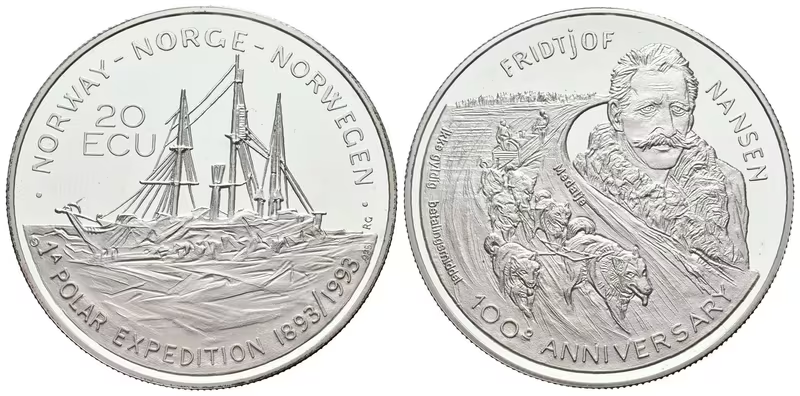
Norsko, 20 ECU 1993 - Fridtjof Nansen, polární expedice Fram, 100. výročí
Norské království (soukromá emise ECU, 1993) 20 ECU 1993 - Fridtjof Nansen, polární expedice Fram, 100. výročí Ag (.925), 38,6 mm (25 g), v kapsli. Stav mince odpovídá fotografii.
Skladem 1 ks