Portuguese Empire
The Portuguese Empire was the first and longest-lasting European colonial empire, which existed from the conquest of Ceuta in 1415 until the handover of Macau to China in 1999. The Portuguese created a global trade network controlling the maritime routes around Africa to Asia and colonised Brazil.
Portuguese expansion began in 1415 with the conquest of Ceuta in Morocco. Prince Henry the Navigator organised systematic exploration of the African coast. The Portuguese discovered Madeira, the Azores and the Cape Verde Islands, which they colonised. Bartolomeu Dias rounded the Cape of Good Hope in 1488 and Vasco da Gama reached India in 1498. This opened up the maritime spice trade, which broke the Venetian and Arab monopoly. Pedro Álvares Cabral discovered Brazil in 1500 on the voyage to India.
In the 16th century the Portuguese built an empire based on the control of strategic harbours and trade routes. Afonso de Albuquerque conquered Goa, Hormuz and Malacca, creating a network of fortresses from East Africa to the Moluccas. The Portuguese controlled the spice trade, monopolising the import of pepper, cloves and nutmeg into Europe. In Brazil they began to cultivate sugar cane using slave labour from Africa. Angola and Mozambique became sources of slaves for the plantations.
History
From the end of the 16th century the Portuguese Empire faced competition from the Dutch and the English. The personal union with Spain in 1580–1640 weakened Portuguese positions. The Dutch occupied Malacca, Ceylon and part of Brazil. After the restoration of independence Portugal concentrated on Brazil, which became its richest colony. The discovery of gold in Minas Gerais in 1690 and of diamonds in 1729 brought enormous wealth. Lisbon became one of the wealthiest cities in Europe.
The Napoleonic invasion forced the Portuguese court to flee in 1807 to Brazil. After the return of the court Brazil gained independence in 1822. Portugal retained its African colonies until decolonisation in the 1970s. The last colony, Macau, was returned to China in 1999, thereby ending the longest-lasting European colonial empire. Portuguese is today the official language in nine countries with more than 250 million speakers.
Coinage of the Portuguese Empire
The Portuguese Empire struck coins in all its colonies adapted to local conditions. The gold cruzado struck from 1457 became an international trade coin rivalling the Venetian ducat. In India Goa struck its own pardao and xerafim modelled on local patterns. The Brazilian mints in Rio de Janeiro, Bahia and Minas Gerais produced gold moedas and dobrões from local gold. The African colonies struck special copper and silver coins for trade with the local population.
The Portuguese monetary system was based on the real as the basic unit. The gold moeda de ouro weighed 10.9 grams and was worth 4000 reais. The quality of Portuguese colonial coins was high; they often bore the armillary sphere, the symbol of Portuguese maritime discoveries. The coinage documents the economic development of individual colonies and the flow of precious metals to Europe. The Brazilian gold coins of the 18th century are among the most beautiful colonial strikes.
In our auction and shop
- Code: SDJI-D1996
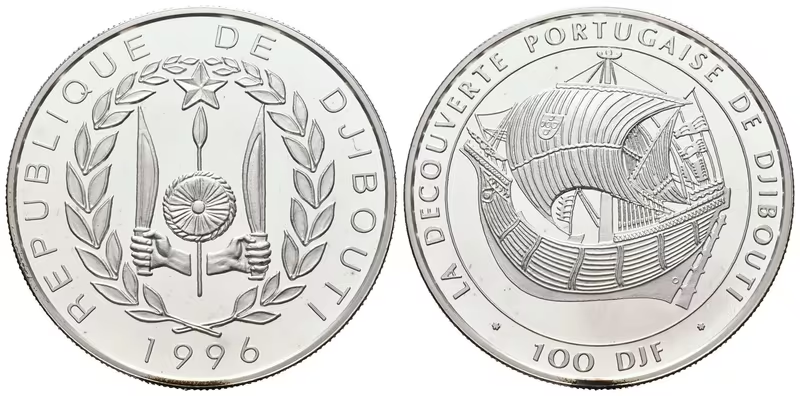
Džibutsko, 100 Franků 1996 - Portugalská karavela Nao, námořní objev Džibutska
Džibutská republika (1977-dosud) 100 Franků 1996 - Portugalská karavela Nao, námořní objev Džibutska, KM# 33 Ag (.925), 38,6 mm (31,47 g), v kapsli. Stav mince odpovídá fotografii. Jedná se o druhotný prodej. (Možná oxidace, atd.. ! - VIZ FOTOGRAFIE !)
Skladem 1 ks - Code: SPORTAN-F1923
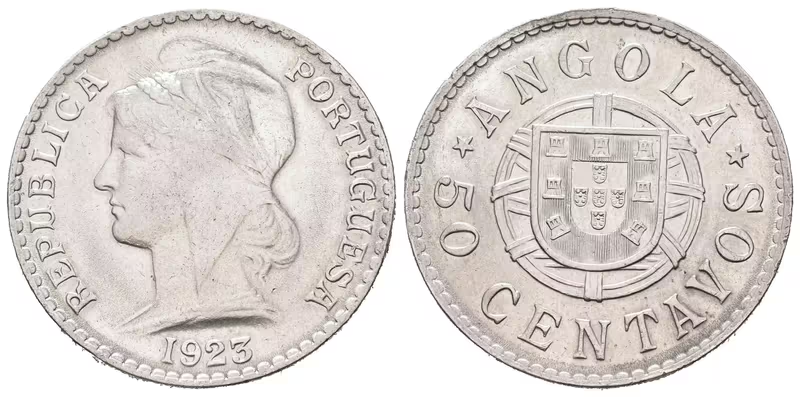
Portugalská Angola, 50 Centavo 1923
Portugalská Angola, republika (1951 - 1975) 50 Centavos 1923, KM.65, velmi pěkná zachovalost, zbytky lesku, rysky a hranky
Skladem 1 ks - Code: SPORTGU-F1946
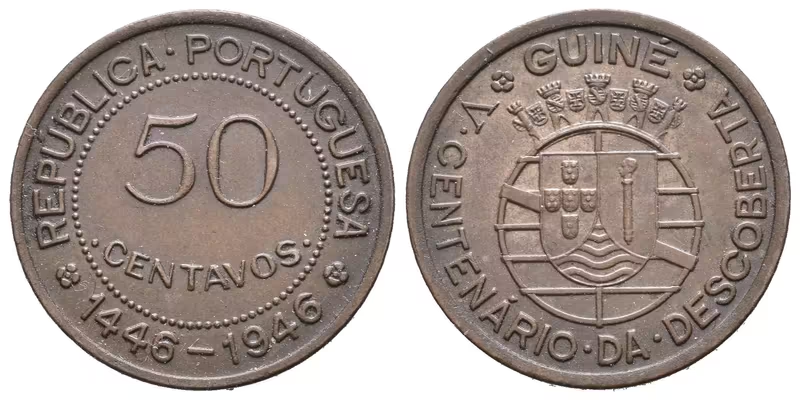
Portugalská Guinea, 50 Centavo 1946
Portugalská Guinea (Guinea-Bissau), republika (1910 - 1975) 50 Centavos 1946 - K 500. výročí objevení, KM.6, krásná zachovalost, patina
Skladem 1 ks - Code: SPORTAN-D1968
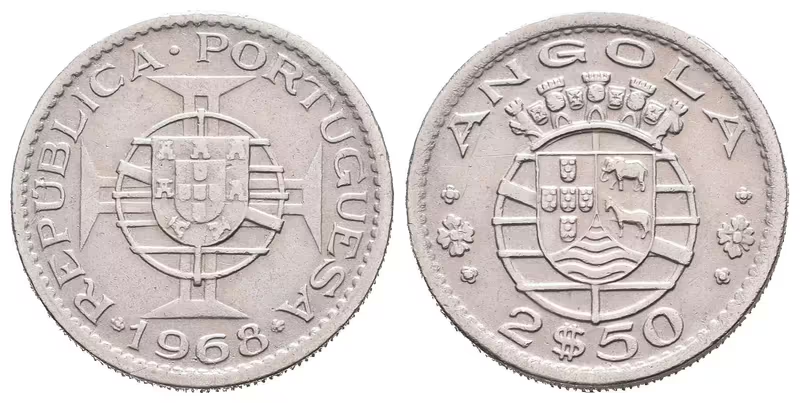
Portugalská Angola, 2,5 Escudo 1968
Portugalská Angola, republika (1951 - 1975) 2,5 Escudos 1968, KM.77, pěkná zachovalost, patina, drobné rysky
Skladem 1 ks