Portuguese Empire
The Portuguese Empire was the first global colonial empire in the world, existing in 1415–1999, which extended across four continents from Brazil through Africa to Asia and founded a world trading system linking Europe with the New World. The Portuguese Empire is significant in numismatics thanks to the varied colonial coins struck from Brazilian gold, In…
The Portuguese Empire began in 1415 with the conquest of Ceuta in North Africa, the first European colonising act on the African continent. The Infante Henry the Navigator (1394–1460) laid the systematic foundations of Portuguese expansion by supporting voyages of discovery along the African coast. Portuguese navigators gradually discovered Madeira (1419), the Azores (1427) and continued in the exploration of West Africa, seeking a route to the fabled land of Prester John and on to India.
The breakthrough was the rounding of the Cape of Good Hope by Bartolomeu Dias in 1488 and the subsequent voyage of Vasco da Gama to India (1497–1499), which for the first time linked Europe with Asia by a sea route. The Portuguese thereby bypassed the Muslim intermediaries and gained direct access to the lucrative trade in oriental spices. Afonso de Albuquerque established Portuguese strongholds in Goa, Malacca and Hormuz, thereby creating the first global trade network.
A fundamental expansion was the discovery of Brazil by Pedro Álvares Cabral in 1500, initially regarded as less important than the Asian colonies. Brazil, however, gradually became the most precious Portuguese colony thanks to sugar cane plantations, the export of timber and especially the discovery of gold mines in Minas Gerais at the beginning of the 18th century. Brazilian gold financed Portuguese culture and Baroque architecture.
The 16th and 17th centuries represented the peak of Portuguese power, with colonies scattered all over the world. The Portuguese Estado da Índia controlled key points of Asian trade, the African coast provided slaves for American plantations, and Brazil supplied raw materials for European markets. The Portuguese Empire was the first truly global empire connecting all continents by oceanic routes.
History
A crisis came with the Spanish union (1580–1640), when Portugal lost its independence after the death of Sebastian I in Morocco. Spanish rule meant entanglement in Spanish wars and the loss of parts of the empire to the Dutch and the English. The restoration of independence in 1640 under the reign of John IV of Braganza renewed the Portuguese state, but the empire never regained its former greatness.
The 18th century brought a second flowering thanks to Brazilian gold from the mines of Minas Gerais, which made Portugal one of the wealthiest European kingdoms. The Pombaline reforms under the reign of Joseph I modernised the administration, but the Lisbon earthquake of 1755 and the Napoleonic Wars at the beginning of the 19th century weakened the empire.
Brazilian independence in 1822 meant the loss of the most important colony. Portugal retained its African colonies — Angola, Mozambique, Guinea-Bissau, Cape Verde and São Tomé and Príncipe — while in Asia Goa, Macau and East Timor remained. These remnants of the empire endured into the 20th century.
The definitive end of the Portuguese Empire came gradually — Goa was occupied by India in 1961, the African colonies gained independence during the Carnation Revolution of 1974–1975, and the last territory was Macau, handed over to China in 1999. Thus ended the existence of the oldest and longest-lasting European colonial empire.
Portuguese colonial coinage
The Portuguese Empire created the most varied colonial coinage system in the world, with mints scattered across four continents. In Brazil the mints in Rio de Janeiro, Bahia and Minas Gerais operated, striking coins directly from local gold and silver. Goa in India was the centre of Asian Portuguese coinage, while the African colonies used mainly Portuguese or Brazilian coins brought from overseas.
Brazilian colonial coinage reached its peak during the "golden age" of the 18th century. Magnificent Portuguese peças (dobrões) were struck from gold from Minas Gerais, which were among the highest-quality gold coins in the world. The Brazilian mints also produced silver patacas and vinténs, while small coins were struck from copper for routine colonial trade. Characteristic motifs were the Portuguese shield, the crosses of the Order of Christ and royal portraits.
In the Asian colonies Portuguese coinage adapted to local traditions and needs. In Goa rupees and their fractions were struck according to the Indian system but with Portuguese motifs. In Macau Chinese and Portuguese elements were combined. Malacca and other Asian strongholds used Portuguese coins adapted to local trade in oriental spices and silk.
The African Portuguese colonies had more limited coin production owing to their lesser economic importance. Coins imported from Portugal or Brazil predominated, with local strikes mainly for the trade in slaves and ivory. Characteristic were the Portuguese cruzados with crosses, which were used for African trade and became a recognisable symbol of Portuguese presence in Africa.
In our auction and shop
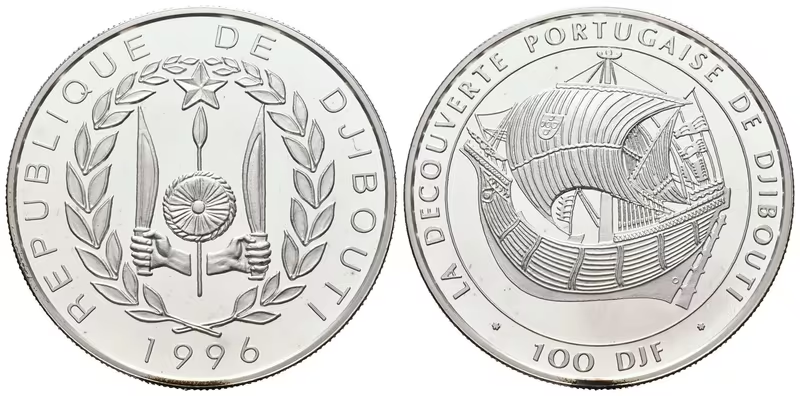
- Code: SDJI-D1996
Džibutsko, 100 Franků 1996 - Portugalská karavela Nao, námořní objev Džibutska
Džibutská republika (1977-dosud) 100 Franků 1996 - Portugalská karavela Nao, námořní objev Džibutska, KM# 33 Ag (.925), 38,6 mm (31,47 g), v kapsli. Stav mince odpovídá fotografii. Jedná se o druhotný prodej. (Možná oxidace, atd.. ! - VIZ FOTOGRAFIE !)
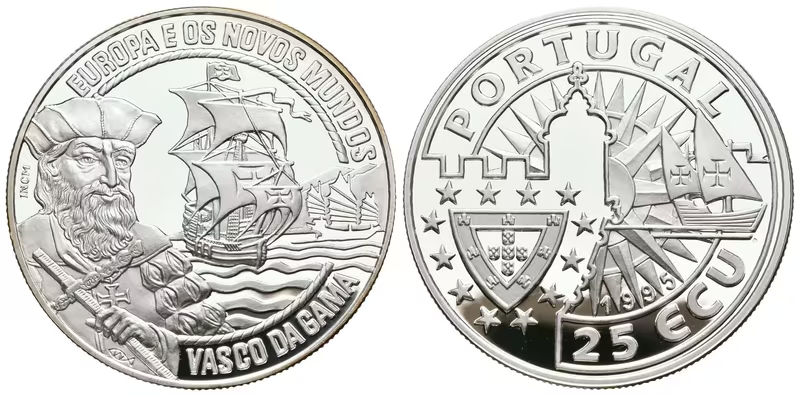
Skladem 1 ks - Code: SPORT-O1995
Portugalsko, 25 Ecu 1995 - Vasco da Gama
Portugalská republika (1911-2001) 25 Ecu 1995 - Vasco da Gama, KM X49 Ag 0,925, 37 mm (28 g), PROOF, kapsle, patina!
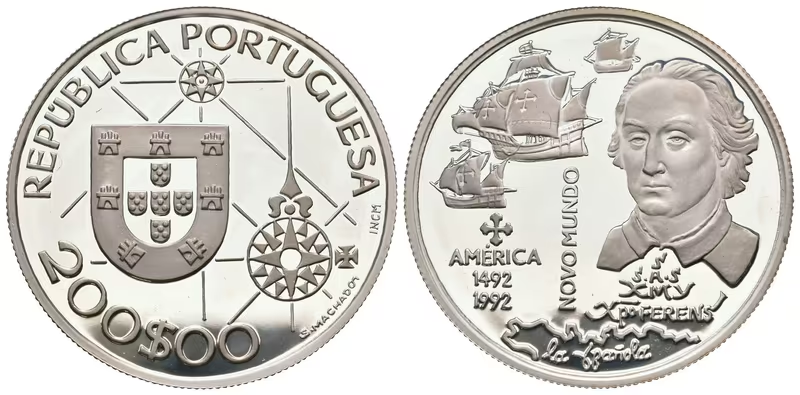
Skladem 1 ks - Code: SPORT-O1992
Portugalsko, 200 Escudos 1992 - Objevení Ameriky
Portugalská republika (1911-2001) 200 Escudos 1992 - Objevení nového světa, KM# 660a Ag 0,925, 36 mm (26,5 g), PROOF, kapsle, patina!
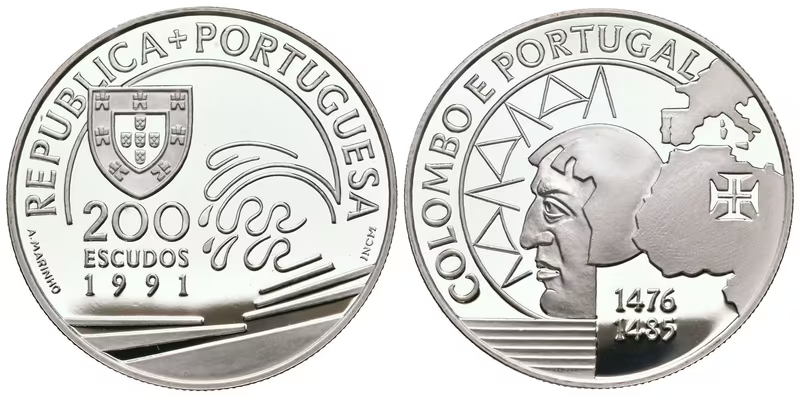
Skladem 1 ks - Code: SPORT-O1991
Portugalsko, 200 Escudos 1991 - Kolumbus
Portugalská republika (1911-2001) 200 Escudos 1991 - Kryštof Kolumbus, KM# 658a Ag 0,925, 36 mm (26,5 g), PROOF, kapsle
Skladem 1 ks