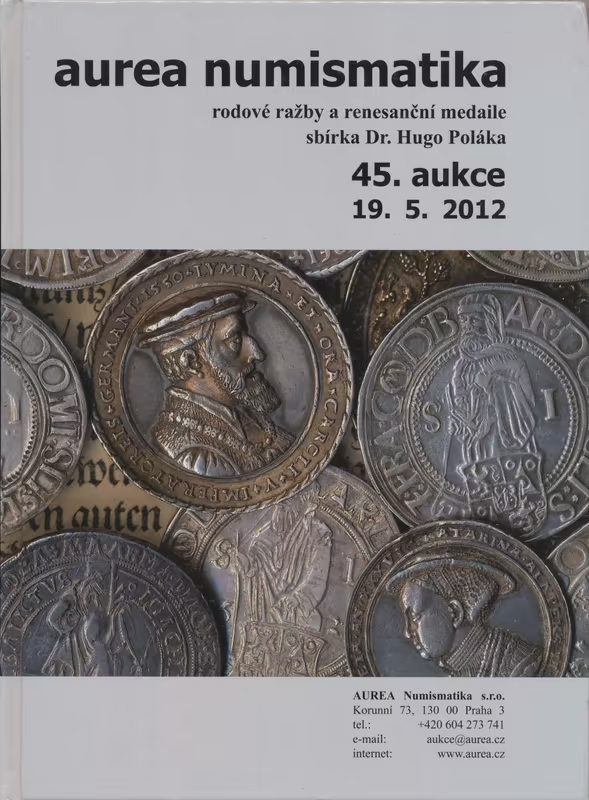
Family strikes
Family strikes are coins and medals issued by prominent noble families on the basis of a special minting privilege. They were not ordinary currency for everyday payment but rather limited, prestigious issues that emphasised the family's standing and its ties to the sovereign.
Family strikes grow out of the idea that the right to strike coins is a manifestation of sovereign power. In the Middle Ages and the early modern period the minting right belonged as a rule to the sovereign, or to selected towns or ecclesiastical institutions. If, however, a noble family rose to become among the most important pillars of the state, it could in exceptional cases gain the possibility of striking its own coins. This was therefore neither a matter of course nor a permanent entitlement: it was usually a grant of privilege, the lease of a mint, or an authorisation tied to a specific territory, yield or extraordinary situation.
In the Czech lands the beginnings of family minting are placed in the 15th century, when alongside the usual royal strikes there also appear issues associated with great noble houses. The motivation varied. Sometimes it was a reward for services rendered, at other times a pragmatic need to ensure striking in places where the authorised holder had metal, mining yield or administrative infrastructure at his disposal. Minting required not only the right but also technique, workers, dies and above all metal. Precisely for this reason family strikes are often associated with regions where there was access to silver or gold, or at least to revenues that could be converted into metallic currency.
A typical feature of family strikes is their limited scope. The nobility usually did not produce currency in large series, because that was not the main goal. The coin was above all to "declare" who stood behind the issue: the family arms, titulature and often a connection with a provincial or territorial symbol functioned as a metallic signature. In a number of cases these were representative issues, intended as gifts, for the demonstration of standing, or to commemorate a particular claim or holding. For this very reason some family coins scarcely appear in ordinary coin finds — people tended to preserve them, and they entered circulation only marginally.
History
In the course of the 16th and 17th centuries family strikes appear in various forms. Some families struck in their own mints on their estates; others made use of governmental mints if the grant or contractual framework permitted. In the Czech environment family minting is associated, for example, with great noble houses that held significant property and political influence. Alongside them it is worth keeping in mind the parallel world of "episcopal" strikes: these are not family strikes in the narrow sense, but they similarly show how the minting right could in exceptional situations extend beyond direct royal administration.
Family strikes gradually receded as state administration and monetary policy became more centralised. The stronger the oversight of the currency, the smaller the room left for exceptions, however prestigious. For numismatics, however, these coins remain exceptionally valuable: they carry not only an image and inscription but also a story about the family's relationship to the sovereign, about power, privileges and how authority could be projected into metal.
Family strikes are recognised above all by the fact that, alongside the usual state and provincial motifs, they bear a distinct family identity. Most often this is the family arms, sometimes supplemented by an inscription that clearly names the issuer or the territory with which the authorisation is connected. Visually these coins tend to be ambitious: the family wishes to display prestige, and so chooses motifs that at first sight feel "more ceremonial" than ordinary small change.
Devices, denominations and collector significance
Denominationally one may encounter both higher-value pieces (especially in the era of the thaler and ducat) and smaller coins, if the family sought to cover the practical need for money in its territory. With the higher values, however, the representative intent is most clearly visible: gold and large silver served as a demonstration of wealth and power and were at the same time better suited as gifts or commemorative objects. This is also the reason why some family strikes have been preserved in surprisingly good condition — they were not "worn out" in everyday payment as intensively as smaller coins.
For the collector, the limited mintage and variability are attractive. Family coins often exist in smaller numbers and may have several variants according to the dies used, the legends or small marks. With a number of types precise attribution is important, because similar iconography may also occur with other issuers, or there may be later imitations and medallic pieces. In practice the legibility of the legends, the preservation of detail in the arms and the natural surface of the metal are assessed; harsh cleaning is often very intrusive on these "prestige" strikes. Family strikes thus form a specific chapter of numismatics, where monetary history meets the history of the nobility and its self-representation.
In our auction and shop
- Code: XH045
45. Aukce - sbírka Dr. Hugo Poláka • rodové ražby a renesanční medaile
Aurea Numismatika 45. Aukce - sbírka Dr. Hugo Poláka • rodové ražby a renesanční medaile Praha - 19.05.2012
Skladem (>5 ks) - Code: XB1295
Mince zemí Koruny České - Sbírka Josefa Květoně
Jan Šmerda Mince zemí Koruny České - Sbírka Josefa Květoně Znojmo 2004, 203 stran, každá mince vyobrazena, tabulky a přehledy, vázané Soupis sbírky pedagoga a numismatika Josefa Květoně, obsahuje mince od antiky, přes středověk, Habsburské ražby, rodové…
Skladem 1 ks - Code: XB1300-0602
Chaurova sbírka - Rodové ražby a ražby Olomouckého biskupství a arcibiskupství
Zuzana Holečková - České, moravské a slezské mince 10. - 20. století Nevládní tolarové ražby - Rodové ražby a ražby Olomouckého biskupství a arcibiskupství Všichni zájemci o numismatiku mají nyní možnost nahlédnout i do druhého svazku nevládních ražeb z…
- Code: RADAS-2018-TOLIJE
Dašek Martin - Tolije Bahenní
Dašek Martin (1981 - ) Niue Islands, 1 Dollar 2018 - Ohrožená příroda - Tolije Bahenní Stříbro 0,999, 34 mm (16 g), kapsle, papírový přebal Od roku 2013 vydávala Česká mincovna každoročně čtyři kolorované stříbrné mince jako trvalou upomínku na…