Rudolph Augustus of Brunswick-Wolfenbüttel
Rudolph Augustus of Brunswick-Wolfenbüttel (1627–1704) was Duke of Brunswick-Lüneburg, who ruled the Duchy of Wolfenbüttel. He was renowned as an educated sovereign and patron, and from his era come representative coinage strikes characteristic of North German Baroque coinage.
Rudolph Augustus was born on 16 May 1627 at Hitzacker as the son of Duke Augustus the Younger of Brunswick-Lüneburg, an important bibliophile and founder of the renowned Wolfenbüttel library. He grew up in an environment of deep interest in science and culture, which shaped his later rule.
After the death of his father in 1666 Rudolph Augustus took over the rule of the Duchy of Wolfenbüttel. His reign fell in the period of gradual consolidation following the devastating Thirty Years' War, which had severely affected the German lands. Rudolph Augustus continued the policy of renewal and development that his father had begun.
The Duke maintained good relations with the imperial court in Vienna and participated in imperial politics as a loyal member of the Holy Roman Empire. His territory was not among the largest, but thanks to sensible administration and support of the economy it maintained stability. Rudolph Augustus also supported science and the arts, continuing the tradition of his father as a patron.
History
In 1685 Rudolph Augustus called his nephew Anthony Ulrich to share his rule, with whom he then ruled jointly. This dual regime continued until Rudolph Augustus's death on 26 January 1704. The duchy then passed fully to Anthony Ulrich, who continued his predecessor's cultural policy.
The mint at Wolfenbüttel belonged among the important North German minting workshops of the 17th century. During the reign of Rudolph Augustus coins of various denominations were struck there, from small kreuzers to representative thalers. The Brunswick-Wolfenbüttel thalers of this epoch stand out for their quality of execution and artistic value.
The obverse of the coins shows a likeness of the Duke with a long wig typical of the Baroque era, or the ducal coat of arms with a horse, the traditional symbol of the House of Welf. The reverses bear the imperial eagle, heraldic motifs or inscriptions with the sovereign's titulature. The strikes document the high level of minting craft in the North German space.
Coinage of the Duchy of Brunswick-Wolfenbüttel
From the numismatic point of view, the coins of Rudolph Augustus are sought above all by collectors of German strikes and thalers. Of particular interest are commemorative strikes issued on the occasion of significant events such as coronations, weddings or deaths of members of the ducal family. These coins served representative purposes and to this day document the cultural level of the Wolfenbüttel court.
In our auction and shop
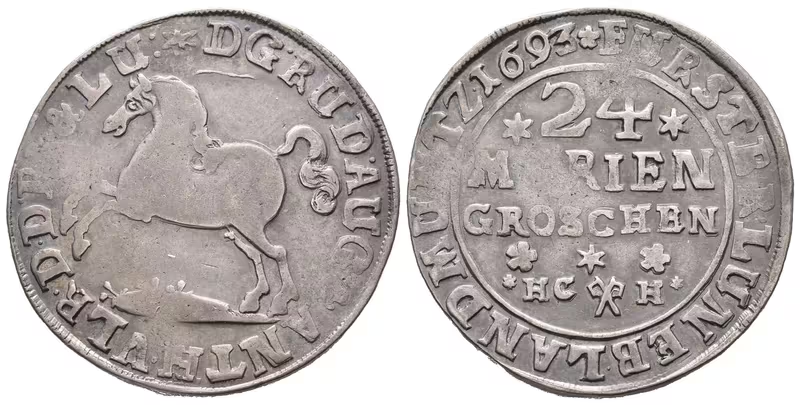
- Code: NABRAUW-1693
Brunšvick-Wolfenbüttel, 24 Mariánských grošů 1693
Braunschweig - Wolfenbüttel, Rudolf August a Anton Ulrich (1666/1685 - 1704) 24 Mariengroschen 1693 HCH, Braunschweig, KM.586, Welt.2080, velmi pěkná zachovalost, patina, rysky a drobné vady střížku
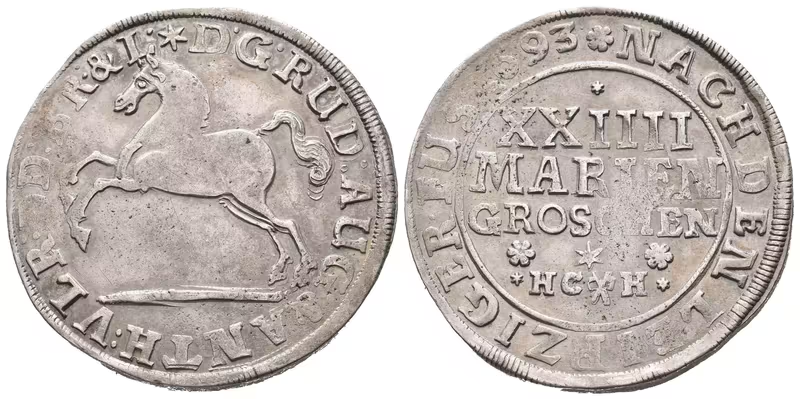
Skladem 1 ks - Code: NABRAUW-1693A
Brunšvick-Wolfenbüttel, 24 Mariánských grošů 1693
Braunschweig - Wolfenbüttel, Rudolf August a Anton Ulrich (1666/1685 - 1704) 24 Mariengroschen 1693 HCH, Braunschweig, Welt.2081, Dav.338 var., ražena dle Lipského měnového standartu Velmi pěkná zachovalost, patina, rysky a drobné vady střížku
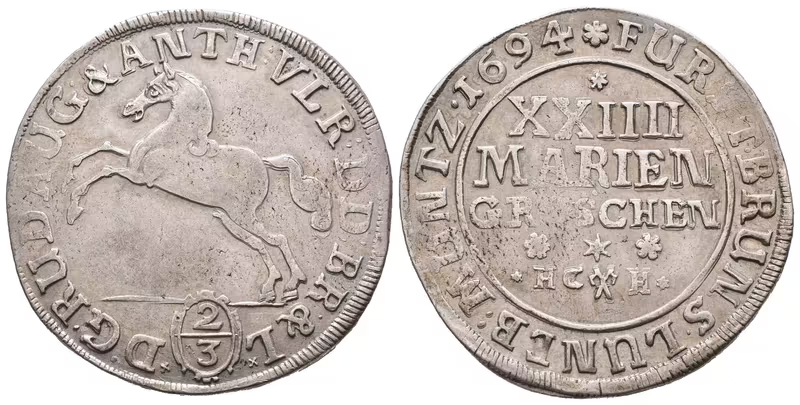
Skladem 1 ks - Code: NABRAUW-1694
Brunšvick-Wolfenbüttel, 24 Mariánských grošů 1694
Braunschweig - Wolfenbüttel, Rudolf August a Anton Ulrich (1666/1685 - 1704) 24 Mariengroschen 1694 HCH, Braunschweig, Welt.2082, Dav.338 v., krásná zachovalost, tmavá patina, pěkně vyražený, drobné vady střížku
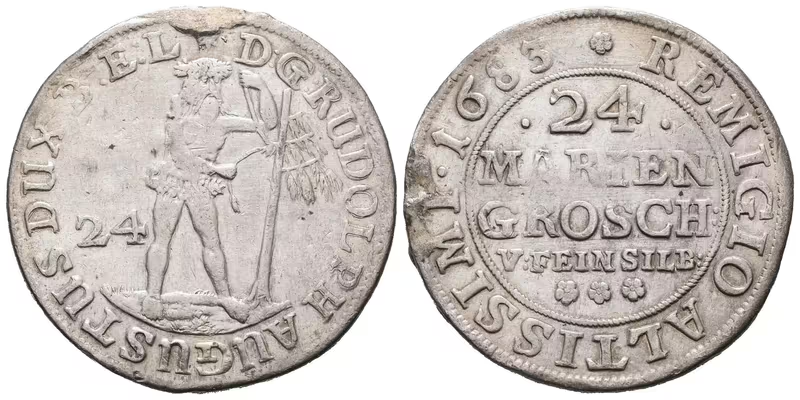
Skladem 1 ks - Code: NABRAUW-1683LOT
Braunschweig - Wolfenbüttel, 24 Mariengroschen 1683 + VI Mariengroschen
Braunschweig - Wolfenbüttel, Rudolf August, 1666 - 1704 24 Mariengroschen 1683, Zellerfeld + VI Mariengroschen 1693, oba m.o., rysky a hrany