15 Kreuzer
The 15 kreuzer, or fifteen-kreuzer piece, is a silver coin introduced in the Czech lands under the reign of Leopold I in 1659 as a practical middle denomination of the kreuzer system. In circulation it was popular also under the popular names 'pětigroš' or 'pětičeskej' and was struck in a number of mints in the lands of the Bohemian Crown and in other par…
The 15 kreuzer was introduced in our lands by the proclamation of Leopold I of 28 March 1659. Relatively precise parameters were set for the denomination: a weight of 6.4 g and a diameter of approximately 26.3 mm. The value was indicated on the coins by Roman numerals on the obverse beneath the bust of the ruler, so that the denomination would be easily recognisable also in ordinary circulation. The very introduction shows that the silver fifteen-kreuzer piece was to fill the space between the smaller kreuzer coins and larger silver denominations and at the same time to offer a 'convenient' value for everyday payments.
In the lands of the Bohemian Crown the 15 kreuzer was struck in several mints: in Prague, Kutná Hora, Jáchymov, Wrocław, Kłodzko and in Silesian Brzeg. The largest production is associated particularly with the Prague and Wrocław mints. In Prague the years 1659, 1663–1664, further 1674 and later 1693–1696 are given, and in various stages the mintmasters also change. Wrocław struck fifteen-kreuzer pieces in several continuous blocks of years (for example 1659–1665, further 1670, 1674–1676, 1681 and later again 1692–1694 and 1696), which documents well that the denomination was stably needed in circulation and that production was shifted according to capacities and the availability of metal.
Alongside these main centres there are also strikings in smaller quantities. In Kutná Hora the years 1694–1696 are given, in Jáchymov then the sole year 1663. In Kłodzko the fifteen-kreuzer piece was struck in 1664–1665 and in Silesian Brzeg, for example, the year 1677 and further 1693–1694 are documented. Such 'more peripheral' mint locations are interesting for collectors precisely because their mintages tend to be smaller and individual years are harder to come by than ordinary Prague pieces.
The fifteen-kreuzer piece moreover was not limited only to the lands of the Bohemian Crown. It was also struck in Hungarian mints – Kremnica, Nagybánya, Bratislava and Košice are cited – which shows that this was a denomination usable within the broader monetary area of the Habsburg Monarchy. In practice this meant that one could encounter the fifteen-kreuzer piece across regions and that its form and marking had to be sufficiently intelligible even outside the 'home' environment of a single mint.
History
Under Joseph I (1705–1711) the 15 kreuzer was not struck, but its striking was renewed only under Charles VI. In the Czech lands at this stage Prague is particularly important (the years 1728, 1732–1738 and 1740 are cited) as well as Wrocław (1733–1738). With these later strikings it is typical that the value also appears on the reverse, often under the imperial eagle, which strengthened the legibility of the denomination in circulation.
Under Maria Theresa fifteen-kreuzer pieces were struck in the sole operating mint in Prague, and that in several blocks of years (for example 1743–1745, 1747–1748 and subsequently 1748–1750 and 1752). This corresponds well to the contemporary centralisation of coinage: instead of many regional mints, striking was concentrated in a smaller number of centres where the metal, quality and accounting reconciliation of production could be better controlled.
A turning point was brought by the instruction of 7 November 1750, when the striking of the 15 kreuzer was discontinued and the denomination was 'retariffed' to 17 kreuzer. For collectors this is important because it creates a clear boundary: the fifteen-kreuzer issues are closed and other value relations follow. At the same time, the sources recall that fifteen-kreuzer pieces were also struck by the bishops of Olomouc, which is an interesting digression outside the purely state coinage system and a reminder that in some periods ecclesiastical authorities with their own mint facilities also participated in striking.
The 15 kreuzer is a rewarding denomination for collectors, because it combines the distinctive portrait style of the 17th–18th centuries with a rich network of mints and years. The basic distinguishing feature tends to be the indication of the value in Roman numerals beneath the ruler's bust on the obverse; with some later strikings the value is also indicated on the reverse. Important too are the mint mark and sometimes also the mintmaster's mark, because these very details often decide whether it is an ordinary or a less accessible variant.
Appearance, terminology and collector tips
The popular names 'pětigroš' or 'pětičeskej' arise from the contemporary practice of naming coins according to their relation to smaller units and according to how they were actually reckoned. In some environments, moreover, 'groš' was used as a popular designation for certain kreuzer values, so similar names can be confusing if an old text is read without context. For the numismatist it is therefore safer to stick to the denomination and the mint marks than to the popular names.
When purchasing a fifteen-kreuzer piece it is worth watching the state of the surface. This is a silver circulating coin which often circulated for a long time, so worn hair on the portrait, shallow legends and dents on the edge are common. By contrast, pieces with a sharp relief and legible marks tend to have a markedly higher collector value. With less common mints (for example Kłodzko or Brzeg) even weaker preservation may be collector-interesting, if the coin is well determined by marks and year.
In our auction and shop
- Code: M92069-1807B
František II., 15 Krejcar 1807 B
František II. (1792 - 1835) 15 Krejcar 1807 B, Kremnica, Ves.69, patina, oběh
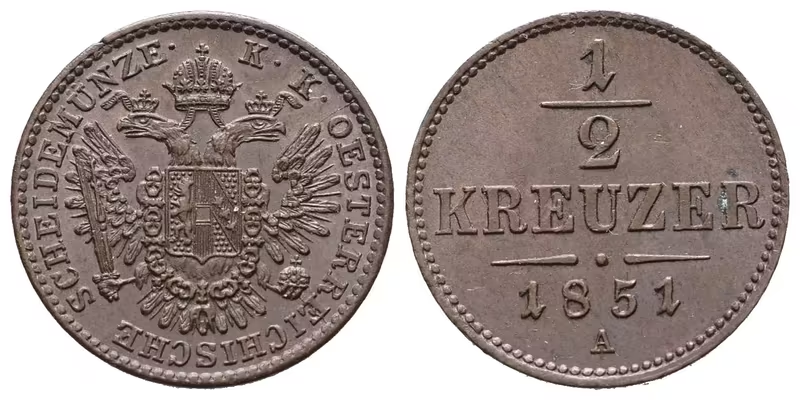
- Code: MA015-1851A
1/2 Krejcar 1851 A
František Josef I. (1848 - 1916) Krejcar 1851 A - Vídeň, Ves. 15, krásná zachovalost, zbytky lesku, tmavá patina
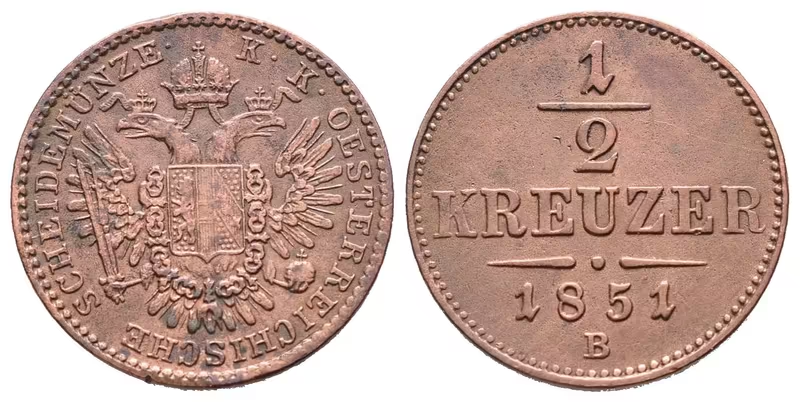
- Code: MA015-1851B
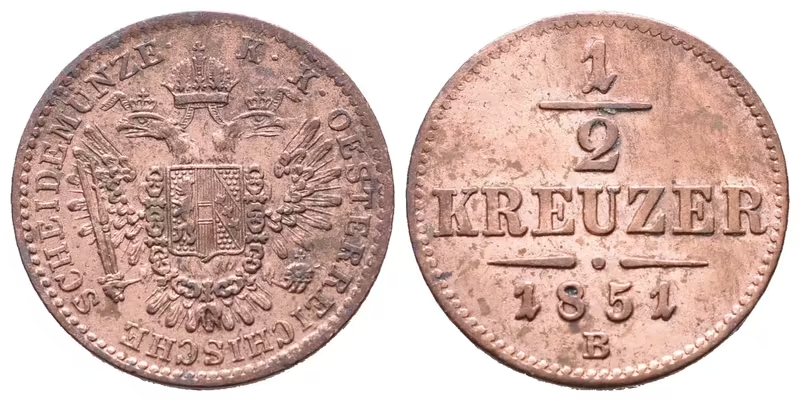
- Code: MA015-1851B.1