Alexander III Alexandrovich
Alexander III Alexandrovich was Russian tsar from 1881 to 1894, known as a sovereign of the "firm hand" who, after the assassination of his father, dampened liberal reforms and strengthened autocratic rule. His era brought conservative domestic policy but also economic growth and modernisation of the empire.
Alexander III Alexandrovich ascended the throne after the murder of his father Alexander II Nikolayevich in 1881. The event shook the entire empire, and the new tsar understood it as proof that excessive loosening of conditions led to disorder and violence. Instead of continuing in the reforming spirit of the 1860s, he therefore chose the path of strengthened state control, an emphasis on order and reliance on the traditional pillars of autocracy, Orthodoxy and state authority.
In domestic policy his rule is associated with a more conservative turn, which affected education, the press and public life. The state strengthened oversight of universities, restricted space for opposition currents and controlled public debate more consistently. Related to this is the expansion of the powers of the police and security forces, which were to prevent terrorism and revolutionary activities. A significant role in the ideological background of the regime was played by Konstantin Petrovich Pobedonostsev, who advocated distrust of parliamentary politics and defended the "educative" role of the state.
Part of Alexander's efforts at the unity of the empire was also the policy of Russification in some parts of the empire — that is, pressure for the strengthening of Russian and centralised administration. In a multinational state, however, this also increased tensions, because various regions had their own traditions, languages and historical experience. Alexander III perceived differences rather as a potential threat to stability than as a source of plurality, and therefore supported procedures designed to "unify" the empire from above.
At the same time his rule is associated with marked economic development. In the 1880s and at the beginning of the 1890s industrialisation strengthened, the railway network was extended and the state made greater use of taxes, tariffs and targeted support for industry. Among the symbols of modernising effort is the beginning of construction of the Trans-Siberian Railway in 1891. A significant place in the financial policy of the period is also occupied by the activity of Sergei Yulyevich Witte, who participated in the modernisation of the economy and of financial administration (a part of his best-known steps, however, falls in the following reign).
History
Difficult moments were also reflected in Alexander's years, for example the great famine at the beginning of the 1890s, which showed the social vulnerability of the countryside and the limits of state aid in a huge empire. Despite the modernising steps, Russia remained a country of deep differences between urban centres and the countryside, between modern industry and traditional agriculture.
In foreign policy Alexander III is often recalled as a sovereign under whom Russia attempted to avoid a great European war and to stabilise the position of the empire. The rapprochement with France gradually firmed up, creating an important framework for the European alliances of the end of the 19th century. Alexander died in 1894 and was succeeded on the throne by his son Nicholas II Alexandrovich, under whom the accumulated social and political tensions began to come to a head far more dramatically.
Alexander III Alexandrovich is associated in numismatics with the classical form of tsarist strikes of the 19th century, where strong state symbolism and emphasis on sovereign authority are recurring features. On Russian coins of this period one usually meets the double-headed eagle as the emblem of the empire and sovereign inscriptions expressing the titulature and the legitimacy of the reign. With some issues a portrait approach also appears, allowing collectors easily to attribute coins to individual tsars by style and detail of execution.
In circulation the rouble system functioned with small kopek denominations and higher values of silver and gold. For the collector this means a wide field: from ordinary copper (later bronze) coins, which bear the traces of everyday use, to more representative silver and gold pieces, in which the quality of striking and the work with relief stands out. With Russian coins of the 19th century, heraldry is often the principal attraction: minor differences in the drawing of the eagle, the crowns, the escutcheons and the lettering can create variants of interest to collectors.
The coins of Alexander III and the collector context
In evaluating coins from Alexander's years, the preservation of the surface is key. With copper and bronze pieces it is worth watching for corrosion and harsh cleaning; a natural patina is usually desirable. With silver and gold a clean, undamaged surface free of polishing — which can leave a "dead" gloss and wipe away fine structures — is valued. The legibility of the legend is also important, because precisely the titulature and dating are usually decisive for secure identification of the type.
Alexander III is therefore interesting for the collector as a "stable" period between the reform era of Alexander II and the tempestuous close of Tsarist Russia under Nicholas II. The coins of his reign often illustrate well how the conservative state ideal was reflected in the symbolism of circulating coinage: an emphasis on the empire, on continuity and on the authority of the state.
In our auction and shop
- Code: BB-SG.0001
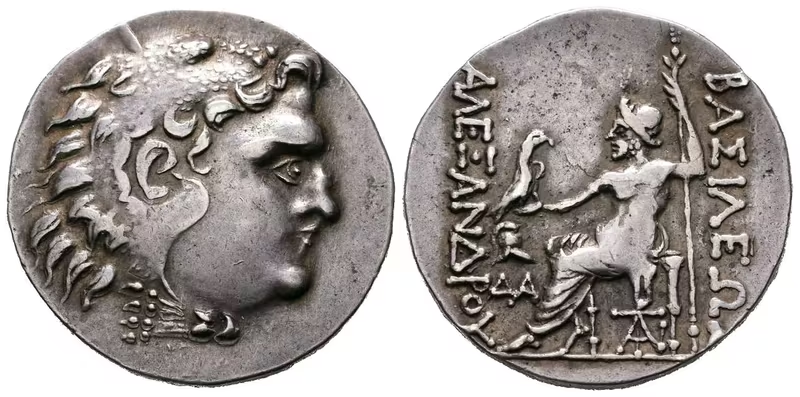
Makedonie, Alexander III.
Makedonie, Alexander III., (336 - 323 př. Kr.) Tetradrachma, Mesembria, 175 - 125 př. Kr., Hlava Heracla ve lví kůži zprava / Zeus sedící na trůně, na ruce drží orla a žezlo, vlevo a pod trůnem monogramy (16,69 g)
- Code: ZSRUS-89D1889
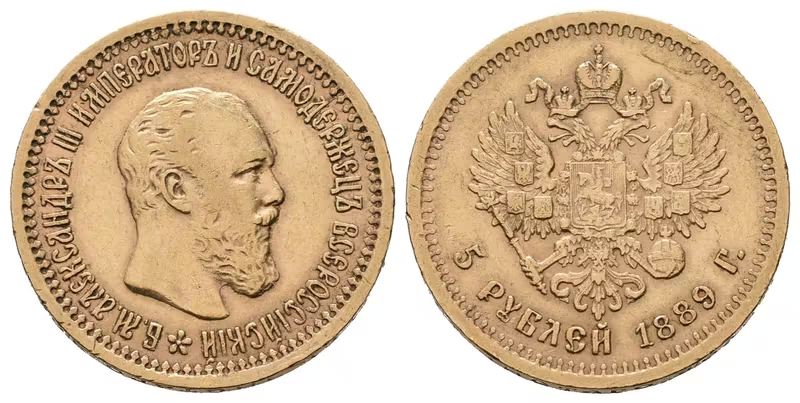
Rusko, 5 Rubl 1889 AG
Rusko, Alexander III. (1881 - 1894) 5 Rubl 1989 AG, St. Peterburg, Bitkin 2.33 Au 0,900, 21,3 mm (6,45 g)
- Code: SRUSFIN88-B1890
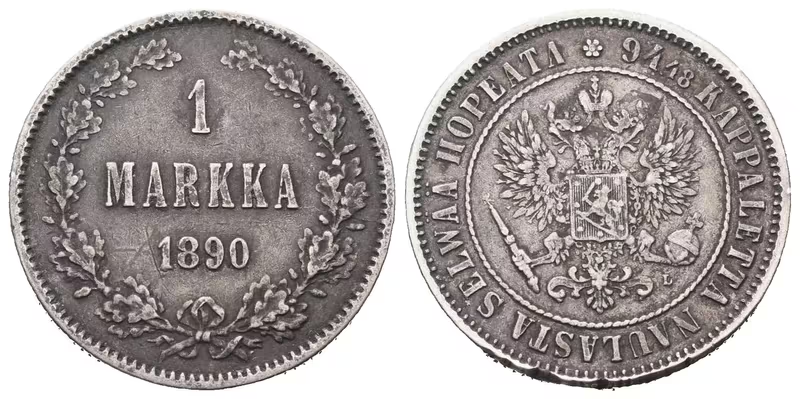
Finsko pod Ruskem, 1 Markka 1890 L
Ražby pro Finsko, Alexander III., 1881 - 1894 1 Markka 1890 L, Helsinky, Bitkin2.230, Uzd.4737