Bern Mint
The Bern Mint is the designation for the mint production associated with Bern, where the Swiss federal mint Swissmint is based. In numismatics it is above all the place where Swiss circulating and commemorative coins with precisely defined parameters are struck.
Swiss coinage long developed within an environment of strong cantonal traditions. Older Swiss coins often bore local symbols and their parameters matched regional custom. With the emergence of a more modern federal framework, however, the need grew for a unified currency that would be usable across the country without complex conversions and without exchange-rate disputes. A unified currency also requires centralised production: the same metal, the same weight, the same diameter and the same denominations.
Bern, as the political centre of Switzerland, was the natural place where federal institutions, including mint production, were concentrated. The mint in Bern ensures that coins enter circulation in quantities matching demand and at the same time in the quality required by modern payment systems. Alongside coinage, commemorative issues are also prepared here, which often have higher demands on relief detail and surface finish, since they serve to commemorate anniversaries or cultural themes.
History
Modern mint production is also a security-sensitive operation. The mint must control not only the quality of striking but also the flow of metal, the storage of semi-finished products and the protection of dies. In this it differs from older workshops, where control was primarily artisanal. Today the mint is an industrial enterprise with strict tolerances and measurable norms: even a small deviation in diameter or weight can cause problems in machines and sorting lines.
The Bern Mint is therefore important in numismatics chiefly as a "production place": it shows where and how modern Swiss coins arise. For Swiss circulating coins the origin is not usually recognised by a prominent mintmark on every piece, but rather from the issue data and official specifications. For commemorative issues, on the other hand, supplementary marks or specific design features may appear, helping to distinguish year sets and series.
Striking, parameters and quality control
The Bern Mint produces coins by machine striking: key are standardised blanks with precise diameter, thickness and weight. For circulation, alloys are used that are chosen so that the coin is durable, well distinguishable and suitable for machine processing. Parameters are therefore always described in the same way: denomination, metal composition, weight, diameter and type of edge (smooth, reeded, possibly with an inscription). These properties are decisive for modern coins' function in circulation.
Quality control monitors sharpness of relief, legibility of inscription, wear of dies and uniformity of surface. For commemorative coins, surface finishes (for example a combination of matt and gloss) and any fineness marking for precious metals are also addressed. In a description, therefore, the quality of strike (ordinary/top) is also given, because two coins of the same denomination may have a different production standard. For Swiss issues the advantage is that specifications tend to be long-term stable, so identification may rest on a precise set of measurable parameters and on the official issue framework.
In our auction and shop
- Code: FNEZA-3636
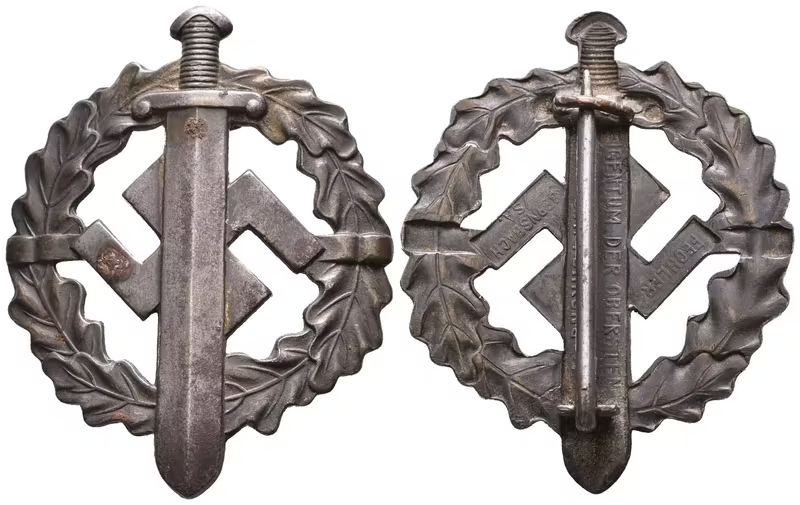
III. Říše, Sportovní odznak SA
Německo - III. Říše Sportovní výkonnostní odznak SA, stříbrný odznak ( SA-Sportabzeichen in Silber ), železo pokovené, značeno Fechler Bernsbach, OEK 3636 Pěkná zachovalost, patina
- Code: RAWICH-2015-MLOK
Wichnerová Majka - Mlok skvrnitý
Wichnerová Majka (1946 - ) Niue Islands, 1 Dollar 2015 - Ohrožená příroda - Mlok skvrnitý Stříbro 0,999, 34 mm (16 g), kapsle, papírový přebal Výrazná černožlutá kresba nezaměnitelně zbarveného obojživelníka, který vyhledává skrýš před sluncem převážně…