Carol I of Romania
Carol I of Romania was a Romanian ruler of the House of Hohenzollern-Sigmaringen who headed the country in the years 1866–1914 (from 1881 as king). His reign is associated with the modernisation of the state and with the stable monetary and coinage policy of the young Romania.
Carol I of Romania came to the Romanian environment at a time when the principality was trying to consolidate its position and create modern state institutions. The election of a foreign prince was a political step: it was meant to strengthen international prestige and at the same time stabilise domestic conditions. In the course of his long reign, Romania was gradually transformed from a principality into a kingdom and consolidated its sovereignty in a region where the interests of the great powers collided.
A fundamental stage was the period when Romania pursued full recognition of its independence. In this connection, the army, diplomacy and the ability to create functioning state administration grew in importance. Modernisation was reflected in the building of infrastructure, in the development of industry and in the creation of a more unified legal framework. For young states, currency is more than just a medium of exchange: it is a symbol of state authority and of the ability to enforce uniform rules in the economy.
History
In 1881 Carol became king, which reflected the strengthening of the country's international position and the ambition to act as a fully-fledged monarchy of European type. The long reign brought a period of relative stability, but also new challenges associated with the transformations of European politics at the turn of the 19th and 20th centuries. Romania sought to manoeuvre between power blocs while building its own institutional foundation.
Carol I died in 1914, just after the outbreak of the First World War. His era thus represents a closed chapter of the "long 19th century", during which modern nation states were taking shape and a stable currency became one of the main instruments of modern governance. For both historians and numismatists, this period is valuable because it left a large number of well-documented issues and clearly legible symbolism of the young monarchy.
Coins and symbolism of the Romanian kingdom
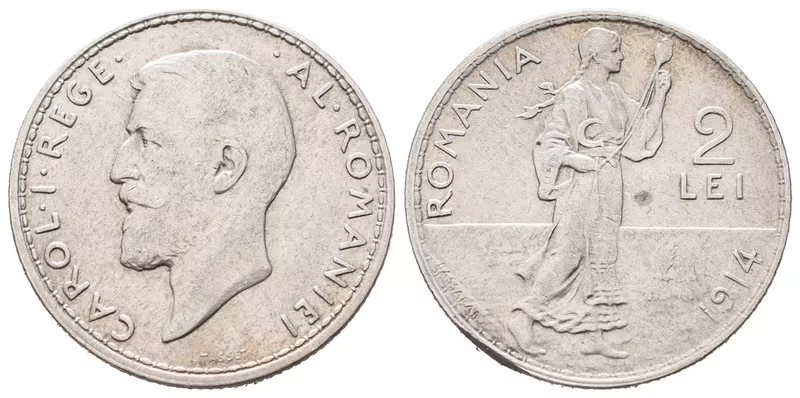
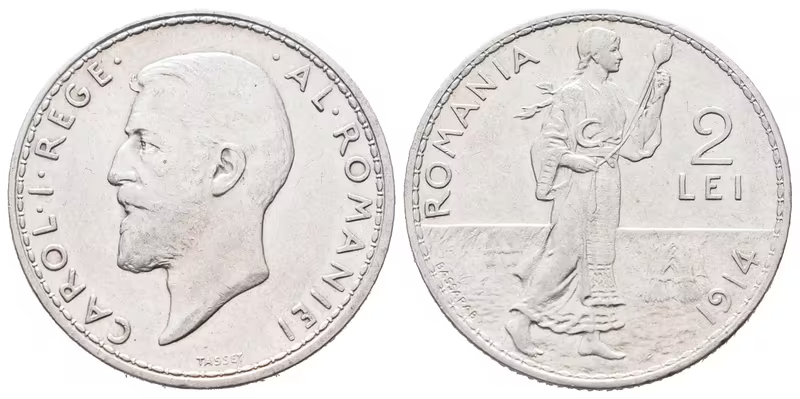
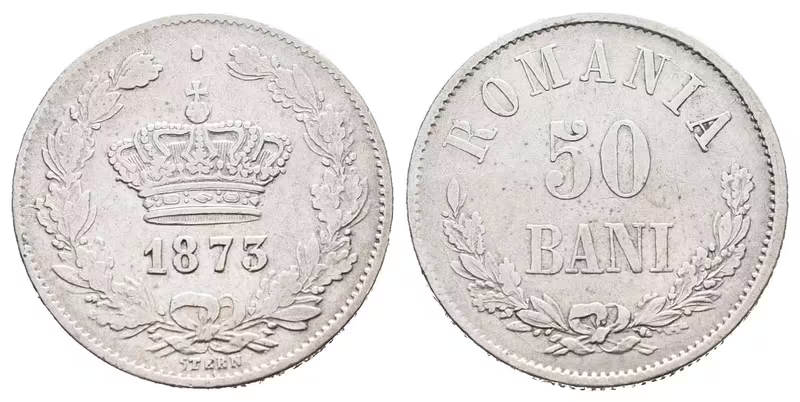
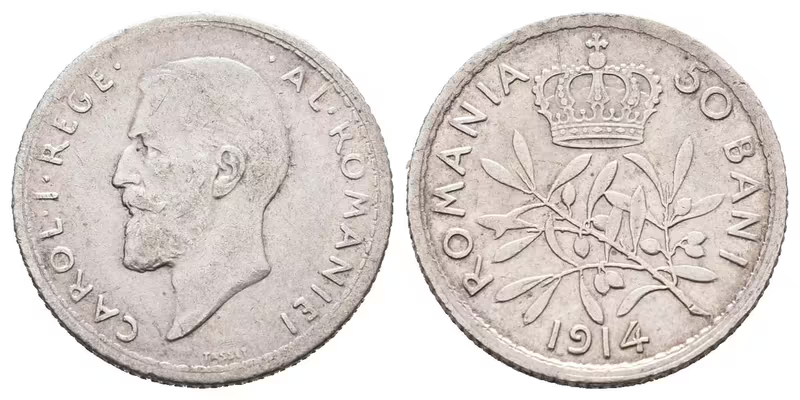
Carol I of Romania appears on coins usually in portrait form, supplemented by state emblems and inscriptions emphasising the royal title. For the collector it is important to track the denomination and metal, since at this time both ordinary circulation coins and higher denominations in silver and sometimes also gold are used, which may have both an investment and a collectors' dimension. With modern strikes, it is usually easier to verify parameters and mintmarks, which simplifies identification and price comparison.
The value of a coin is fundamentally affected by the state of preservation: with portrait types, wear quickly shows on the hair, cheekbones and in the fine details of the legend. The quality of the surface is also important — scratches and careless cleaning can significantly reduce the price. Romanian coins from the era of Carol I are also popular because they combine a legible modern style with the historical story of the formation and consolidation of the state.
In our auction and shop
- Code: SRUM86-B1914
Rumunsko, 2 Lei 1914
Rumunské království, Carol I. (1866 - 1914) 2 Lei 1914, KM.43, pěkná zachovalost, zbytky lesku, patina, rysky
Skladem 1 ks - Code: SRUM86-B1914.1
Rumunsko, 2 Lei 1914
Rumunské království, Carol I. (1866 - 1914) 2 Lei 1914, KM.43, VELMI pěkná zachovalost, lesk, drobné rysky
Skladem 1 ks - Code: SRUM86-D1873.1
Rumunsko, 50 Bani 1873
Rumunské království, Carol I. (1866 - 1914) 50 Bani 1873, KM.9, patina, rysky
Skladem 1 ks - Code: SRUM86-D1914