Centenionalis
Centenionalis is the numismatic designation for late Roman bronze coins of the 4th century, used in specialist literature for part of the small-denomination currency of that time. The exact contemporary definition of the name is not always unambiguous, so the term is often understood as a practical category for a certain type of bronze.
Centenionalis appears in connection with the turbulent development of Roman coinage in the 4th century. The empire was then dealing with a reorganisation of administration, the army and taxes, and the monetary system was adjusted accordingly. Alongside gold (which formed the backbone of state finances), bronze currency was crucial for everyday life. It was precisely with the bronzes that changes in size, weight and type occurred most often, which today complicates the precise naming of individual denominations.
The term centenionalis is used in modern numismatics as a useful "pigeonhole" for certain bronze coins struck roughly from the reign of Constantius II and other rulers of the mid-4th century down to its close. In the sources we encounter names and monetary terms which may not correspond to how we distinguish coins today by diameter and weight. In cataloguing practice, typological groups are therefore often used, based on style, iconography, mintmarks and metrology.
History
At that time, bronze strikes were produced in large quantities in a network of imperial mints spread throughout the empire. Mintmarks on the reverse or in the exergue make it possible to determine the place of striking and sometimes the workshop within the mint. This is important not only for the collector but also for historians: the distribution of finds and the frequency of types suggest how money flowed, where there was a strong military presence and how the state sought to supply the market with small currency.
The iconography of 4th-century bronzes is markedly propagandistic. The obverse is dominated by the emperor's portrait, while on the reverse, motifs of victory, the army, personifications and later also Christian symbolism appear. With some issues, it is also valuable to follow the political context: changes in titulature, co-rulers, turning points in the dynasty or important military campaigns. "Centenionalis" in this sense designates a piece of everyday history — a coin which people actually held in their hands in ordinary payments.
How a centenionalis is identified
A centenionalis is in practice identified by the portrait and legend, the reverse type, and above all by the mintmark. Because it is bronze, the state of the surface plays a major role: corrosion, cleaning and patina can decide both attractiveness and price. With late Roman bronzes, high variability of dies is common, so even small differences may form separate variants.
It is also useful to bear in mind that the word centenionalis itself may not be "a name struck on the coin" but a scholarly term. In a catalogue, therefore, look chiefly for the ruler, the legend, the reverse type and the mint; only then is the placement into a group by size and standard addressed. This makes it possible to compare the piece with similar specimens and to avoid confusion with other 4th-century bronze denominations.
In our auction and shop
- Code: BE147-0090
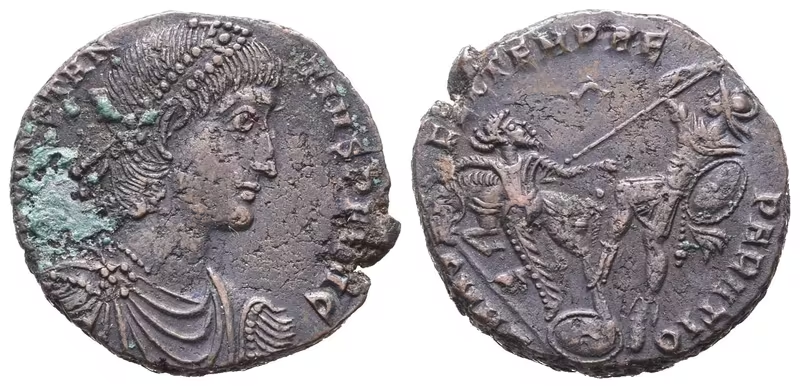
Constantius II., centenionalis, Heraclea, RIC VIII 90
Constantius II. (337 - 361) mincovna Heraclea, FELIX TEMPORVM REPARATIO, legionář srážející nepřítele na koni, RIC VIII 90
Skladem 1 ks - Code: BE159-0027
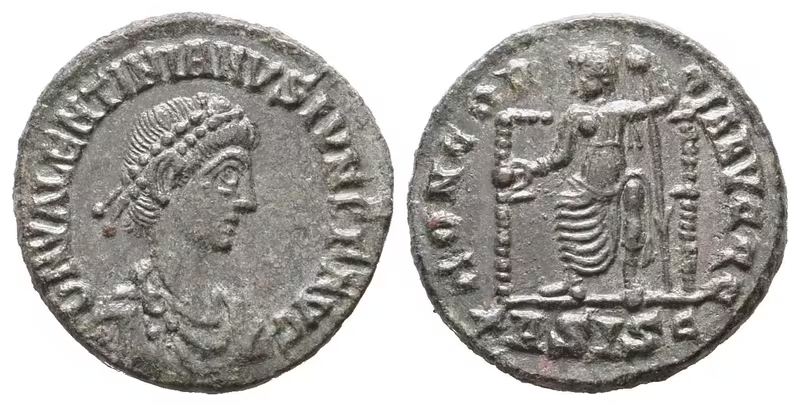
Valentinianus II., centenionalis, Siscia, RIC IX 27
Valentinianus II. (375 - 392) mincovna Siscia, sedící Roma na trůně, RIC IX 27
Skladem 1 ks - Code: BE156-ES24
Valens, centenionalis
Valens (364 - 378), centenionalis - mincovna Siscia, stojící Viktorie s věncem RIC IX 24
Skladem 1 ks - Code: BE155-EF4
Valentinianus I., centenionalis
Valentinianus I. (364 - 375), centenionalis - mincovna Konstantinopol, stojící císař s Viktorií a Christogramem RIC IX 4
Skladem 1 ks