Gustaf VI Adolf
Gustaf VI Adolf was the Swedish king who reigned from 1950 to 1973, known as the "people's monarch" for his modesty, scholarly interests and close relationship with his subjects. He modernised the Swedish monarchy and adapted it to the democratic society of the 20th century.
Oscar Fredrik Wilhelm Olaf Gustaf Adolf was born on 11 November 1882 at Drottningholm Palace as the eldest son of the future King Gustaf V and Victoria of Baden. His childhood was marked by tragedy when, in 1920, his first wife Margaret of Connaught, granddaughter of the British Queen Victoria, to whom he was deeply emotionally attached, died. From their marriage came five children, including the future King Gustaf Adolf, who tragically perished in an air crash in 1947. In 1923 Gustaf Adolf married a second time, to Louise Mountbatten, sister of the last Viceroy of India.
Before acceding to the throne Gustaf Adolf spent almost seventy years as heir to the Swedish crown, one of the longest such periods in European history. He used this long wait to develop his scholarly interests, especially in archaeology and botany. He gained a doctorate in archaeology at the University of Uppsala and undertook a series of archaeological expeditions to the Mediterranean, China and Korea. His collection of Chinese art ranked among the most important in Europe and later became the basis of the Museum of Far Eastern Antiquities in Stockholm. He published scholarly works and was a member of several academies of sciences, which was wholly exceptional among European sovereigns.
When at last, in 1950 at the age of 67, he ascended the throne following the death of his father Gustaf V, Sweden was undergoing rapid modernisation and the building of the welfare state. Gustaf VI Adolf perfectly understood his constitutional role and never sought to intervene in the political decisions of the Social Democratic governments. His motto "Duty before all" captures his approach to royal duties. He became a symbol of continuity and stability at a time of rapid social change, when Sweden was building its model of the welfare state known as the "people's home" (folkhemmet).
History
His reign was characterised by openness and informality. Gustaf VI Adolf often travelled on the Stockholm metro without an escort, shopped in stores and held informal conversations with citizens. This "common touch" won him enormous popularity across the political spectrum. He significantly contributed to the modernisation of the monarchy—he abolished many court ceremonies, opened the royal palaces to the public and supported the democratisation of society. His support for science and culture was legendary—he regularly visited universities, supported research and was patron of many cultural institutions.
In foreign policy Gustaf VI Adolf represented Sweden during the Cold War, when the country maintained its neutrality. His personal relations with the British royal family (he was a cousin of King George VI) and extensive contacts in the international scientific community strengthened Sweden's position on the international stage. He actively supported Nordic cooperation and was one of the initiators of the establishment of the Nordic Council. His state visits were carefully prepared and often included scholarly lectures or archaeological excursions, which was unusual but reinforced the image of Sweden as a progressive and educated country.
Gustaf VI Adolf died on 15 September 1973 at the age of 90, the oldest reigning European monarch of his time. His death marked the end of an era—he was the last Swedish king with real, if limited, political powers. The new constitution of 1974 deprived the Swedish king of all executive powers. His grandson Carl XVI Gustaf, who succeeded him on the throne, inherited a monarchy firmly anchored in democratic society, which was largely thanks to Gustaf VI Adolf. His legacy as a "citizen king" and scholar on the throne remains an inspiration for modern constitutional monarchies.
Coinage and monetary reforms
The era of Gustaf VI Adolf represents a significant transformative period of Swedish coinage. In 1952 a new krona series was introduced bearing his portrait by the sculptor Leo Holmgren, which replaced the older design from the time of his father. The portrait shows the king in profile with his characteristic spectacles, which was a first in Swedish numismatics. The most significant change was the gradual abandonment of silver in circulating coins—from 1968 the higher denominations were struck in cupronickel, reflecting the worldwide trend brought about by the rising price of precious metals.
Under Gustaf's reign there was also a reform of small coins—in 1962 coins of 1 and 2 öre were abolished, and in 1972 a new 5-krona coin was introduced. Commemorative coins issued during his reign often reflected his scholarly interests—for example, the silver 10-krona coin of 1962 marking the 70th anniversary of his birth depicted archaeological motifs. His portrait also appeared on banknotes, particularly on the 10-krona note, which depicted the king together with a view of the Royal Palace in Stockholm. Altogether his era represents the transition from traditional to modern coinage.
In our auction and shop
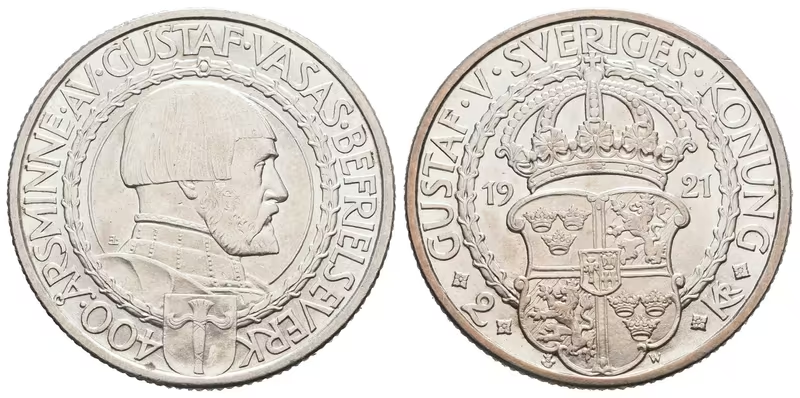
- Code: SSVED96-B1921
Švédsko, 2 Koruna 1921
Gustav V. (1907 - 1950) 2 Kronor 1921 W - Gustaf Vasa, 400. výročí Švédské války za osvobození , KM.799, luxusní zachovalost, ražební lesk, patina, nep. rysky
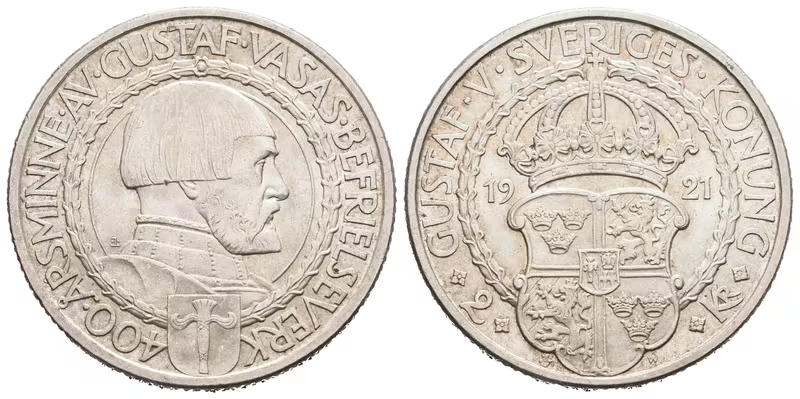
Skladem 1 ks - Code: SSVED96-B1921.1
Švédsko, 2 Koruna 1921
Gustav V. (1907 - 1950) 2 Kronor 1921 W - Gustaf Vasa, 400. výročí Švédské války za osvobození , KM.799, luxusní zachovalost, ražební lesk, patina, nep. rysky
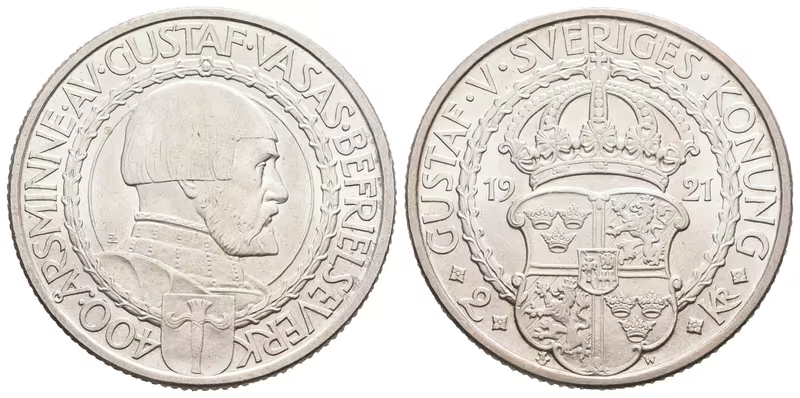
Skladem 1 ks - Code: SSVED96-B1921.2
Švédsko, 2 Koruna 1921
Gustav V. (1907 - 1950) 2 Kronor 1921 W - Gustaf Vasa, 400. výročí Švédské války za osvobození , KM.799, luxusní zachovalost, ražební lesk, patina, nep. rysky
Skladem 1 ks