John Philip of Saxe-Altenburg
John Philip of Saxe-Altenburg (German Johann Philipp von Sachsen-Altenburg) was born on 25 January 1597 in Torgau as the eldest surviving son of Duke Frederick William I of Saxe-Weimar and his second wife Anna Maria of Palatinate-Neuburg. By order of birth he was the fourth son, but the only one of the first three siblings to reach adulthood.
When his father died in 1602, John Philip was only five years old. Guardianship over him and his younger brothers Frederick, John William and Frederick William was taken up by his uncle John of Saxe-Weimar, who however was more interested in the natural sciences and the arts than in politics. Already in the following year, 1603, the young prince forced through a division of the family holdings. Under the partition treaty John Philip together with his brothers received Altenburg and several other towns, while his uncle John kept Weimar and Jena. Thus the Duchy of Saxe-Altenburg came into being.
Because the brothers were still minors, the regency was exercised first by the Saxon Elector Christian II (1603–1611) and after him by his brother and successor John George I (1611–1618). Only in 1618 was John Philip, as the eldest of the brothers, declared of age and took over the rule of the duchy. At the same time he assumed guardianship over his younger siblings. All four brothers formally co-ruled, which was also reflected in the coinage of the duchy.
Two of the brothers died childless during John Philip's lifetime: Frederick fell in battle in 1625 during the Thirty Years' War, and John William died in 1632 in Brzeg. From then on only John Philip and the youngest Frederick William II continued in the joint rule, with effective power held by John Philip until his death.
In addition to political activity, John Philip also devoted himself to intellectual interests. In 1613 he was appointed Dean of the University of Leipzig. He also became an active member of the Fruchtbringende Gesellschaft (Fruitbearing Society), the most important German linguistic association of the seventeenth century, which sought to cultivate the German language.
Family and descendants
In 1638, under a partition treaty following the extinction of the Saxe-Eisenach line, John Philip received the towns of Coburg, Bad Rodach, Römhild, Hildburghausen and Neustadt. Before his death he drew up a will in which he appointed his daughter Elisabeth Sophie heir to the Altenburg line in the event of the extinction of the male descendants. This provision later led to disputes between the Saxe-Gotha and Saxe-Weimar branches.
John Philip of Saxe-Altenburg died on 1 April 1639 in Altenburg at the age of 42. He was succeeded by his younger brother Frederick William II. The Duchy of Saxe-Altenburg existed independently until 1672, when after the death of Frederick William III it passed to the Saxe-Gotha line.
On 25 October 1618 in Altenburg, John Philip married Elisabeth of Brunswick-Wolfenbüttel, the widowed sister-in-law of his former regents — the Saxon Electors Christian II and John George I. From the marriage came a single daughter:
Elisabeth Sophie (10 October 1619 – 20 December 1680), who on 24 October 1636 married Duke Ernest I of Saxe-Gotha. She thus became the founder of the Gotha line of the Wettins, from which descended the later rulers of Belgium, Bulgaria, Portugal, and through Prince Albert also the British royal family.
Coinage of the Duchy of Saxe-Altenburg
During the rule of John Philip and his brothers, a number of remarkable strikes came into being at the Saalfeld Mint, which belong to the most interesting examples of German coinage in the first half of the seventeenth century. The mint master from 1612 to 1632 was Wolf Albrecht the Younger of Coburg, whose initials WA appear on the coins.
A characteristic feature of Altenburg coinage is the depiction of all co-ruling brothers on a single coin — the so-called "thalers of the four brothers" (Vier-Brüder-Taler). On the obverse of these thalers is the bust of John Philip in armour with a sash and plumed helmet, on the reverse the busts of his three younger brothers. This type of joint strike followed an older Saxon tradition, in which all co-rulers of the House of Wettin were depicted on coins.
The thalers were struck in the period 1618–1625, when all four brothers were alive. After the death of Frederick in 1625, a commemorative mourning strike was issued. In the later period 1625–1632 strikes with three brothers continued, and after 1632 only with John Philip and Frederick William II. From this period also come gold ducats struck at Saalfeld in 1637–1638.
Altenburg thalers have a diameter of approximately 42–43 mm and a weight of around 28.5–29 grams of silver. They are listed in the Davenport catalogue under numbers 7367–7373. For collectors they represent an attractive example of portrait strikes from the period of the Thirty Years' War and document the complex dynastic relations between the Saxon duchies.
In our auction and shop
- Code: XB-1585
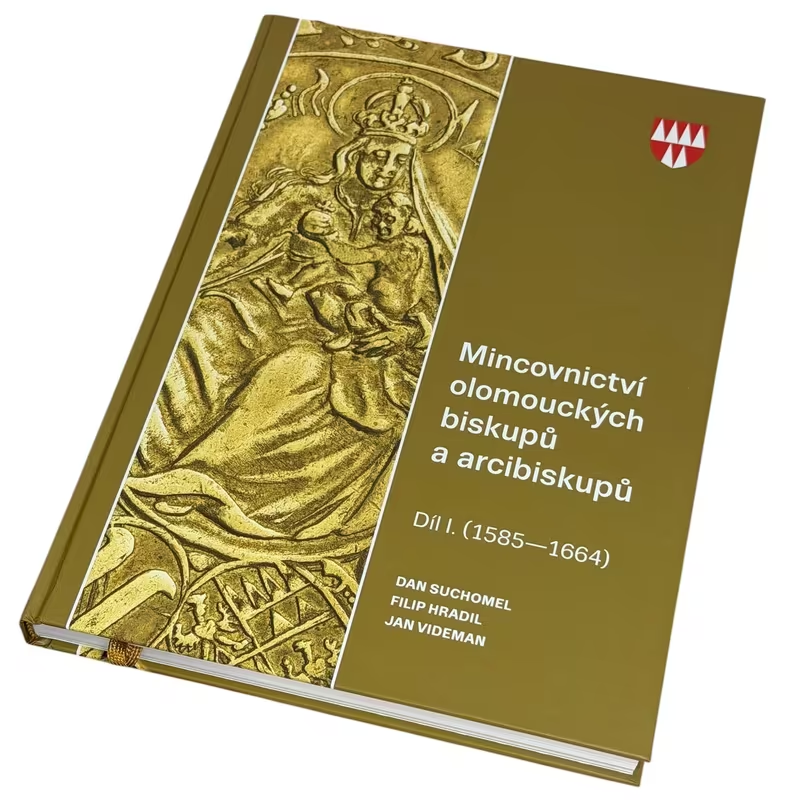
Mincovnictví olomouckých biskupů a arcibiskupů, I. díl
Dan Suchomel, Filip Hradil, Jan Videman Mincovnictví olomouckých biskupů a arcibiskupů, díl I. (1585 - 1664) Praha 2026, 236 stran a vyobrazení, vázané, nové! Publikace tematicky navazuje na oblíbený a obtížně sehnatelný sběratelský katalog z pera…
Skladem (>5 ks)