Charles I of Brunswick-Wolfenbüttel
Charles I of Brunswick-Wolfenbüttel was Prince of Brunswick-Wolfenbüttel (1735–1780) from the Welf family (Bevern line), known as an Enlightenment-oriented ruler and patron. He supported learning and institutions in Brunswick and Wolfenbüttel, and his era is visible also in the coins of the time.
Charles I of Brunswick-Wolfenbüttel was born on 1 August 1713 in Brunswick as the son of Ferdinand Albrecht II and Antoinette Amalia of Brunswick-Wolfenbüttel. He belonged to the Bevern branch of the Welfs, which in the 18th century held rule in the Brunswick-Lüneburg circle. After his father's death he succeeded in 1735 as Prince (often called "Duke" in German sources) of Brunswick-Wolfenbüttel and reigned until his death on 26 March 1780, again in Brunswick. His long reign falls within a period when European states were striving to modernise administration, education and the economy, while at the same time facing costly conflicts and shifts in international politics.
Charles I is a typical representative of Enlightenment princely patronage. A ruler in this period did not strive only for courtly representation, but also wished his country to appear as a cultivated and "useful" whole: supporting education, the sciences and institutions which trained officials and specialists for the administration of the state. In this spirit the Collegium Carolinum was founded in 1745, an educational establishment between gymnasium and university, considered the predecessor of today's Technical University of Braunschweig. Such an institution had a practical purpose: it provided the education needed for a modern state apparatus, for technical fields and for craft and economic practice, and at the same time increased the prestige of the country.
The Enlightenment image of the ruler was strengthened also by his support of libraries and learning. In the milieu of Wolfenbüttel and Brunswick a court culture and library tradition had long developed, functioning both as a centre of learning and as an instrument of representation. Charles I belonged to those rulers who understood the importance of specialists, administrators and learned men: a good institution was meant not only to be an "ornament" but also a source of expertise and prestige. It is characteristic of the 18th century that similar projects relied on a network of courts, scholars and officials, and it was precisely this infrastructure that created the space for long-term reforms.
History
Politically, Charles I lived in a period when the smaller German principalities moved between the interests of the great powers. Within the Holy Roman Empire it was important to maintain the stability of the country, protect its economy and at the same time not to be lost in competition with bigger players. This was reflected in fiscal and administrative practice: the ruler needed predictable revenue, functioning offices, control over coinage and the ability to respond to market fluctuations and to extraordinary expenditure. Charles I thus stands at the boundary of two worlds: still a Baroque court and traditional dynastic representation, but already a more modern state investing in education, administration and "useful" institutions.
In dynastic continuity Charles I was also significant because rule passed after him to his son Charles William Ferdinand, known from later European history as a Prussian field marshal and an important military figure. Charles I nevertheless remains above all a ruler of a long, relatively stable period when the Brunswick area sought to keep pace with modernisation while at the same time cultivating a cultural setting that is still reflected in local institutions today.
For numismatics Charles I is interesting as a coining lord of the 18th century, when in the German lands silver and gold denominations were struck within a complex, regionally varied monetary environment. The coins of this period usually bore the ruler's portrait, titulature and the country's emblems, because the coin was the everyday testimony of legitimacy and state authority. Among Brunswick strikings various silver values appear, used both for everyday payment and for larger transactions; the specific typology depends on the country's coinage customs and the standards of the day.
Coins, symbolism and legacy
In practice, with the coins of Charles I one looks above all at year of issue, mint, metal, weight standard and of course the image and legend. The ruler's portrait is usually a key determining feature, but small details of the legend and the execution of arms are equally important, as it is precisely these that may distinguish individual issues and periods. The 18th century saw the increasing introduction of mechanical strikings and quality control, so that on many coins an effort towards regular form and legibility is visible, even though local practice could bring differences between individual series.
Charles's legacy, alongside the coin strikings, is most readable in institutional memory: the Collegium Carolinum (1745) shows the typical Enlightenment model in which a ruler strengthens the state through education and expertise. Such projects often outlive their founder's lifetime and form a stable "long trace" of a reign that is sometimes more important than one-off political episodes. For collectors and for those interested in history, Charles I is therefore a figure in whom the story of a ruler is naturally bound up with coins, institutions and the cultural heritage of the Brunswick region.
In our auction and shop
- Code: MCZ118-PROOF
500 Kč 2018 - Washingtonská deklarace, PROOF
Česká republika (1993 - ) 500 Koruna 2018 - 100. výročí Washingtonské deklarace, autor Jakub Orava, Aurea C218, etue, certifikát, PROOF Ag 0,925, 40 mm (25 g), raženo 5 000 ks (běžná kvalita), 9 700 ks (proof) Washingtonská deklarace (původním názvem…
Skladem (>5 ks) - Code: FA-234A.1
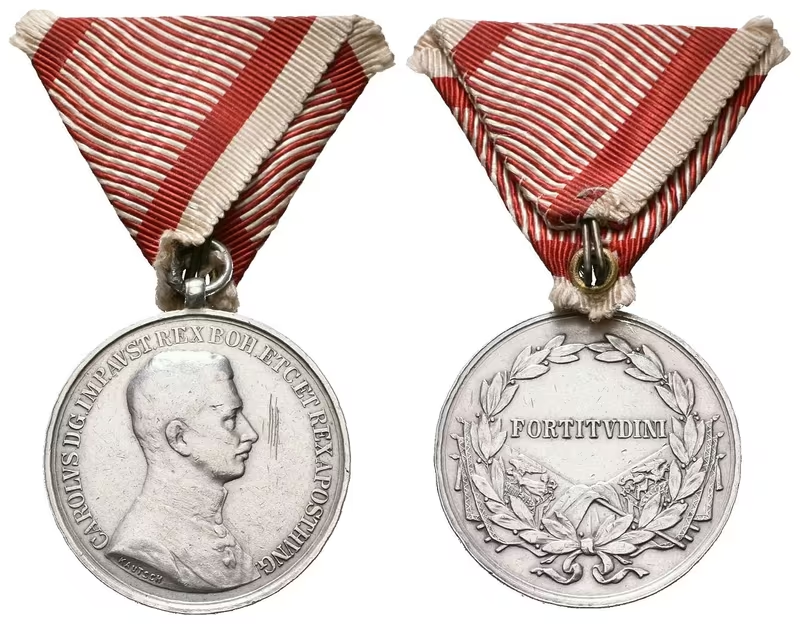
Medaile za statečnost, stříbrná, I. třída
Rakousko - Uhersko / Rakouské císařství Medaile za statečnost, stříbrná medaile, I. třída, IX. vydání 1917 - 1918, Karel, stříbro, signováno KAUTSCH, puncováno na hraně "A", Marko 234a Patina, škr. a hranky
Skladem 1 ks - Code: FA-234A
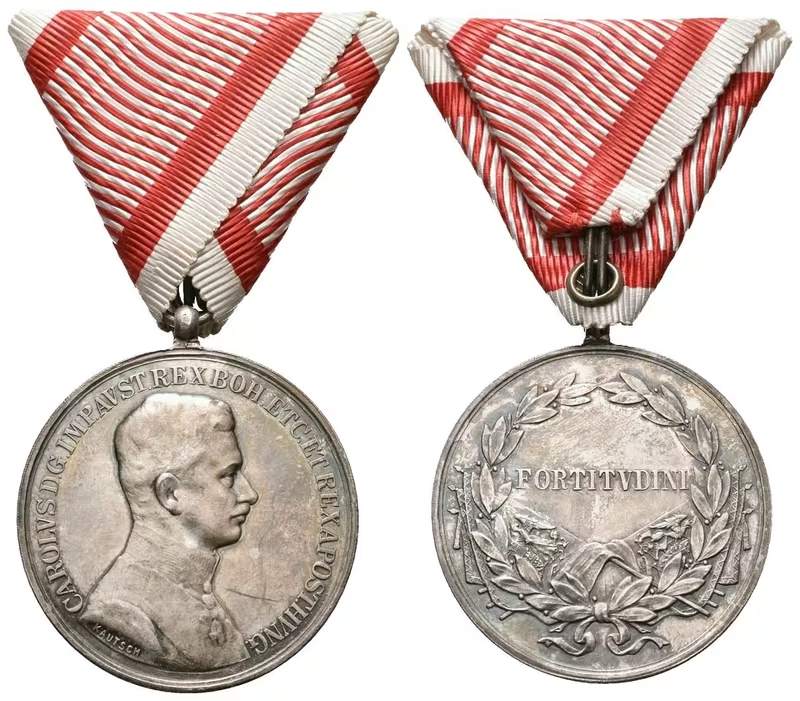
Medaile za statečnost, stříbrná, I. třída
Rakousko - Uhersko / Rakouské císařství Medaile za statečnost, stříbrná medaile, I. třída, IX. vydání 1917 - 1918, Karel, stříbro, signováno KAUTSCH, nepuncováno, Marko 234a Krásná zachovalost, zbytky lesku, patina, rysky
Skladem 1 ks - Code: RAWEIN-1915
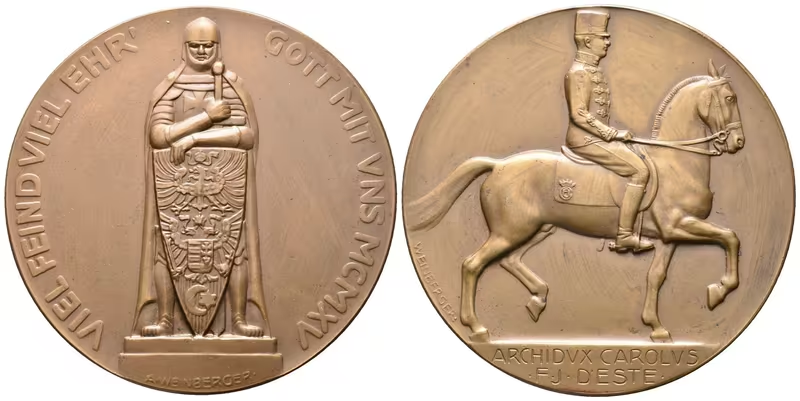
Weinberger Anton Rudolf -Arcivévoda Karel d’Este
Weinberger Anton Rudolf (1879 - 1936) AE Medaile 1915 - Arcivévoda Karel d’Este na koni vpravo, nápis / Stojící rytíř s mečem a štítem, opis. Bronz 60 mm
Skladem 1 ks