Leu
The leu is the national currency of Romania and Moldova; its name comes from the old designation of Dutch thaler coins bearing a lion, which circulated in the Danubian Principalities from the 17th century. In numismatics the Romanian leu represents an interesting chapter of Balkan coinage with a rich history of denominational reforms, and gold and silver…
The origin of the name leu reaches back to the 17th century, when in Wallachia and Moldavia the Dutch lion thalers known as "leeuwendaalder" circulated, from which the Romanian designation leu, meaning lion, arose. These quality silver coins became a favoured means of payment in the trade of the Danubian Principalities with the Ottoman Empire and gradually displaced Turkish and Austrian coins. The first attempts to create a Romanian currency of their own appeared after the unification of Wallachia and Moldavia in 1859 under the rule of Alexandru Ioan Cuza, but only the gaining of independence in 1877 made it possible to introduce a national currency.
The first Romanian leu was officially introduced on 22 April 1867 according to the standards of the Latin Monetary Union, with one leu corresponding to the French franc and containing 4.5 grams of pure silver. The first coins were struck at the mints in London, Paris and Brussels, since Romania did not yet have its own mint. The Romanian leu was divided into 100 bani and existed in silver denominations of 50 bani, 1, 2 and 5 lei; later, gold coins in denominations of 20 and 100 lei were added on the model of the French napoleondors. Romania's own mint in Bucharest began operating only in 1880, under the reign of King Carol I of Hohenzollern.
History
The interwar period brought the first serious crisis for the leu: the First World War and the country's occupation by the Central Powers led to hyperinflation. In 1929 the leu was stabilised and pegged to gold, but the economic crisis of the 1930s and the Second World War caused further depreciation. After the establishment of the communist regime in 1947, the first monetary reform was carried out at a ratio of 20,000 old lei to one new leu. The communist era was characterised by the gradual debasement of the currency and by limited convertibility: the official exchange rate was artificially maintained, while on the black market the leu was traded at a fraction of its official value.
After the fall of the Ceaușescu regime in 1989 Romania faced high inflation, reaching hundreds of percent annually. Democratic governments tried to stabilise the currency, but only in 2005 was a redenomination carried out at a ratio of 10,000 old lei to one new leu, designated RON. The modern leu is freely convertible and Romania has committed to adopting the euro after meeting the convergence criteria. Current banknotes and coins depict significant figures of Romanian history and culture, including the poet Mihai Eminescu and the composer George Enescu.
The coin system and variants
The historical Romanian leu went through several redenominations and reforms. The original silver coins from the period of the kingdom contained the standard amount of silver according to the Latin Monetary Union: the five-leu piece weighed 25 grams at a fineness of 900/1000. The gold twenty-lei pieces contained 6.45 grams of gold and were equivalent to the French napoleondor. After the Second World War the country switched to aluminium and steel coins with surface treatment.
The Moldovan leu, introduced in 1993 after Moldova gained independence, is a separate currency, although it shares its name and historical roots with the Romanian leu. It is divided into 100 bani and uses a similar system of denominations. Current Romanian coins in denominations of 1, 5, 10 and 50 bani are struck from steel with various surface treatments, while commemorative coins are struck from silver and gold.
In our auction and shop
- Code: YLEA-338881
Lupa kapesní 10x, LED + UV Leuchtturm LU32
Leuchtturm LU32 – Precizní skládací kapesní lupa O bjevte kvalitu a preciznost německé tradice s kapesní lupou LU32 od renomovaného výrobce Leuchtturm, který má 90 let zkušeností v oblasti sběratelských potřeb. Tato elegantní skládací lupa nabízí 10×…
Skladem (>5 ks) - Code: YL-322779
Nobile - Etue na 1x Quadrum - Leuchtturm
Systém Nobile - Etue z kovu potažená koženkou - představuje cenově optimální řešení. Vnitřní část víka je obložena vybraným saténem se stužkou, která přispívá k optimální mincí proti mechanickému poškození. Pojme kapsle Quadrum – modulární systém.
Skladem (>5 ks) - Code: YLEV-339043
Volterra - Etue na 1x Quadrum - Leuchtturm
Volterra představuje řešení inspirovaní klasickým designem. Dřevo immitující mahagon. Pojme kapsle Quadrum – modulární systém. Etue je vybavena vnitřním saténovým obložením a saténovými stužkami, které umožňují bezpečné uložení certifikátů či dalších…
Skladem (>5 ks) - Code: YL-100254
Ochranný obal na bankovky BASIC Plus 215 (215 x 140 mm) - Leuchtturm
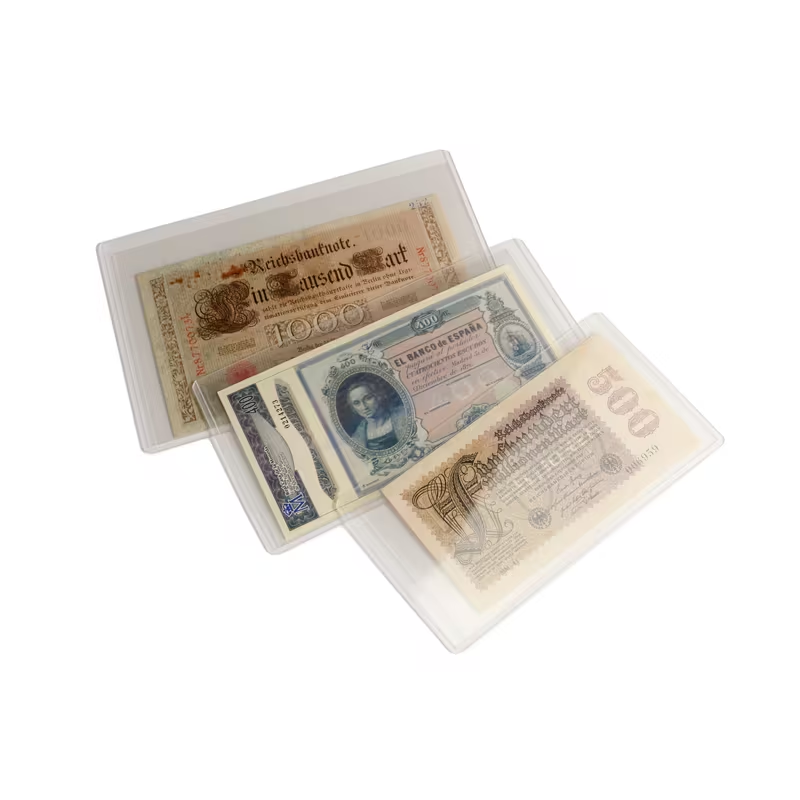
Pevný průhledný obal Leuchtturm BASIC Plus 215 (Toploader) na bankovky do rozměru 215 x 140 mm . Vnější rozměr 223 x 144 mm. Svařeno na 3 stranách, otevřeno nahoře na delší straně s přesazeným okrajem pro snadné vkládání. Tvrdé PVC 100 % bez kyselin a…
Skladem (>5 ks)