Mahatma Gandhi
Mahatma Gandhi, born Mohandas Karamchand Gandhi, was an Indian lawyer, philosopher and leader of the Indian independence movement, who lived from 1869 to 1948 and advocated non-violent resistance against British rule. He has appeared on Indian coins of all denominations since 1969; the Gandhi rupees and commemorative strikes represent the most widespread…
Mohandas Karamchand Gandhi was born on 2 October 1869 in the port city of Porbandar in Gujarat into a Hindu family of the merchant caste. His father Karamchand was the dewan, the chief minister, of a small princely state, and his mother Putlibai was a deeply pious woman whose religious devotion fundamentally influenced Gandhi's later philosophy. At the age of thirteen he was, according to tradition, married to Kasturba, who was the same age, with whom he later had four sons. In 1888 he sailed to London to study law at University College, where he first encountered Western culture and Christianity, but also deepened his devotion to Hinduism and to vegetarianism.
After completing his studies and a brief unsuccessful attempt at legal practice in Bombay, Gandhi accepted in 1893 an offer to work for an Indian firm in South Africa. It was there that he experienced racial discrimination, which prompted him to political activity. During twenty-one years in South Africa he developed the concept of satyagraha — non-violent resistance based on truth and moral force. He led campaigns against discriminatory laws, organised strikes and protest marches, for which he was imprisoned several times. His successes in South Africa, including the abolition of certain discriminatory laws, made him a well-known figure throughout the British Empire.
History
After his return to India in 1915, Mahatma Gandhi gradually became the undisputed leader of the independence movement. He took over the leadership of the Indian National Congress and transformed it from an elite organisation into a mass movement. His campaigns of non-violent resistance included a boycott of British goods, the Salt March of 1930, which challenged the British salt monopoly, and the Quit India movement during the Second World War. Gandhi was imprisoned repeatedly, spending a total of nearly seven years in prison, but his moral authority grew with every arrest. He promoted the unity of Hindus and Muslims, fought against untouchability and strove for the self-sufficiency of Indian villages.
Gandhi's greatest triumph, the achievement of Indian independence on 15 August 1947, was at the same time his most tragic moment, on account of the partition of the country into India and Pakistan, accompanied by mass violence. Gandhi, who opposed the partition, spent the day of independence in a protest fast in Calcutta, where he sought to stop the communal violence. His efforts for Hindu–Muslim reconciliation provoked the hatred of Hindu extremists. On 30 January 1948 Gandhi was shot dead by Nathuram Godse during the evening prayer in Delhi. His last words were "Hé Ráma", an invocation of the god Rama.
Gandhi on Indian coins
The first coin with Gandhi's portrait was issued in 1969 on the occasion of the centenary of his birth. Since then his depiction has become a standard element of Indian coinage. Modern Indian rupees of all denominations from 50 paise to 20 rupees bear Gandhi's smiling portrait in his characteristic round spectacles. The design, made from a photograph of 1946, has become one of the most recognisable numismatic portraits in the world.
The Indian government regularly issues commemorative coins to mark important anniversaries of Gandhi's life — his birth, the Salt March, the Quit India movement and his death. Special collectors' editions in gold and silver often depict various aspects of his life, including the spinning wheel, which became a symbol of self-sufficiency, or his famous sayings in Devanagari and English. It is worth noting that Gandhi himself was opposed to being depicted and venerated, but his numismatic presence has become a symbol of Indian national identity.
In our auction and shop
- Code: ZSSEY-L2013
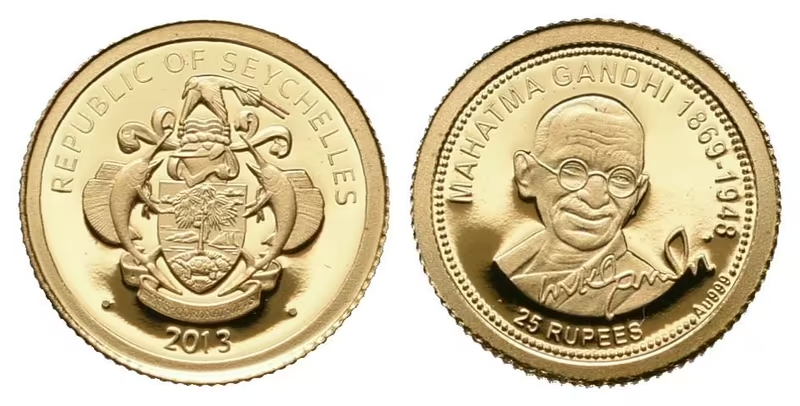
Seychelles, 25 Rupees 2013 - Mahátma Gándhí
Republic of Seychelles 25 Rupees 2013 - Mahátma Gándhí Au 0,9999, 11 mm (0,5 g), kapsle, PROOF Z cyklu Nejmenší zlaté mince světa