Copper
Copper is a soft reddish metal with a melting point of approximately 1084 °C and a density of around 8.94 g/cm³. In coinage it is, after silver, among the most frequently used metals — either directly or, more often, in alloys that are harder and better resistant to circulation.
Copper has accompanied human civilisation from prehistoric times, since it can be found in nature even in pure form and at the same time is relatively easy to process. With the development of metallurgy it became one of the basic metals not only for tools and weapons but also for trade and later for monetary circulation. In numismatics, copper has a particular position: it is sufficiently widespread and malleable to be used for the manufacture of smaller denominations in large quantities, and at the same time striking enough through its colour and patina, which on older mintages often becomes a typical recognising feature.
The oldest copper coins appeared in antiquity, when in the Greek environment copper mintages were already struck in the 5th century BC. Rome, in turn, knew heavy cast copper currency at the time of the Roman Republic, especially in the 4th century BC, when copper (and bronze and copper mixtures more generally) was applied as a practical material for robust forms of means of payment. These early traditions show that copper was perceived in monetary practice as a metal suitable for ordinary transactions and for broader strata of the population, while precious metals remained reserved for higher values.
In the Czech lands, copper was long used in coinage primarily as an additive in alloys with silver. Medieval practice envisaged that precisely defined proportions of other metals were mixed into the silver coinage raw material; in period terminology one also encounters concepts for officially established ratios and procedures of metal preparation. Copper was often delivered to production in the form of small granules, and its "conversion" into this form was provided by specialised craftsmen in separate workshops. This was no minor matter: the uniform dosing of copper helped to maintain the quality of the alloy and thereby trust in the coin.
History
The extraction of copper took various forms. It was mined separately from copper ores, but could also arise as a by-product of mining silver ores. In such cases, the smelted copper sometimes still contained residual amounts of silver. In the historical environment, a distinction was drawn between copper "with admixture" and copper purified of other metals — the difference was not only technical but also economically sensitive, since raw material containing silver represented a potential loss for the sovereign or the holder of mining rights. It is therefore not surprising that special regulatory measures could be attached to such material, for example restrictions on export.
As regards domestic copper mintages, early examples mentioned are small coins associated with Hussite centres, especially Prague and Tábor. On a larger scale, copper then asserted itself prominently in the so-called counting tokens (jetons) and similar mintages, which appeared in considerable quantities from the reign of Ferdinand I and originated in various mints — not only in Prague and Kutná Hora but also in other regions including southern Bohemia and Jáchymov (Joachimsthal), and exceptionally in some family mints. From the point of view of monetary circulation, an important milestone is the introduction of copper circulation denominations in the 18th century, when in our lands greschels appeared and shortly afterwards also copper kreuzers. By this, copper was permanently included among the metals from which the smallest values were struck, and various functional tokens or small forms of means of payment were gradually also made from it.
In pure form copper is relatively soft, and therefore for ordinary coinage circulation it is more often used in alloys. Admixtures increase hardness, resistance to wear and stability of the surface, so that coins better withstand long-term circulation. Among the most common copper-based alloys belong bronze (copper with an admixture of tin), brass (copper with zinc) and tombac (copper with a smaller share of zinc), which differ in colour, hardness and behaviour during striking. In practice, the choice of alloy depended on the desired appearance, the cost of the raw material and on how long a particular denomination was to last in circulation.
Coinage use and alloys
Historical coinage also knew mixtures that combined copper with silver. In the ancient and later environment, one encounters the term billon, that is, an alloy in which silver is present in a smaller proportion and the rest is composed predominantly of copper. Such mixtures made it possible to strike coins "of the silver type" with lower intrinsic value, which was important for state finances and for covering the need for medium denominations. In the modern period, other copper alloys were also applied, for example aluminium bronzes, which can offer good resistance and a striking colour, and are therefore suitable for small change and commemorative mintages.
Thanks to its colour and chemical properties, copper is characterised by the formation of patina. It can range from brown to green hues, and on older coins often reveals storage conditions and the long-term action of the environment. Numismatic practice therefore looks not only at the motif itself and the state of preservation of the strike, but also at the character of the surface, since copper and copper alloys can "age" very differently.
In our auction and shop
- Code: ZD-3003MAS
Medaile b.l. - Největší Češi - Tomáš Garrigue Masaryk
Česká republika (1993 - ) Cyklus medailí Největší Češi Medaile b.l. (2014) - Tomáš Garrigue Masaryk Au 0,585, 11 mm (0,5 g), PROOF
Skladem 1 ks - Code: FA-234A.1
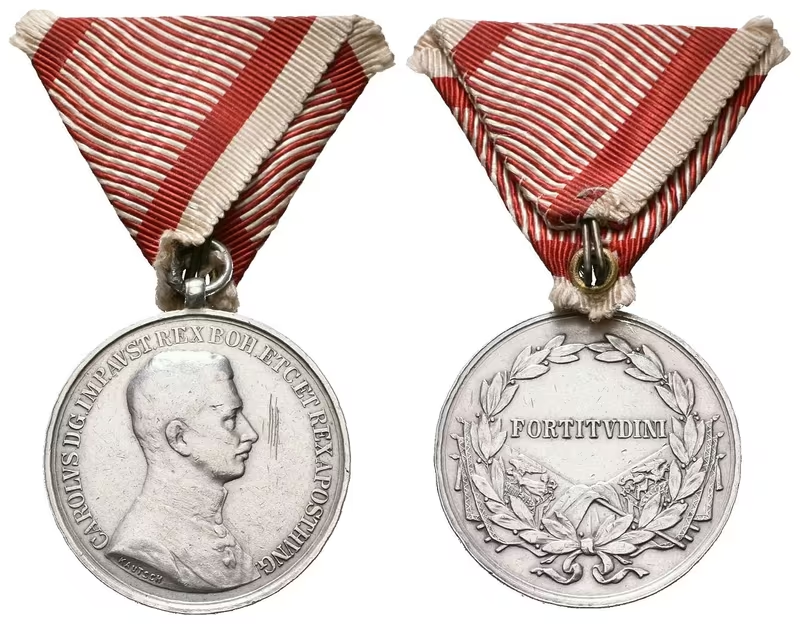
Medaile za statečnost, stříbrná, I. třída
Rakousko - Uhersko / Rakouské císařství Medaile za statečnost, stříbrná medaile, I. třída, IX. vydání 1917 - 1918, Karel, stříbro, signováno KAUTSCH, puncováno na hraně "A", Marko 234a Patina, škr. a hranky
Skladem 1 ks - Code: FA-234A
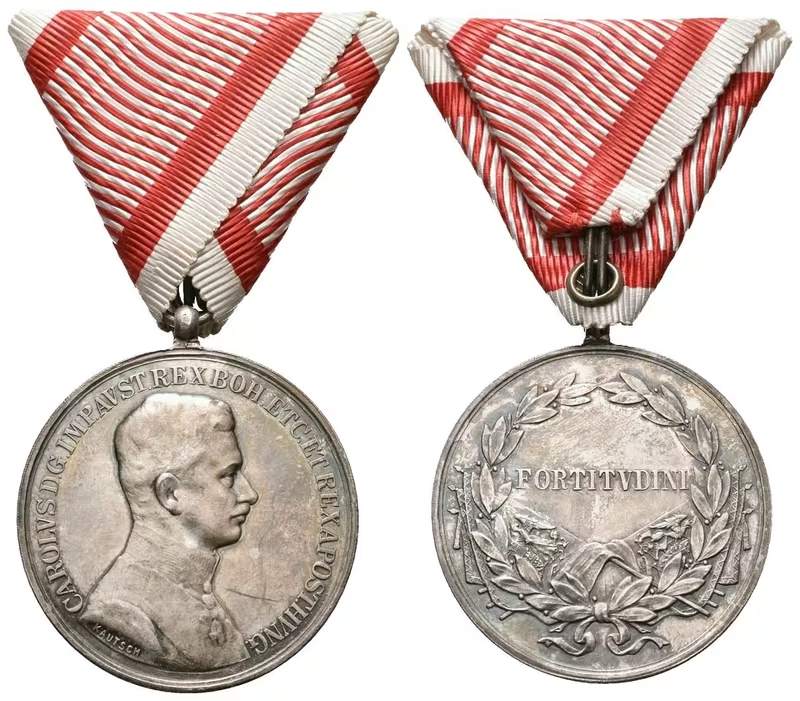
Medaile za statečnost, stříbrná, I. třída
Rakousko - Uhersko / Rakouské císařství Medaile za statečnost, stříbrná medaile, I. třída, IX. vydání 1917 - 1918, Karel, stříbro, signováno KAUTSCH, nepuncováno, Marko 234a Krásná zachovalost, zbytky lesku, patina, rysky
Skladem 1 ks - Code: FA-235D
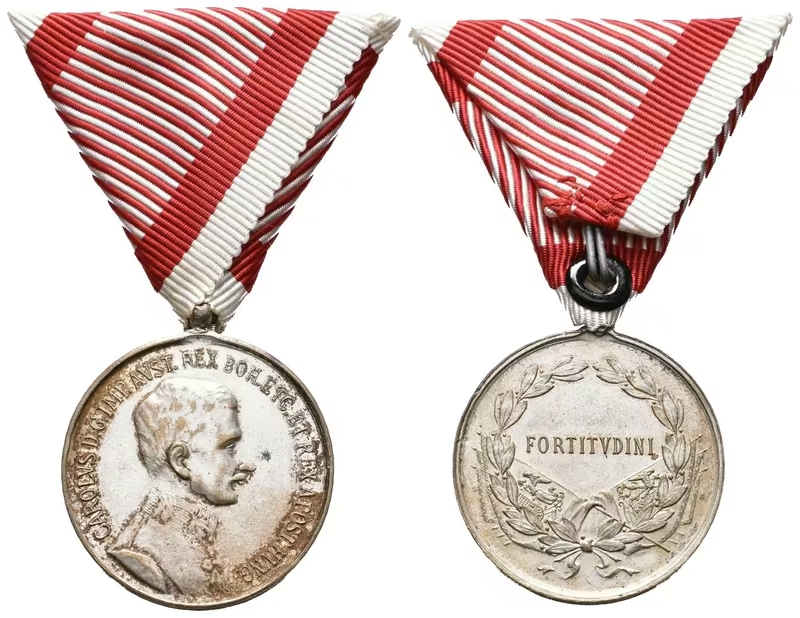
Medaile za statečnost, II. třída, postříbřená
Rakousko - Uhersko / Rakouské císařství Medaile za statečnost, stříbrná medaile, II. třída, IX. vydání 1917 - 1918, Karel, válečný kov stříbřený/pocínovaný, nesignováno, Marko 235d Pěkná zachovalost, patina, zbytky lesku, drobné rysky
Skladem 1 ks