Tarentum Mint
The Tarentum Mint denotes the coinage of the Greek city of Taras (Roman Tarentum, today's Taranto) in southern Italy. It became famous especially for the silver nomos (didrachm) with a rider on horseback and the hero Taras on a dolphin, which is among the icons of ancient numismatics.
The Tarentine mint belongs to the most important minting centres of the Greek West in the area of Magna Graecia. Taras arose as a Spartan colony at a strategic location on a wide bay in the "instep" of the Apennine Peninsula. The advantageous harbour, trade contacts throughout the Ionian and Adriatic seas, and a prosperous agricultural hinterland created the conditions for intensive monetary circulation - and thereby for extensive and long-lasting coin production.
The most typical and, for collectors, most famous Tarentine issue is the silver nomos (in the literature often also didrachm or stater). This "trade" denomination was struck at Taras from the turn of the 6th and 5th centuries BC and for a long time maintained a stable weight standard of around 7.8 g. It was precisely this stability, together with the high artistic level of the engraving, that helped Tarentine coins gain trust in long-distance trade. Around the turn of the 4th and 3rd centuries BC, however, the standard gradually changed, and around 280 BC a reduction in weight to approximately 6.6 g is documented, which is usually associated with the transformation of political and economic conditions in southern Italy and with the growing influence of Rome.
The iconography of Tarentine coins is exceptionally rich and at the same time surprisingly coherent. On the obverse a horseman appears for centuries in various variants: he may hold a spear, a shield, a wreath, sometimes he is accompanied by the goddess of victory, or a sporting or military scene plays out. The reverse is the "signature" of the city: a young man (Taras or Phalanthos according to the tradition of the founder) rides on a dolphin, often with a trident, a kantharos or another symbol of the sea and prosperity. It is precisely the connection of horse and dolphin that created one of the most recognisable "marks" of the ancient world and at the same time reflects local identity - Taras was a city of riders and of seafarers.
History
The mint was not restricted to silver alone. In various periods it also struck bronze coins for local circulation, and exceptionally one may also encounter more valuable denominations. From a numismatic point of view, Tarentum is also fascinating in that the names of officials (magistrates) and sometimes also the marks of engravers often appear on the coins. This allows for a finer chronology: Tarentine issues can be divided according to style, abbreviations and control marks into a series of periods which respond to political events as well as to the needs of the market.
In the 3rd century BC, Taras was struck by conflicts with Rome, and an important chapter is represented by the events associated with Pyrrhus, king of Epirus, who came to the city's aid. The wartime tension and exceptional financial demands could have been reflected both in the volume of striking and in shifts in weight standards. After the conquest of Tarentum by Rome in 272 BC, the city was gradually incorporated into the Roman sphere of power. Coinage of the Greek type still continued for some time, but in the long horizon Tarentine monetary practice adapted itself to Roman standards and other forms of currency took over the role. Even so, the "classical" Tarentine nomoi of the 5th to 3rd centuries BC have remained an enduring symbol of the advanced minting culture of Greek Italy.
The Tarentum Mint is well recognisable to collectors thanks to the basic pair of motifs: the horseman (obverse) and Taras on the dolphin (reverse). In detail, however, there exist tens to hundreds of variants which differ in the rider's equipment, the horse's position, accompanying symbols, inscriptions and marks. Frequent are the Greek legend TARAS and also abbreviations or monograms which may refer to the responsible official or to the control of the issue. With later issues, the names of magistrates written out in full or abbreviated appear, which is valuable for more precise dating.
Issues, marks and identification of coins from Tarentum
From a practical point of view, a combination of several features helps in identification: (1) weight and diameter - whether they correspond to the "heavier" issues around 7.8 g or to the later reduced ones around 6.6 g; (2) style of engraving - earlier pieces tend to be stricter, while the classical 4th century BC often stands out for an exceptional quality of relief; (3) specific symbols and monograms which can be compared with catalogues and auction archives. With Tarentine coins, uneven striking of details is also common, because blanks and dies changed over time and the relief tends to be high. In sum, however, Tarentum offers ideal "textbook" material: at one mint one can follow the development of style, economic pressures and the way in which civic identity was consistently reflected in metal.
In our auction and shop
- Code: XB-1000
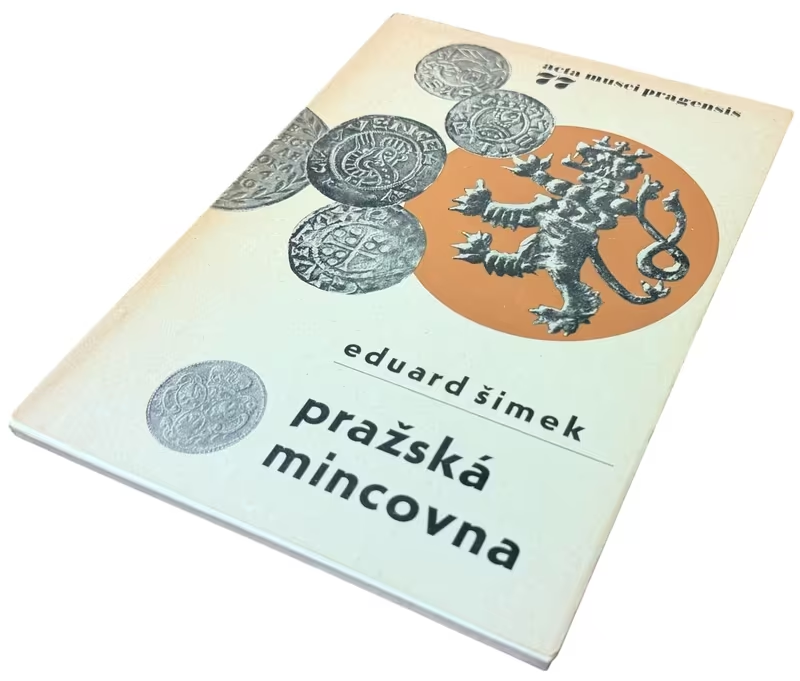
Pražská mincovna
Šimek, Eduard Pražská mincovna devět století české mince - katalog výstavy Praha 1977, 38 stran a 48 stran vyobrazení, brožované, pěkná zachovalost
Skladem 1 ks - Code: MC138-PROOF6
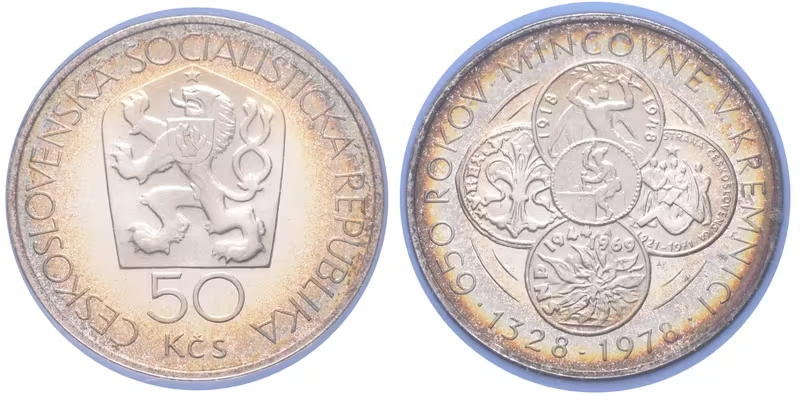
50 Kčs 1978 - Mincovna Kremnica, PROOF
Československo (1953 - 1993) 50 Koruna 1978 - 650. výročí mincovny v Kremnici, autor Andrej Peter, Aurea 138, PROOF Ag 0,700, 31 mm (13 g), raženo 70 076 ks (běžná kvalita), 2 708 ks (proof), původní plastová kapsle, patina v ploše - viz foto
Skladem 1 ks - Code: MC138-PROOF5
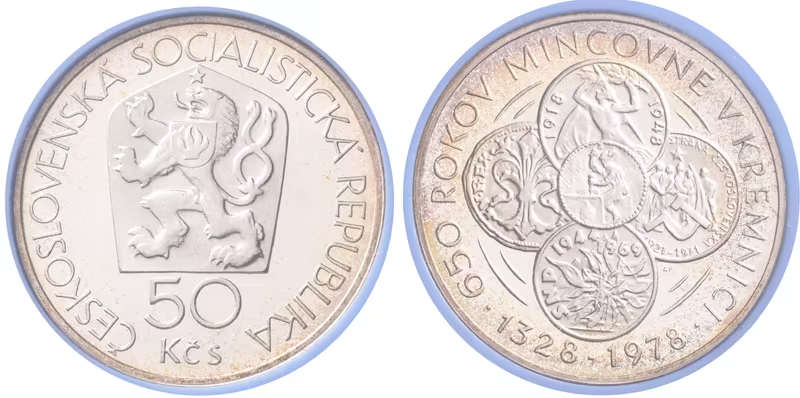
50 Kčs 1978 - Mincovna Kremnica, PROOF
Československo (1953 - 1993) 50 Koruna 1978 - 650. výročí mincovny v Kremnici, autor Andrej Peter, Aurea 138, PROOF Ag 0,700, 31 mm (13 g), raženo 70 076 ks (běžná kvalita), 2 708 ks (proof), původní plastová kapsle, patina v ploše - viz foto
Skladem 1 ks - Code: MC138-PROOF4
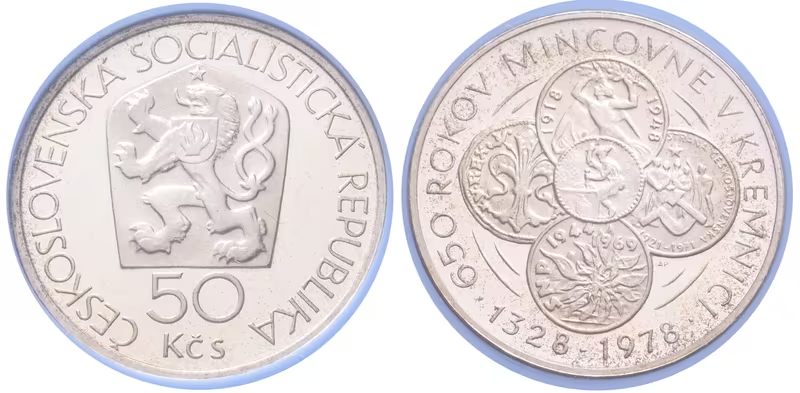
50 Kčs 1978 - Mincovna Kremnica, PROOF
Československo (1953 - 1993) 50 Koruna 1978 - 650. výročí mincovny v Kremnici, autor Andrej Peter, Aurea 138, PROOF Ag 0,700, 31 mm (13 g), raženo 70 076 ks (běžná kvalita), 2 708 ks (proof), původní plastová kapsle, patina v ploše - viz foto
Skladem 1 ks