Minting consortia
Minting consortia are associations of financiers, businessmen or banks which, on the basis of a contract, participated in the striking of coins or in the organisation of mint operations. They typically provided the state with metal, production and sometimes also financing, in exchange for a share of the profit and defined rights.
Minting consortia relate to the practice whereby a sovereign or state did indeed hold the right of coinage, but partly "outsourced" the actual production of coins to private capital. In pre-modern Europe it was not unusual that the operation of a mint required significant investment: the purchase of metal, the maintenance of technical equipment, qualified workers and logistics for the transport of ingots and of finished coins. If the state treasury was empty, or if it was necessary quickly to increase the volume of striking, the solution presented itself in the form of contracts with entrepreneurs who had the capital and contacts on the market for precious metals.
Such consortia could have various forms. Sometimes it was a looser association of several investors, at other times a firmly organised group with clearly divided roles (supplier of metal, operator of equipment, merchant ensuring sale and exchange). A common feature was the contractual link with the state authority: a minting consortium usually did not act "on its own" but within a granted concession or lease. The state determined the monetary parameters (denominations, weight, fineness, types) and controlled that the coins corresponded to the norms, while the consortium bore part of the costs and risks.
The economic sense of these arrangements was twofold. For the state, cooperation represented a way to ensure circulating tender quickly and to stabilise the collection of taxes and current payments, without having to release immediately a large volume of cash to purchase metal. For the consortium it was a business opportunity, because in striking, the seigniorage (the difference between the face value of the coin and the costs of metal and production) was realised, along with fees for exchange or other contractually agreed revenues. At the same time, however, it was a sensitive area: as soon as doubts about the quality of the coin arose, this affected not only confidence in the currency, but often also the reputation and financial health of the participants.
History
The role of minting consortia was most pronounced in periods of financial pressure, wars and monetary tension, when it was difficult to maintain stable parameters of circulating tender. In such moments it was shown that private capital could speed up striking, but at the same time a temptation could arise to push for higher profit at the expense of quality. For this reason, over the course of time, the control, the recording of metal and oversight over mints was strengthened. In the long horizon, then, a number of states aimed at centralising coinage more and holding it more directly under state administration, while the consortial model shifted into more marginal or transitional solutions.
Minting consortia in practice ensured chiefly three things: the supply of metal, the striking itself and the release of coins into circulation. The metal was bought on the market or obtained by exchange for other coins, or from the yields of mines and smelters. The consortium often worked with precise weight and fineness regulations, because the credibility of the currency rested upon them. Production took place at a mint which the consortium either operated directly or in which it had contractually secured capacity and personnel. The finished coins then travelled into circulation via the state treasury, exchange offices, suppliers to the army or trade networks.
For collectors it is important that the coin itself usually does not bear the inscription "consortium". Identification stems from the historical context: from who administered the mint in the given period, what contracts were concluded and what mint marks or variants were then used. Indirect guides may also be sudden changes in the volume of striking, in the quality of execution or in the range of denominations, which sometimes correspond to a change of operator or financial model. With some issues, therefore, in addition to the sovereign and the mint, the specific "administrative regime" of the striking is also mentioned in the literature.
How they functioned and how to recognise them in numismatics
The numismatic value of coins associated with consortial operation rests chiefly on two things: on typology and on context. Typologically, they are ordinary state denominations, but the context supplies a "story" - these are coins from a time when the state relied on private capital in order to maintain monetary operation. For collectors specialising in a particular region or sovereign, it is often an interesting supplement, because it allows coins to be understood not only as objects but also as the result of concrete economic and organisational decisions.
In our auction and shop
- Code: YLE-318864
Mincovní plato S-formát - 20 políček 41x41 mm - 2 kusy
Zásuvky s modrým povrchem imitujícím velur pro ukládání mincí. Zapouzdřené mince nebo mince bez obalu lze snadno vložit do čtvercových políček. Plata Formát-S do kufříků na mince CARGO S.
Skladem (>5 ks) - Code: YL-302460
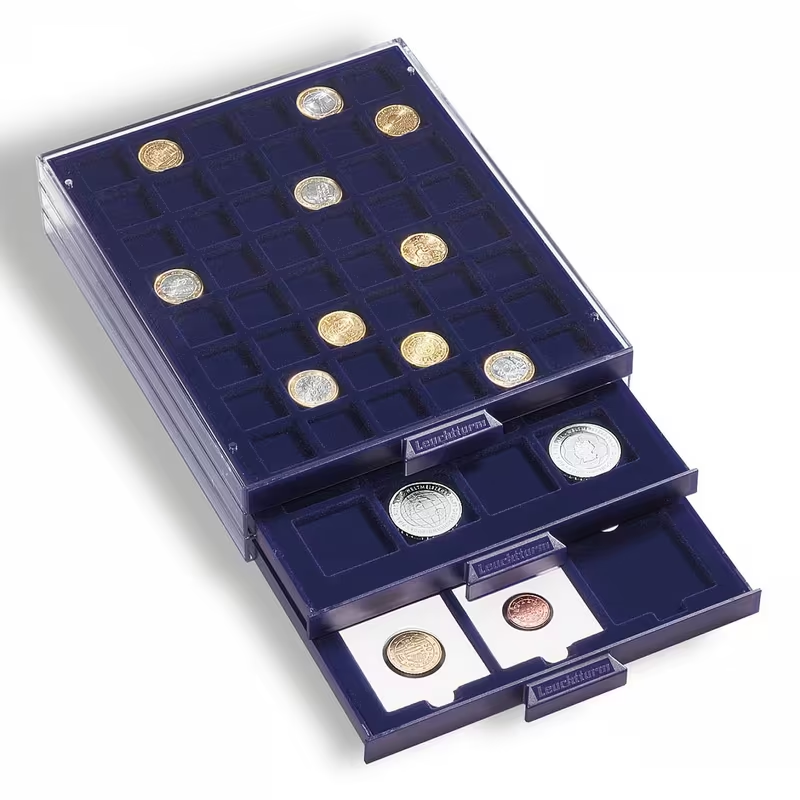
Mincovní box Leuchtturm SMART, stohovatelné plato - 35 polí, 27 x 27 mm
Stohovatelné plato (mincovní box) Leuchtturm SMART — 35 polí, 27 x 27 mm Průhledný zásuvný box s tmavě modrou sametovou vložkou na 35 mincí (pro mince do průměru 27 mm). Vnější rozměr: 250 × 195 × 19 mm.
Skladem (>5 ks) - Code: YL-307053
Mincovní box Leuchtturm SMART, stohovatelné plato - 12 polí, 50 x 50 mm (QUADRUM)
Stohovatelné plato (mincovní box) Leuchtturm SMART — 12 polí, 50 x 50 mm Průhledný zásuvný box s tmavě modrou sametovou vložkou na 12 mincí (pro mince do průměru 50 mm nebo 12 ks kapslí QUADRUM (50 × 50 mm) ). Vnější rozměr: 250 × 195 × 19 mm.
Skladem (>5 ks) - Code: YL-334107
Mincovní box Leuchtturm SMART, stohovatelné plato - 20 polí, 41 x 41 mm
Stohovatelné plato (mincovní box) Leuchtturm SMART — 20 polí, 41 x 41 mm Průhledný zásuvný box s tmavě modrou sametovou vložkou na 20 mincí (pro mince do průměru 41 mm). Vnější rozměr: 250 × 195 × 19 mm.
Skladem (>5 ks)