Munich Mint
The Munich Mint (Bayerisches Hauptmünzamt) is the Bavarian state mint in Munich, which is one of the oldest mints in Europe still in operation. From the Middle Ages it struck coins for the Bavarian dukes, and later also for modern Germany; today it is known by the mark D on German euro coins.
The Munich Mint is closely linked with the origin and rise of Munich as a major town of Bavaria. The right to mint is traditionally associated with the year 1158, when, in connection with the development of trade routes and markets, the right to strike one's own coinage also began to be more systematically applied in the area. For medieval rulers and towns it was a key instrument of economic and political power: the coin carried the authority of the issuer and at the same time made it possible to collect fees, organise markets and enhance the prestige of the seat. The first strikings in Munich belonged to the typical small silver coinage of their time, and the town gradually developed its own visual tradition, which was reflected in various forms in coin motifs.
With the growing importance of the Wittelsbachs and the transformation of Bavaria from a duchy into a significant imperial power, the importance of Munich's coin production also grew. The mint produced circulation coins for the needs of the region, but also more representative pieces of higher values, which were used in long-distance trade and in payments among the nobility, towns and institutions. In the early modern period coinage became ever more professionalised: the control of fineness improved, monetary relations were unified and there were growing efforts to achieve more stable standards, so that a coin would hold up even outside the immediate region. It was at that time that the thaler sphere came fully to the fore in the German lands, and large silver coins became one of the most visible symbols of state self-confidence.
A significant chapter is the modernisation of the mint at the time when Bavaria was being transformed into a modern state. In the 19th century, especially after the creation of the Kingdom of Bavaria, the mint operation was concentrated into the role of a central institution and technologically approached the most advanced European mints. The transition from manual and simpler mechanical methods to modern presses meant greater uniformity of strikings, sharper details and faster production. From this period there is also the building in Munich known as the Alte Münze, which was for a long time closely connected with coin production. The mint thereby also became part of the wider story of the city: not only as an economic enterprise, but as a state institution that accompanied administration, the army and public finances.
History
Following the unification of the German area and the creation of modern monetary systems, the Munich Mint adapted to common standards while retaining its regional identity. In numismatics it is therefore important as a workshop that "bridges" the long period from medieval pfennigs and groschen types to modern coins and contemporary issues. Today the Munich Mint is known, among other things, for striking German euro coins with the mark D, continuing the tradition of mint marks that allow the origin of a coin to be determined even within a single currency.
The Munich Mint is attractive to collectors because its production covers a wide range of denominations and periods. With older strikings it is interesting mainly as the producer of Bavarian coins — from small circulation pieces to large silver pieces, in which heraldry and titulature stand out. Bavarian strikings often bear striking provincial arms and show how rulers' representation changed: from simple symbols to richly composed shields, crowns and portraits. On coins one can well follow the changes in style and political standing of Bavaria within the Empire and later within the German area.
In modern times the key identifying feature is the mint mark. On German euro coins a small letter is used to designate a particular mint; for Munich it is D. This is useful not only for collectors of years and variants, but also for understanding how the division of production within a single state works: the same denomination and year may exist with several mint marks, because it is struck by several mints. With older coins, in turn, various legend variants, small differences in engraving and sometimes also mintmasters' marks play a role, which help to attribute the issue precisely.
Mint mark, strikings and collectible significance
The Munich Mint thus represents one of the most important "continuous" lines of central European coinage. Its strikings are sought after both in specialised collections of Bavaria and the German provincial coins, and by collectors of modern euro coins who follow marks, mintages and variants. Thanks to its long tradition, Munich is moreover a good example of how a mint becomes an institution: from a medieval workshop serving the local circulation to a modern state operation producing standardised currency for millions of users.
In our auction and shop
- Code: ZC900
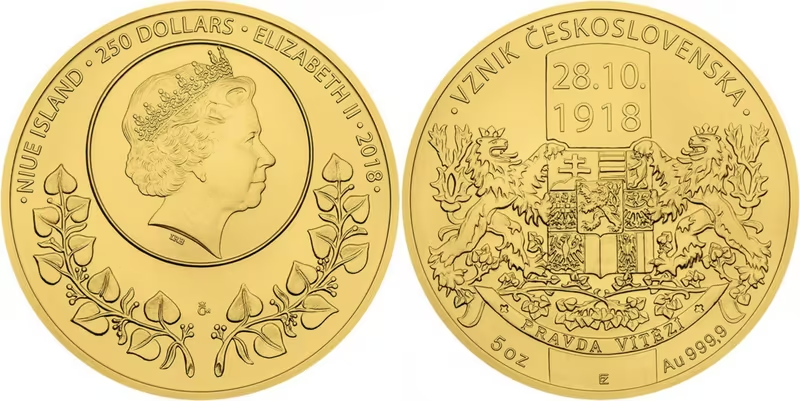
Niue, 250 Dollars 2018 - Vznik Československa
250 Dollars 2018 - Vznik Československa, zlatá pětiuncová mince, autor Zdeněk Fojtů Au 0,9999, 50 mm (155,5 g), raženo 100 ks, Česká mincovna, certifikát, luxusní dřevěná etue, papírový přebal Počátky naší republiky jsou se zlatem neodmyslitelně spjaty.…