Estates coins
Estates coins represent a body of silver and gold strikes issued by the Czech Estates government during the anti-Habsburg revolt of 1618 to 1620 and subsequently in Silesia until 1635. These emergency means of payment arose out of the necessity to finance the military operations of the rebel Estates and are characterised by the gradual debasement of preci…
The beginnings of Estates coinage are inseparably linked to the Prague Defenestration of 23 May 1618, when the Czech Protestant Estates threw the imperial governors Jaroslav Bořita of Martinice and Vilém Slavata out of the windows of Prague Castle. This act of revolt against Habsburg power triggered not only the Czech Estates revolt but also the Thirty Years' War. The rebel Estates immediately faced a critical problem - how to finance the army needed to defend the country without access to the imperial treasury and mints.
On 20 March 1619, Emperor Matthias died, which temporarily weakened the position of the Habsburgs. The Czech Estates exploited the interregnum to create their own government - a thirty-member Directory composed of representatives of all the Estates. This Directory took control of the country's financial system, including the right to mint coins. Although the new emperor Ferdinand II of Styria confirmed the Czech Estates' privileges, including freedom of religious profession guaranteed by the Letter of Majesty of Rudolf II, he was rejected as king by the Czech Estates.
The military situation demanded immediate financial means. The Directory began alliance negotiations with the Silesians, the Lusatian Sorbs and the Austrians, later also with the Moravians and the Hungarian rebel leader Gabriel Bethlen. The creation of this anti-Habsburg coalition meant enormous expenditure on pay, weaponry and supplies. Ordinary revenues from taxes and customs duties were far from sufficient to cover the rising costs.
The Estates Diet met on 25 June 1619 to decide on further action. After dramatic negotiations, on 26 August 1619 Frederick of the Palatinate, Elector of the Rhine and leader of the Protestant Union, was elected King of Bohemia. The coronation took place ceremoniously on 4 November 1619 in St Vitus Cathedral. The new king, however, was unable to master the catastrophic economic situation of the country. State debt grew geometrically, the army demanded pay, allies financial support.
Even before Frederick's coronation, Albrecht Klusák of Kostelec on 28 June 1619 issued a new mint ordinance. This reform introduced a new monetary system based on domestic means of payment and abolished the old denominations. The main unit became the kreuzer, with the thaler containing 72 kreuzers. At the same time the silver content of coins was ordered to be reduced - the 24-kreuzer fell from its original content to just 9.4 per cent of pure metal.
History
The mints in Prague, Kutná Hora and Jáchymov began the mass minting of new denominations. Thalers, 24-kreuzers, 12-kreuzers, 3-kreuzers, kreuzers and the white pence called hellers were issued. The Czech coins bore the Latin inscription MONETA REGNI BOHEMIAE (the coin of the Czech Kingdom) and a crown with the legend IN DEO FORTITUDO (Strength in God). The Moravian strikes used a similar system with 24-kreuzers, 12-kreuzers and additionally thalers.
Gold coins represented prestigious issues intended primarily for international payments. The Silesian Estates struck imposing denominations - 6-ducats, 3-ducats and ducats, then 6-thalers, 3-thalers, thalers and half-thalers. The most important mints in Silesia were in Wrocław, Głogów, Legnica and Opava. These strikes often bore the names of specific Silesian princes supporting the revolt.
The catastrophe came with the Battle of White Mountain on 8 November 1620. The Estates army was crushed within two hours by imperial detachments. Frederick of the Palatinate, mockingly called the Winter King for the short period of his reign, fled the country. After the loss of Bohemia and Moravia, resistance moved to Silesia and partly to the territory of Upper Hungary. Shortly after the defenestration, Frederick travelled into exile in the Netherlands, where he died in 1623 in The Hague.
Ferdinand II on 5 December 1620 ordered the withdrawal of all Estates coins from circulation. The debased Estates strikes caused the first great inflationary crisis in Czech history, known as the kipper and wipper era or the long-coin period. The kreuzer currency lost all confidence, and trade reverted to barter or foreign currencies. The economic collapse prepared the ground for mass confiscations and a change in the ownership structure of the Czech lands.
In Silesia the minting of Estates coins continued thanks to temporary military successes. In 1633, after the invasion of Swedish armies, the Estates government was restored in Wrocław, which struck 5-ducats, ducats, 2-thalers, thalers and 3-kreuzers. Only in 1635 did Silesia return definitively under the rule of Ferdinand II, and the monetary system was unified with the Czech and Moravian one.
Technical parameters and numismatic value
The consequences of Estates coinage were long-lasting. The monetary reform of 1623-1624 introduced a new system based on the Rhenish gold gulden. The population lost most of the savings deposited in the debased kreuzers. Mistrust of paper money and light coins persisted in the Czech lands for generations. Paradoxically, it was precisely the experience of inflation with Estates coins that prepared the ground for the stable monetary system of Maria Theresa a century later.
Estates coins show considerable variability in both quality of strike and content of precious metal. The initial issues from 1619 still maintained a relatively high standard - the thaler contained 29.22 grams at a fineness of 888 per mille. Gradual debasement led to a decline to a mere 625 per mille in the late strikes. The difference between nominal and actual value reached as much as 400 per cent.
Technically the most interesting are the Silesian multiples of ducats. The six-ducat weighing over 20 grams of gold represents one of the heaviest European gold coins of the 17th century. These prestigious pieces were produced by hand-hammering from rolled gold sheets, each one is a unique work of art. The minting of large denominations served propaganda purposes - it demonstrated the strength and wealth of the Estates government.
The iconography of Estates coins combines Protestant symbolism with traditional Czech motifs. The Czech lion, the Moravian eagle and the Silesian eagle with the perizonium represent the lands' coats of arms. The inscription UNIO TE STANTE VIREBO (If you join me, you will be strong) on the Moravian strikes expresses the idea of Estates unity. The absence of the ruler's portrait on many issues symbolises the republican tendencies of the revolt.
The present-day numismatic value of Estates coins significantly exceeds the value of the metal contained. Ordinary kreuzers are in the order of thousands of koruny, rare thalers reach tens of thousands. Gold multiples of ducats are among the most valuable Czech numismatic monuments with prices exceeding millions of koruny. Estates coins represent a material testimony of a dramatic period of Czech history and are sought by collectors throughout the world.
In our auction and shop
- Code: XB1300-0403
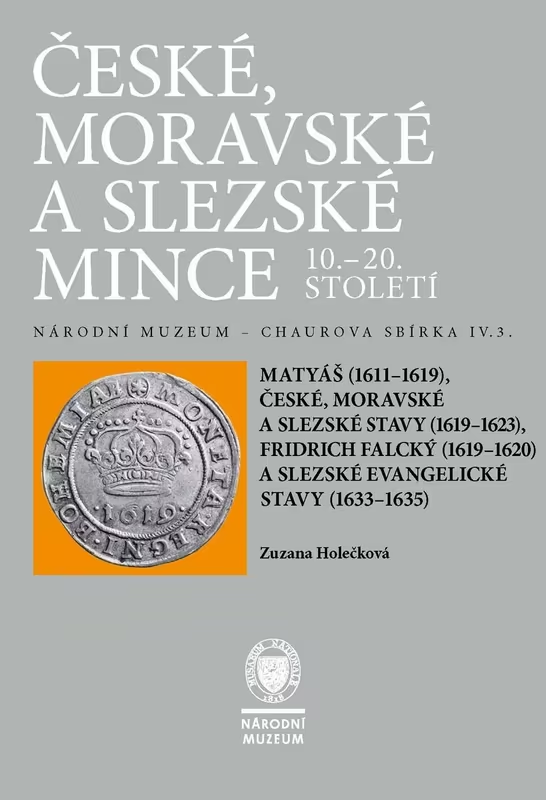
Chaurova sbírka - Matyáš, Fridrich Falcký a stavovské ražby
Katalog mincí Matyáše Habsburského, Fridricha Falckého a stavů zemí Koruny české Zuzana Holečková Publikace je dalším svazkem edice proslulé Chaurovy sbírky uložené v Národním muzeu. Přináší velmi podrobný popis rozsáhlého a v řadě ohledů výjimečného…
Skladem 1 ks - Code: ZD-2019PHA
Zlatá mince Praha - dobová pohlednice
Niue 5 Dollars 2021 (Petra Brodská) - Zlatá mince Praha - Stavovské divadlo v dobové pohlednici Au 0,9999, 11 mm (0,5 g), náklad 2000 ks, PROOF Divadlo původně neslo jméno osvíceného vlastence hraběte Františka Antonína Nostice-Rienecka, který ho nechal…
- Code: ZSNIU-2019
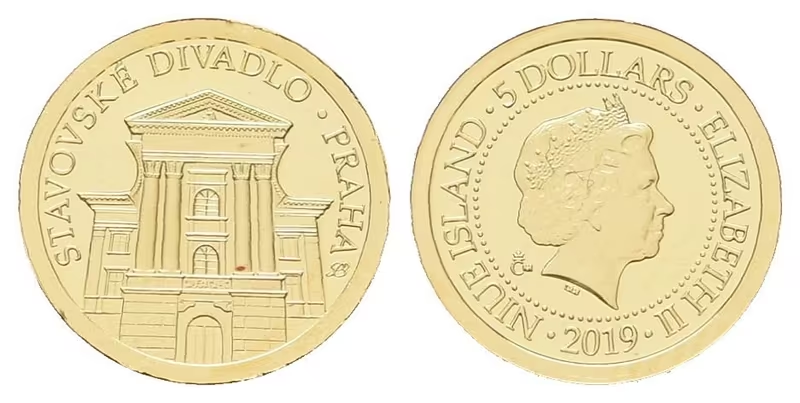
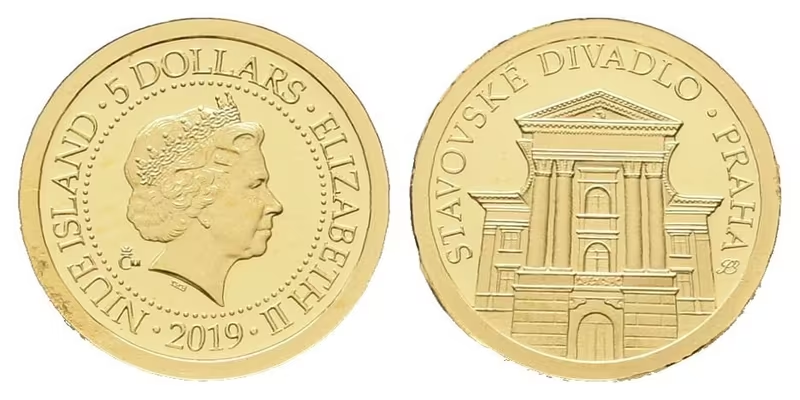
Niue Island, 5 Dollars 2019 - Stavovské divadlo
5 Dollars 2019 - Zlatá mince Praha - Stavovské divadlo, Au 0,999, 11 mm (0,5 g), kapsle, obal jako certifikát v AJ a ČJ, PROOF Z cyklu Nejmenší zlaté mince světa
- Code: ZD-2019FID
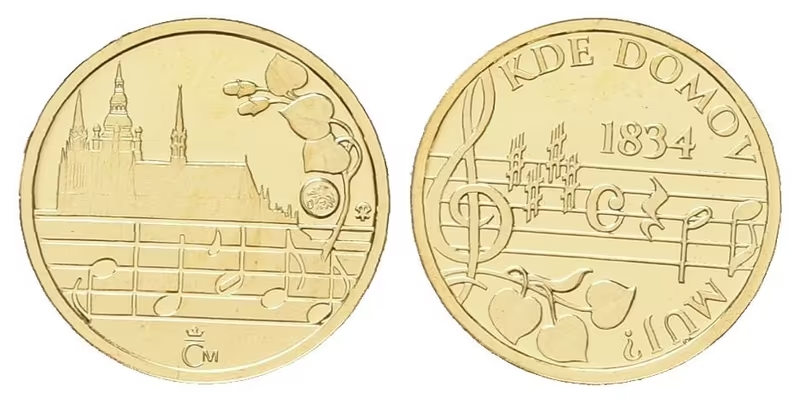
Zlatá mince Kde domov můj - dobová pohlednice
Niue 5 Dollars 2019 (Asamat Baltaev) - Zlatá mince Kde domov můj - Fidlovačka v dobové pohlednici Au 0,9999, 11 mm (0,5 g), náklad 1000 ks, PROOF Řada pamětních mincí vyražených z jedné poloviny gramu ryzího zlata, které jsou zasazeny do replik dobových…