Mine-yield coinage
Mine-yield coins are coins struck from metal mined in specific mines, with the name of the mine, a symbol or reference to the mining tradition clearly indicated on the coin. They arose as representative, often also commemorative issues which were intended to document the origin of the metal and at the same time to promote the importance of the given minin…
Mine-yield coinage harks back to a time when the extraction of precious metals represented strategic wealth of the state and of the ruler. With silver and gold not only the nominal value of the coin was important, but also the prestige associated with "one's own" metal and with the mines that brought revenue into the treasury. Therefore, in some mining regions a tradition arose of coinage that explicitly emphasised the origin of the metal: the coin thus became not only a means of payment, but also documentary evidence of economic strength and technical advancement.
Mine-yield coinage had a great tradition particularly in the Ore Mountains (Erzgebirge), above all on the Saxon side, where mining districts were long connected with mint policy and with the self-presentation of rulers. In the Bohemian environment, this principle is manifested mainly in selected issues of the 18th and 19th centuries, when the origin of metal from specific Bohemian mines was emphasised. Typically, such coins are not ordinary circulating coinage struck "just so", but rather an exceptional mintage with a clear message: this piece was struck from metal from a specific place.
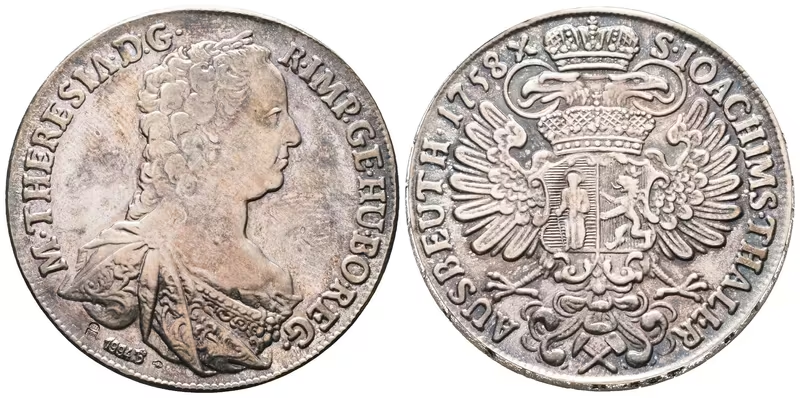
Among Bohemian gold mine-yield coins, for instance, the Jílové ducats are mentioned, struck from the gold of the Jílové mines during the reigns of Joseph I and Charles VI. These coins were associated with mining symbolism and with the motif of a patron saint, thereby connecting economics with the religious protection of miners and mines. For silver mine-yield coinage in the Bohemian lands the thalers of Charles VI and later also the thalers of Maria Theresa are recalled, for which it is emphasised that they were struck from silver of the Jáchymov mines. Precisely Jáchymov had an exceptional name in European mint memory already from the 16th century, and "Jáchymov" silver carried strong symbolic capital even in later periods.
History
The modern period also brought mine-yield coinage that was at the same time commemorative. A well-known example is the so-called Příbram gulden, struck from metal obtained from the St Vojtěch mine on Březové Hory near Příbram on the occasion of reaching the exceptional depth of 1,000 metres. Similarly, the so-called Kutná Hora double gulden is mentioned, struck from silver coming from attempts to revive mining around Kutná Hora. Such issues show that mine-yield coinage was not only a mediaeval or Baroque matter: even in the 19th century it was used as a "commemorative coin from specific metal" intended to recall a mining success or a revived district.
In a broader sense, mine-yield coinage is an important source for the history of mining. On coins it is possible to record not only the ruler and denomination, but also economic propaganda: the state communicates where wealth comes from, which mine is important and what achievement is considered worthy of commemoration. Therefore these coins are sought after not only for the metal but also for the story they carry.
Mine-yield coins are recognised by the explicit reference to the origin of the metal. This may be expressed directly in the inscription (a mention of the mine or district), by the symbol of the patron of the mine or by mining iconography. On some silver mine-yield thalers, mining tools are also indicated as a mark, for example crossed hammers, sometimes placed beneath the state coat of arms. Such a sign functions as a "seal of origin" and distinguishes the mine-yield coinage from an ordinary year of the same denomination.
Marks, motifs and identification
In practice it is important to distinguish whether it is a true mine-yield coin (the metal demonstrably comes from the named mine), a later imitation, or merely a thematic mintage with a mining motif. Genuine mine-yield issues are usually marked by a combination of several features: the year, mint, control mark and the specific motif or inscription that is typical of the given issue. Because these coins are often collector-attractive, with more valuable pieces it pays to track provenance and expert determination of the variant.
From the numismatic point of view, mine-yield coinage is interesting in that it connects three worlds: mining (origin of the metal), state administration (mint privileges and control) and symbolism (patrons, mining marks, commemorative text). On the coin there thus arises a short but eloquent message: the metal is not anonymous, but "from a specific place", and precisely this is the main meaning of mine-yield coinage.
In our auction and shop
- Code: RG-1994MAR
Výtěžkový tolar Marie Terezie 1758
AR Medaile 1994 - replika výtěžkového tolaru Marie Terezie 1758, Ag 0,999, 40 mm (29,16 g), etue Výtěžkové ražby jsou mince ražené ze surovin vytěžených v určitých místech. Do Čech přišel zvyk razit tyto mince ze saské strany Krušných hor. Na každé…
Skladem 1 ks