Württemberg Mint
The Württemberg Mint is a historical and current designation for the mint facility associated with the land of Württemberg, traditionally with Stuttgart. It struck land and later imperial coins and today continues within the state mint enterprise of Baden-Württemberg, where the mint mark F is used.
The Württemberg Mint is tied to the history of south-western Germany, where from the Middle Ages onwards land states gradually formed with their own finances, law and economic policy. The right to strike coins was among the most important prerogatives of the ruler, since it made it possible not only to ensure circulating currency for markets and the collection of fees, but also to represent power through symbols and titulature on the metal. For Württemberg it is essential that the mint tradition in the Stuttgart area is attested already in the 14th century: the land at that time was joining the wider circle of German mint practices, where small silver and copper denominations for everyday circulation dominated.
More distinctly the separate mint history of Württemberg is associated with the year 1374, when the local ruler obtained mint authorisation from the emperor. From then on the striking developed in various forms repeatedly according to the needs of the state and to economic cycles. In the early modern period, coinage was sensitive to the price of metal and to military expenditure: when the state needed money, it could strike more coins, change denominations or, in crises, worsen the metal standard, which appeared repeatedly in European history. The mint was not just a "factory", but a part of financial administration: under the supervision of the ruler, the chamber and the mintmasters, the supply of metal, control of purity, oversight of dies and the collection of mint fees were addressed.
History
In the 18th and 19th centuries the role of mints transformed with the modernisation of the state. Württemberg gradually strengthened its administrative apparatus and with it the capacity to standardise the currency. Coins were ever more uniform, technologically more precise and better protected against counterfeiting. Precisely in the 19th century mechanical production also improved significantly: from hand-striking and simpler presses there was a transition to mechanised procedures, which made it possible to achieve stable diameter, exact weight and a higher-quality relief. This had a direct impact on trust in the currency and on the convenience of everyday use.
A fundamental change was brought by German unification and the creation of the German Empire in 1871. Lands such as Württemberg became part of a common monetary framework (the mark), while in many cases retaining the possibility of striking coins with land identity - typically with the portrait of the local ruler - but in unified imperial parameters. This is a very attractive period for numismatics: on the coins the federal system meets regional representation, so that according to the portrait and arms one can determine the land, while the weight and denomination standard corresponds to the empire. In modern times, state mint production in Baden-Württemberg has continued the Württemberg tradition. Today the Stuttgart facility is part of the joint enterprise based in the state, and on the coins it is distinguished by the mint mark F, which determines the origin of the striking.
Coinage, the mark F and practical identification
The Württemberg Mint is important in numismatic descriptions above all as the "place of origin" of the coin. With German coins of the 19th and early 20th centuries, you encounter the fact that alongside the denomination and year, the mint mark also plays a role, since the same type could be struck in several mints. For Stuttgart the letter F is used, which makes it possible to quickly distinguish the striking from those of other German mints. With land and imperial issues from the mark period, the combination is then key: ruler (for example a Württemberg king), denomination (e.g. 2, 3 or 5 marks), year and precisely the mint mark.
In addition to circulating currency, the mint also struck commemorative and ceremonial issues. These could commemorate anniversaries, ruler's visits or state events and were often produced in higher quality. In modern production the mint also participates in striking euros, where the mark F again determines the Stuttgart origin. For collectors this means that the "Württemberg Mint" may in a catalogue denote both historical Württemberg coinage (including the imperial period) and current German coins produced in Stuttgart. When describing a specific coin it is therefore worth stating not only the name of the mint but also the period and monetary system, since precisely this determines the role the coinage played in circulation and what standards it had to meet.
In our auction and shop
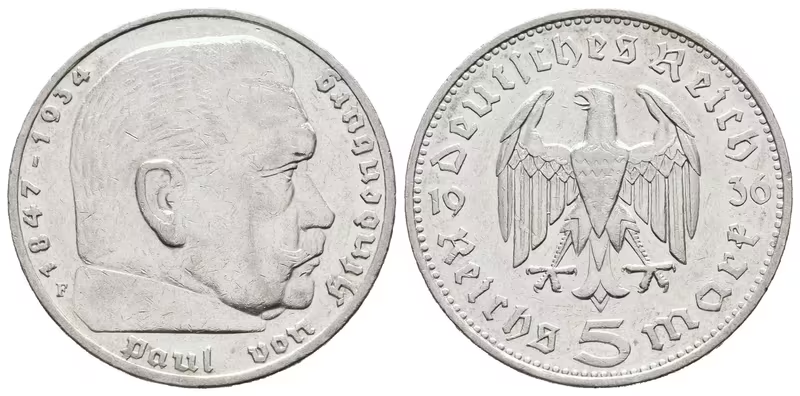
- Code: NF-G1936F.2
III. říše, 5 Marka 1936 F
III. říše (1933 - 1945) 5 Marka 1936 F, Státní mincovna Stuttgart / Státní mincovny Bádenska-Württemberska pěkná zachovalost, ilustrační fotografie Ag 0,900, 29 mm (13,88 g), raženo 3 320 000 ks
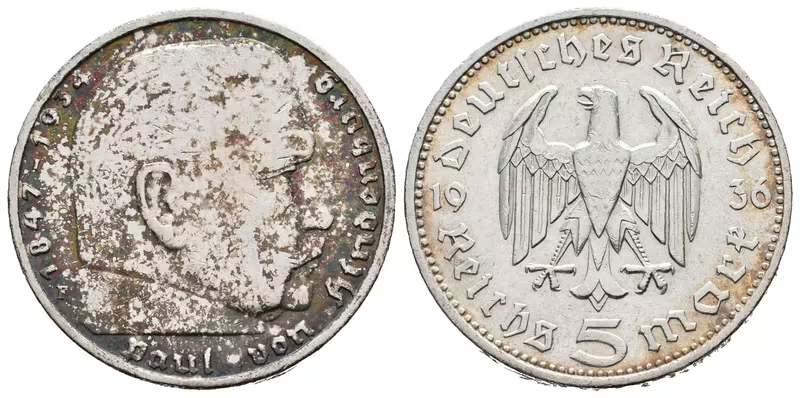
Skladem 1 ks - Code: NF-G1936F.1
III. říše, 5 Marka 1936 F
III. říše (1933 - 1945) 5 Marka 1936 F, Státní mincovna Stuttgart / Státní mincovny Bádenska-Württembersk, ilustrační fotografie Ag 0,900, 29 mm (13,88 g), raženo 3 320 000 ks
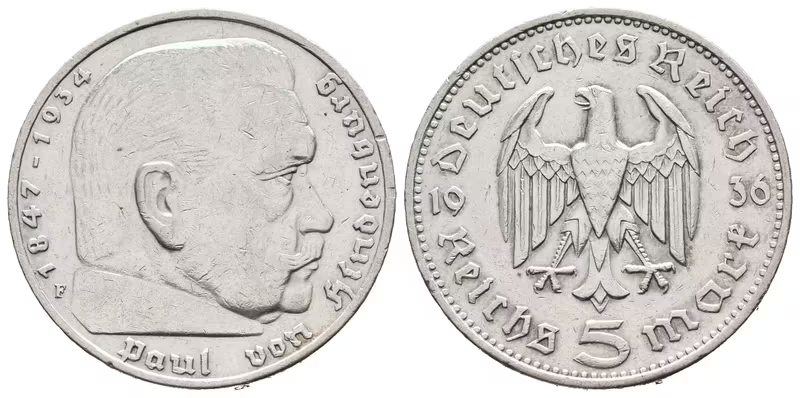
Skladem 1 ks - Code: NF-G1936F
III. říše, 5 Marka 1936 F
III. říše (1933 - 1945) 5 Marka 1936 F, Státní mincovna Stuttgart / Státní mincovny Bádenska-Württemberska pěkná zachovalost, ilustrační fotografie Ag 0,900, 29 mm (13,88 g), raženo 3 320 000 ks
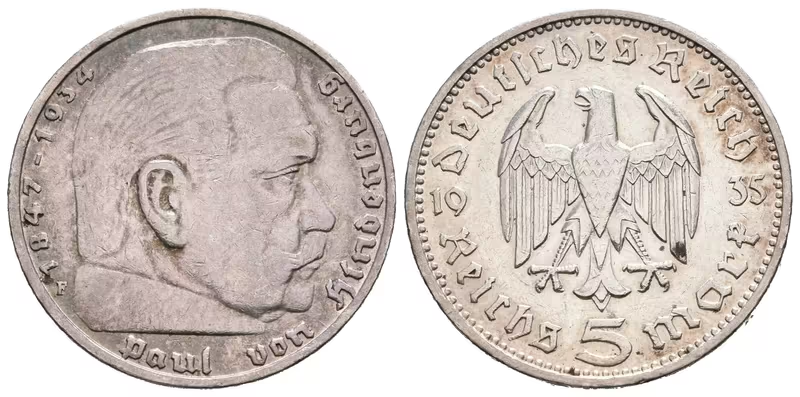
Skladem 1 ks - Code: NF-G1935F.1
III. říše, 5 Marka 1935 F
III. říše (1933 - 1945) 5 Marka 1935 F - Státní mincovna Stuttgart / Státní mincovny Bádenska-Württemberska , krásná zachovalost, ilustrační fotografie Ag 0,900 , 29 mm (13,88 g), raženo 4 372 000 ks
Skladem 1 ks