Augsburg Mint
The Augsburg Mint is the designation for the minting operation associated with the city of Augsburg, known especially from the period of the free imperial city, when coins were struck here for local circulation and trade. On the strikes the city emblem — the pine cone — often appears, along with inscriptions referring to the city or its standing.
The Augsburg mint grew up in the environment of a wealthy commercial city, where coins were essential for markets, crafts and long-distance financial operations. In the Middle Ages, minting rights were one of the important expressions of power and prestige — and in the case of free imperial cities they were also a symbol of self-government. Thanks to its economic strength, Augsburg belonged among cities that managed to use coinage not only practically but also representatively: the coins were to be trustworthy, accepted and at the same time legible as the product of a particular community.
Medieval civic minting was usually focused on small silver coins intended for everyday circulation. In the German space, in various periods, one encounters pfennigs and one-sided thin strikes (bracteates), the typology of which is very varied. With such coins, variable striking quality, irregular edges and differences between individual issues are common, because production was heavily dependent on the work of dies and on local conventions. For today's identification, therefore, no single detail is decisive but rather a combination of features: motif, fragments of legend, metal, weight and comparison with specialist surveys.
In the early modern period, coinage in the Empire gradually became more oriented towards wider standards and larger denominations corresponding to the growth of trade. As a significant financial centre of the 16th century, Augsburg had a natural interest in its currency appearing stable and being intelligible to commercial partners. "Imperial" attempts at the unification of coin parameters also came into play, so that civic strikes had to move between local tradition and broader rules determining which values were to be in circulation and what parameters they were to have. For collectors this means that Augsburg coins from different periods may look very different — from small silver pieces to more elaborate strikes with richer titulature and civic symbolism.
History
One of the most easily recognisable elements of Augsburg's coinage production is the city emblem — the pine cone. On the coins it may appear as the main motif or as a smaller "mark" accompanying the inscription. Alongside it appear other elements typical of civic strikes: civic legends, sometimes dates and motifs linked with the city's identity and standing in the Empire. Given that Augsburg was also a culturally strong centre, on some issues one can observe engraving of good quality for the period, but at the same time it holds that with circulating coins the practical side was often more important than "medallic" perfection.
After the dissolution of the free imperial cities in the Napoleonic era, the conditions for minting also changed, and Augsburg became part of the Bavarian state framework. For numismatics, however, the Augsburg Mint remains a term mainly in connection with civic strikes of the high Middle Ages and the early modern period. These are a valuable source, because they preserve in metal the economic strength of the city, its symbols and the transformations of political conditions.
When identifying Augsburg coins it is worth starting with the iconography: the pine cone is the quickest clue, but it is always good to verify the legend and the overall style as well. With small medieval pieces, the legend is often partly off the flan, so fragments of letters and comparison with types in a catalogue also decide. With early modern strikes, the metal and denomination also help: larger silver coins tend to have more legible legends, sometimes also dates, and are collector-assessed by the preservation of the relief and the original surface.
Typical strikes and identifying features
With popular types, caution towards modern imitations is in order. Authentic hammer-struck coins have typical "living" traces of production (small unevenness, natural edges, patina), while cast forgeries often betray themselves by softer details and an unnatural surface. It is always worth addressing the provenance of the coin, quality photographs and comparison with verified pieces. The Augsburg Mint is at the same time an excellent collecting theme: it makes it possible to assemble a collection that connects the history of the city, the trade network and the development of money in the German space.
In our auction and shop
- Code: NASTOL-C1555
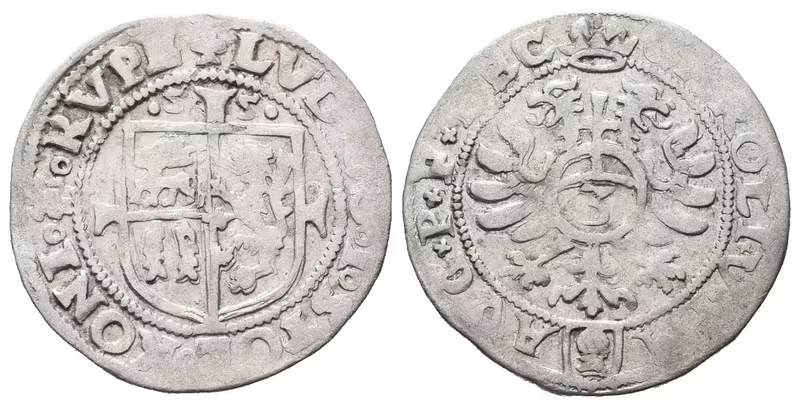
Stolberg, 3 Krejcar 1555
Stolberg-Königstein, Ludwig II. von Königstein, 1535 - 1574 3 Krejcar 1555, Fried.355f, minc. Augsburg, ražba Ludvíka jako zástavního pána Augsburské mincovny.
- Code: NAAUGS-1424
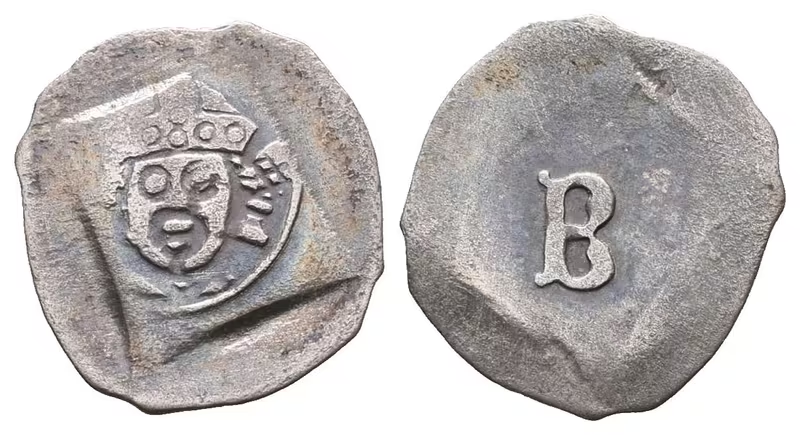
Augsburg, Fenik se čtyřrázem
Augsburg - bisupství, Peter von Schaumburg (1424 - 1469) Pfennig se čtyřrázem, Rad.XIII/8, patina 3 Krejcar 1555, Fried.355f, minc. Augsburg, ražba Ludvíka jako zástavního pána Augsburské mincovny.