Diner
The diner is the official currency of the Principality of Andorra, a small state in the Pyrenees between France and Spain, struck since 1977. The name comes from the Spanish dinero (money) and the Catalan diner, historically denoting a denarius.
For centuries Andorra had no currency of its own and used the Spanish peseta and the French franc, in accordance with the principle of co-principality - the country has two heads of state, the Spanish bishop of Urgell and the French president. This unique system arose in the Middle Ages and survives to this day. The first attempts at a domestic currency took place during the Napoleonic Wars, when local authorities issued emergency paper money, but these issues were not successful. In the 20th century the question of a national currency arose several times, but practical reasons for maintaining foreign currencies always prevailed.
The decision to strike its own coins came in 1977 in connection with growing tourism and an effort to strengthen national identity. The first diners were struck in 1977 as a commemorative issue for various events. As Andorra did not have its own mint, minting took place in Spain and later in various European mints. The diner was defined as a theoretical currency unit divided into 100 cèntims, but in practice it never served as a circulating medium. All strikes were intended for collectors and tourists.
History
From 1982 regular issues of gold and silver diners began with themes from Andorran history, culture and nature. Motifs include Pyrenean landscapes, Romanesque churches, historical documents such as the Pariatges (medieval agreements on the co-principality) and significant personalities. After the introduction of the euro in neighbouring countries in 2002, Andorra de facto adopted the euro, although it is not formally a member of the eurozone. In 2014 a monetary agreement was signed with the EU, allowing Andorra to strike its own euro coins from 2014. Diners, however, continue to be struck as a numismatic issue.
Andorran diners are exclusively collector and investment coins without the function of circulating medium. They are struck in limited series from gold, silver and base metals. Gold diners of 20, 50 and 100 diners contain a quarter to one ounce of gold. Silver coins of 10, 25 and 50 diners are popular with collectors for their interesting motifs and high-quality execution. All coins bear Catalan inscriptions, which emphasises Andorra's cultural identity.
The diner as a collector coin
The design of the diners is created by various European artists, and each issue has a specific theme. Popular are series dedicated to the Olympic Games (Andorra regularly takes part in both the summer and winter games), European integration, the protection of the Pyrenean environment and significant anniversaries. Technically, diners are struck to the highest proof quality with a mirror field and matt relief. Some issues use modern techniques such as holograms, colour printing or inset crystals. Mintages are small, usually 3,000-25,000 pieces, which increases their collector value. Paradoxically, diners are not commonly available in Andorra - they are sold mainly through international numismatic dealers.
In our auction and shop
- Code: SPER-D1899
Peru, 1/2 Dinero 1899
Republika, 1822 - 1/2 Dinero 1899 JF, KM.206, krásná zachovalost, ražební lesk, patina
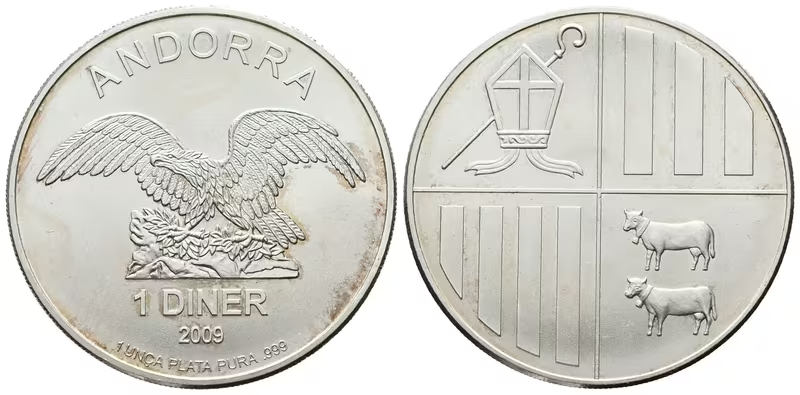
Skladem 1 ks - Code: SAND-D2009
Andorra, 1 Diner 2009 - Orel zlatý, andorrský státní znak
Andorrské knížectví 1 Diner 2009 - Orel zlatý, andorrský státní znak Ag (.999), 38 mm (31,1 g), BU, v kapsli. Stav mince odpovídá fotografii.
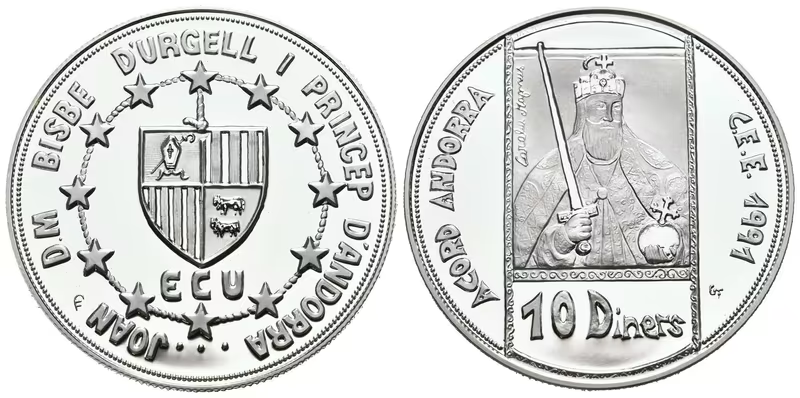
- Code: SAND-C1994
Andorra, 10 Diners 1994 - Karel Veliký, ECU série, heraldika
Andorrské knížectví 10 Diners 1994 - Karel Veliký, ECU série, heraldika, KM# 98 Ag (.925), 38 mm (31,8 g), v kapsli. Stav mince odpovídá fotografii.
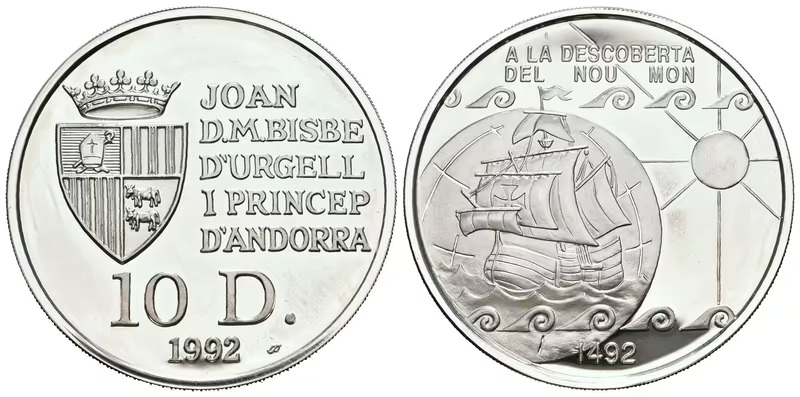
- Code: SAND-C1992
Andorra, 10 Diners 1992 - Objevení Nového světa - Kolumbova plachetnice Santa María, 500. výročí
Andorrské knížectví 10 Diners 1992 - Objevení Nového světa - Kolumbova plachetnice Santa María, 500. výročí, KM# 98 Ag (.925), 38 mm (31,47 g), v kapsli. Stav mince odpovídá fotografii.