Warsaw Mint
Warsaw Mint (Polish: Mennica Warszawska) is the historical and present-day designation for coin production in Warsaw, which has ensured the striking of Polish circulating coins, commemorative issues and medals. As a strategic state enterprise it developed in line with the changes of Polish statehood and monetary reforms.
The Warsaw Mint is closely linked with the moment when Warsaw became the political and administrative centre of the country. As soon as, in the early modern period, key institutions concentrated in the metropolis, it was natural that coin production also gradually became established here. A mint in the capital had a practical advantage: it was close to the state administration, finance and quality control, so it could flexibly respond to the needs of circulation, taxes and the army.
In the Polish environment, the Warsaw minting tradition was more clearly profiled in the 18th century, when the state sought a more stable and more unified monetary environment. At that time the role of centrally managed striking was reinforced, which was to ensure confidence in the weight and fineness of coins and to limit the chaos caused by the mixing of various currencies and regional customs. The mint also fulfilled a representational function: coins bore state emblems and royal or state motifs, which confirmed the legitimacy of power and the "unified face" of the currency.
Great changes were brought by the period of the partitions of Poland and the changing state forms of the 19th century. Monetary systems were adapted to the political reality, and coin production was governed by the entity for which and according to which rules the currency was struck. In such stages, the mint is not only a manufacturing enterprise but also a sensitive instrument of politics: every change of inscription, emblem or denomination signals who has the right to "speak in money" and what the links to the wider economic area are.
History
After the restoration of Polish statehood in the 20th century, it again became clear how important reliable coin production is for confidence in the currency. In the interwar period, the Polish circulating tender stabilised and issues had to conform to new standards and modern technology. The Second World War and the subsequent post-war recovery again meant a fundamental turning point: the economy was changing, materials were limited and circulation required large volumes of small coins. In the socialist period, coin production concentrated on mass production of circulating tender and on commemorative issues, which often bore state and anniversary themes.
In the modern era the Warsaw Mint has moved from a "purely state" operation to a broader conception of minting and security products. Alongside circulating coins, commemorative and collector issues, medals and technically demanding products, where the minting craft combines with elements of protection against counterfeiting, are significantly applied. For numismatics it is important that the mint in the metropolis long reflects the history of the state: changes of emblems, names of currency and style of striking are a "chronicle in metal" which can be read even without a knowledge of the archives.
The Warsaw Mint has traditionally ensured chiefly circulating coins for everyday payments. These must be durable, well recognisable and economically meaningful, and so the materials and alloys are often changed according to the price of metals and the demands of longevity. Alongside circulating tender, commemorative coins and medals are also struck in Warsaw, where there is room for more detailed relief, higher quality of surface and thematic series (history, culture, anniversaries, personalities). It is precisely commemorative issues that tend to be artistically the most attractive and often come into being in variants for collectors.
Issues, marks and use in practice
For the identification of coins, the combination of denomination, year, motif and any mint or producer mark is important in practice. With modern issues the technological side also plays a role: various surface finishes, precise edges, micro-features and other details which increase the difficulty of counterfeiting. With older coins from the Warsaw tradition, the historical interpretation of emblems and inscriptions is key, because these best reveal the political period and monetary system in which the coin came into being. The Warsaw Mint thus stands at the boundary of technology and history: it produces practical circulating tender, but at the same time creates objects which carry the long-term memory of the state.
In our auction and shop
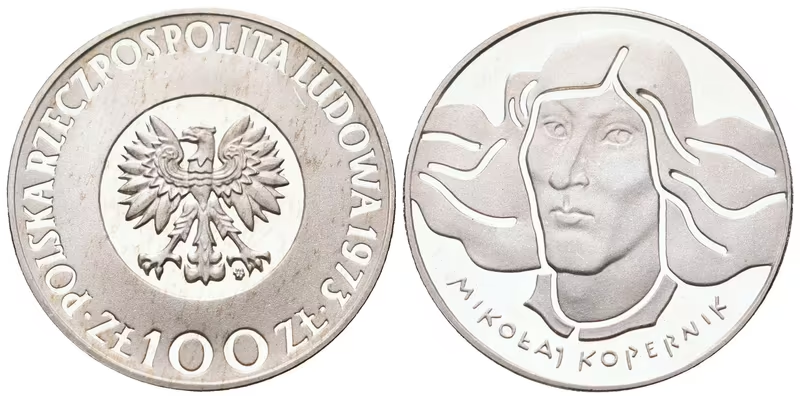
- Code: SPOL-G1973
Polsko, 100 Zlotych 1973 - M. Koperník
Polská lidová republika (1949-1994) 100 Zlotych 1973 - M. Koperník, Y# 68 Ag (.625), 32 mm (16,5 g), proof. V kapsli. Emise: 51 048 ks. Mincovna: Mennica Polska, Varšava. Autor: Jerzy Jarnuszkiewicz. Stříbrná pamětní neoběžná mince, vydaná k 500. výročí…
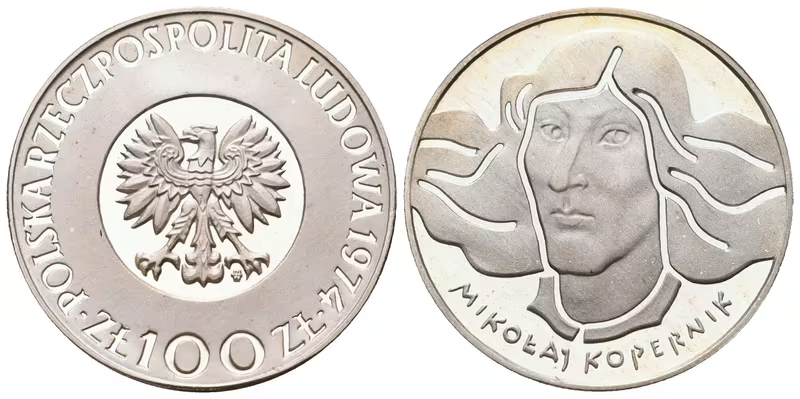
Skladem 1 ks - Code: SPOL-G1974
Polsko, 100 Zlotych 1974 - M. Koperník
Polská lidová republika (1949-1994) 100 Zlotych 1974 - M. Koperník, Y# 68 Ag (.625), 32 mm (16,5 g), proof. V kapsli. Emise: 50 000 ks. Mincovna: Mennica Polska, Varšava. Autor: Jerzy Jarnuszkiewicz. Stříbrná pamětní neoběžná mince, vydaná k 500. výročí…
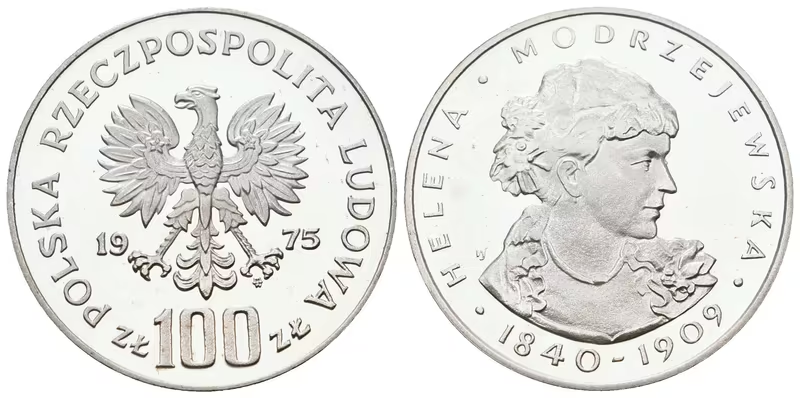
Skladem 1 ks - Code: SPOL-G1975
Polsko, 100 Zlotych 1975 - H. Modrzejewska
Polská lidová republika (1949-1994) 100 Zlotych 1975 - H. Modrzejewska, Y# 78 Ag (.625), 32 mm (16,5 g), proof. V kapsli. Emise: 60 158 ks. Mincovna: Mennica Polska, Varšava. Autor: Stanisława Wątróbska-Frindt. Stříbrná pamětní neoběžná mince - divadelní…
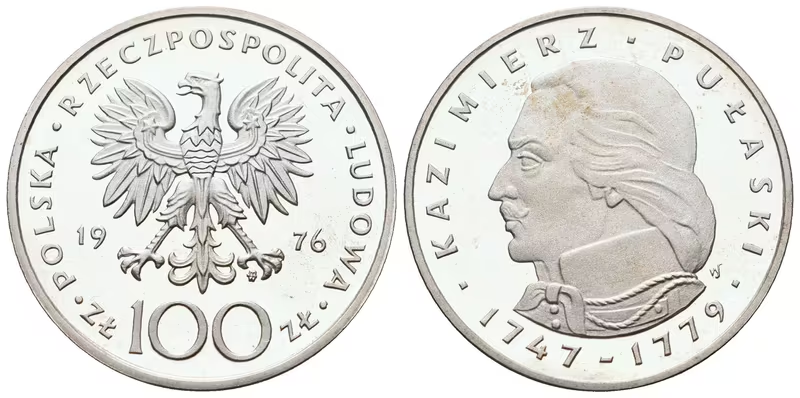
Skladem 1 ks - Code: SPOL-G1976
Polsko, 100 Zlotych 1976 - K. Pulaski
Polská lidová republika (1949-1994) 100 Zlotych 1976 - K. Pulaski, Y# 84 Ag (.625), 32 mm (16,5 g), proof. V kapsli. Emise: 100 334 ks. Mincovna: Mennica Polska, Varšava. Autor: Stanisława Wątróbska-Frindt. Stříbrná pamětní neoběžná mince - důstojník…
Skladem 1 ks