Mint of Poland
The Mint of Poland (in Polish, Mennica Polska) is the Polish mint based in Warsaw, which produces circulation and commemorative coins, medals and other minted products. In practice it is chiefly associated with issues for the Polish zloty and with modern technologies of security and metal processing.
The roots of Polish coinage in Warsaw reach back to the early modern period, although the institution known today as the Mint of Poland is usually traced to the state mint founded in the 18th century. Under the rule of Stanisław II August Poniatowski, a more modernly organised mint was established in Warsaw, intended to supply stable coinage to circulation and to support state finances. At that time, an emphasis on uniform parameters of strikings — weight, fineness, quality control and clear responsibility of mintmasters — was gaining ground throughout Europe, and Poland was no exception.
The development of the mint was, however, fundamentally influenced by the political upheavals connected with the partitions of Poland and the subsequent transformations of state administration. Coin production changed in different periods according to whether it was to serve a domestic currency or had to adapt to a broader economic framework. For numismatists this remains important even today: older Polish strikings are often identified by the state-legal context in which they were produced, by the marks they bear and by how they relate to the monetary systems of their time.
After the restoration of Polish statehood following the First World War, the question of a single currency and reliable means of payment was once again addressed. In the 1920s, when the Polish zloty was stabilised, Warsaw coin production followed modern industrial methods and gradually strengthened its role as the central supplier of coinage for the state. In the 20th century, coinage in general was transformed: circulation coins were increasingly struck from cheaper alloys, while precious metals were used rather for commemorative issues, medals and later also for bullion programmes.
History
After the Second World War, Polish coin production operated within a state-run economy and large series of currency. At the same time, commemorative production was developing, drawing on the tradition of state symbolism, anniversaries and cultural motifs. In the last decades of the 20th century and following the changes after 1989, the mint underwent gradual modernisation and transformation, which moved it from a purely state-owned manufacturing enterprise to an institution oriented also towards international commissions, the collectors' market and broader work with precious metals.
Today's Mint of Poland is therefore perceived in two ways: as the continuation of a long Warsaw coinage tradition and at the same time as a modern industrial enterprise that produces not only for domestic needs but also for foreign clients. In numismatics, the name appears on circulation coins issued for Poland, on commemorative and collectible issues, and on specialised strikings for various countries and institutions.
The Mint of Poland focuses on several mutually complementary areas. The basis is the striking of circulation coins and commemorative issues, where the ability to maintain precise parameters — weight, diameter, fineness and quality of coin relief — is key. Modern coins moreover require features that facilitate machine processing in circulation (uniform edge, rim, legible denominations) and at the same time help against counterfeiting (fine structures, micro-elements, specific surfaces or combinations of metals).
Production, technology and applications
A significant share of production consists of commemorative and collectible strikings. These differ from currency in their emphasis on artistic execution, on surface quality and on limited mintages. In practice, various levels of finish are applied, for instance polished strikings, frosted reliefs or highly sculptural motifs. The collectible value is then determined not only by the metal content but mainly by the mintage, theme, execution and preservation without surface interventions.
In addition to coins, the mint also produces medals, tokens and other minted items, which often serve to represent institutions, anniversaries or as gift products. Work with precious metals is also important: for modern mints it is not just the striking itself but also securing the material, processing it and ensuring precise quality control. For collectors and investors it is in practice essential that the parameters be easily verifiable and that the product correspond to the declared fineness and weight.
In our auction and shop
- Code: ZSAUST-AD2014
Austrálie, 100 Dollars 2014 - Year of the Horse
Elizabeth II. (1952 - 2022) Austrálie, 100 Dollars 2014 - Year of the Horse (Rok koně) Au 0,9999, 39,34 mm (31,107 g), 1 Oz, Proof Znamení Koně v čínském horoskopu je spojováno s energií, svobodou a přirozeným charismatem. Lidé narození v tomto znamení…
Skladem 1 ks - Code: SUGA-D2006A
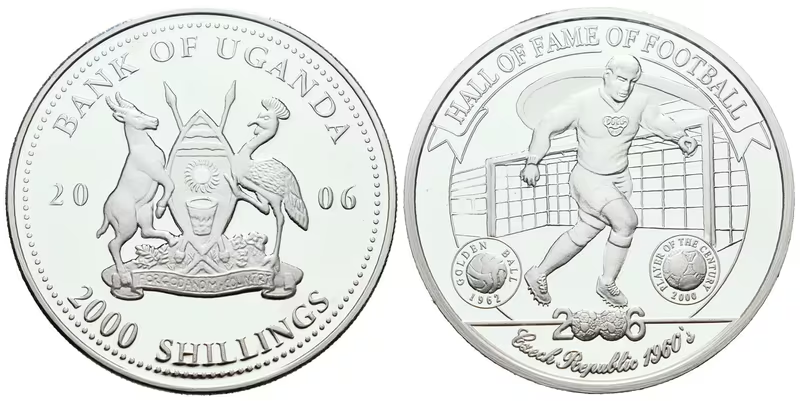
Uganda, 2000 Shillings 2006 - Josef Masopust
Ugandská republika (1987 -) 2000 Shillings 2006 - Josef Masopust, KM# 328 Postříbřený mědinikl (CuNi), 39 mm (24,8 g), proof, v kapsli. Mincovna: Cape Mint - Jihoafrická republika. Ze série "Hall of Fame of Football" (Fotbalová síň slávy) - Josef…
Skladem 1 ks - Code: SUGA-D2006B
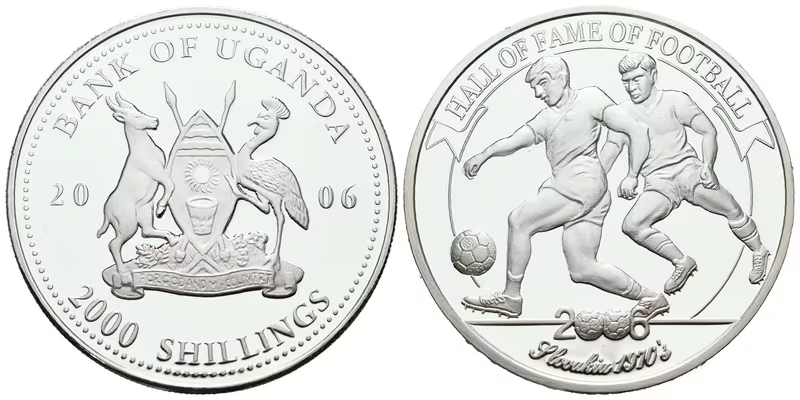
Uganda, 2000 Shillings 2006 - Jozef Adamec
Ugandská republika (1987 -) 2000 Shillings 2006 - Jozef Adamec, KM# 332 Postříbřený mědinikl (CuNi), 39 mm (24,8 g), proof, v kapsli. Mincovna: Cape Mint - Jihoafrická republika. Ze série "Hall of Fame of Football" (Fotbalová síň slávy) - Jozef Adamec -…
Skladem 1 ks - Code: SMAN90-D1997
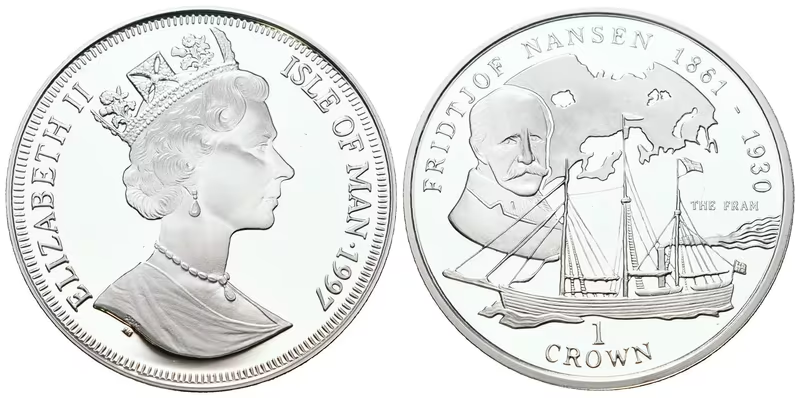
Ostrov Man, 1 Crown 1997 - Fridtjof Nansen
Ostrov Man, Elizabeth II. (1952 - 2022) 1 Crown 1997 - Fridtjof Nansen, KM# 768a Ag (.925), 38,6 mm (28,28 g), proof. V kapsli. Mincovna: Pobjoy Mint - Velká Británie. Stříbrná pamětní neoběžná mince, ze série "Great Explorers of the World" (Velcí…
Skladem 1 ks