Panda
Panda designates the world-famous series of investment and at the same time collector-sought coins from precious metals, which the People's Republic of China has been issuing since 1982. Characteristic is the motif of the giant panda, the annual change of artistic execution, and a price derived mainly from the gold or silver content.
The Panda series originated at the beginning of the 1980s, at a time when many states were once again strongly orienting themselves towards the minting of investment coins from precious metals. In 1982 China launched gold coins with the motif of the giant panda, which quickly gained a foothold not only in Asia, but also among investors and numismatists in Europe and North America. Their appeal lay in the combination of several elements: high purity of the metal, state guarantee, and above all an attractive motif of a national symbol, easily recognisable across cultures.
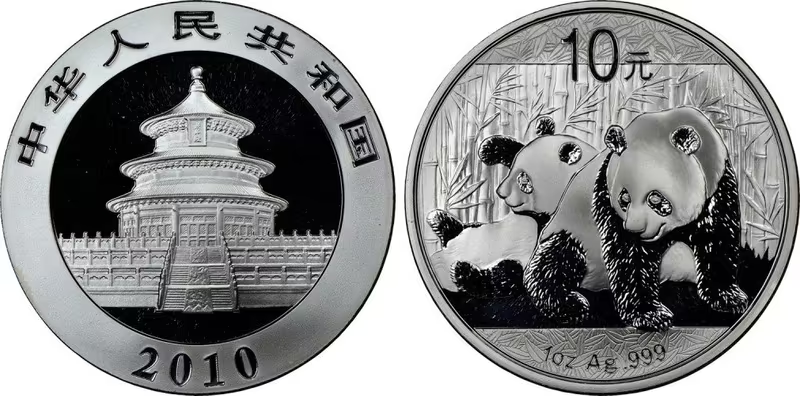
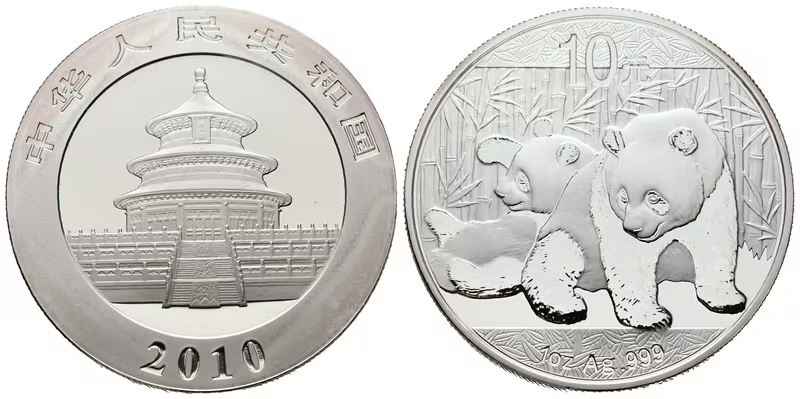
From the outset the Panda established a distinctive concept of two sides of the coin. On one side appears the motif of Beijing's Temple of Heaven, specifically the building known as the Hall of Prayer for Good Harvests, accompanied by the date. The other side bears the depiction of a panda (or a group of pandas), and it is here that a tradition gradually formed of changing the artistic treatment usually every year. Thanks to this, a purely investment coin also became a series that people deliberately complete by year. The changes concerned not only the composition, but also the style — from realistic depictions to delicately stylised scenes including bamboo groves or cubs.
The annual change of motif has its own development story. At the turn of 2001 and 2002 there was an exception when the motif was kept the same, which provoked a strong response among collectors. Subsequently China returned to the practice of regular changes, which are today considered one of the main "identifying features" of the whole series.
History
The series gradually expanded with further variants. Alongside the gold coins came silver Pandas, which began to be struck in 1983. Silver opened the series to a wider circle of interested parties, because it made it possible to acquire coins with a similar motif at a lower acquisition price. Over the years various weight and size variants have appeared, including larger pieces intended more for collector or representative purposes.
An important milestone was 2016, when the Panda — unlike a number of Western investment coins — reoriented from traditional troy ounces to metric expression of weight in grams. This change better corresponds to the domestic system of measures and at the same time distinguishes the Chinese series on the global market. Nevertheless, the basic idea remained: these are coins from precious metal, whose market price is derived mainly from weight, purity and current demand, while the additional collector value can be formed by year, execution and availability.
The Panda is struck primarily from gold and silver, usually in high purity (for silver most often 99.9% Ag, for gold commonly 99.9% Au). The coins are legal tender in China and bear a face value in yuan, which, however, in practice does not express their market price. For investment coins of this type, what is decisive is mainly the fine weight of the metal, and therefore the Panda is assessed on the exchange market similarly to other bullion strikes.
Execution, motifs and practical parameters
Characteristic is the constant "architecture" of both sides: the obverse repeats the Temple of Heaven with the date, while on the reverse the motif of the panda varies. It is precisely the changing reverse that is the reason the Panda is often perceived as straddling the line between an investment coin and a collector's item. With some years and finishes the premium above the metal value can be higher, especially for fine grades, more limited issues or variants with significantly reduced availability.
From a technical standpoint several sizes exist. For a long time the "ounce" variants were the most widespread, but since 2016 the basic weights have been expressed in grams (typically 30 g for the most common pieces). Alongside standard strikes, larger formats or special emission finishes also appear. The coins may come from several official mints, although for Chinese strikes a clear mint mark on the coin itself is not always standard. In practice, the combination of year, motif variant, parameters and the finish of the edge or details of the relief is therefore important for expert description.
In our auction and shop
- Code: SCIN-G2015
Čína, 10 Yuan 2015 - Panda
Čína 10 Yuan 2015 - Čínská panda Ag 0,999, 40 mm (31,105 g), 1 Oz, Proof komisní prodej, kapsle mohou být lehce poškrábané Čínská Panda Čínské stříbrné investiční mince Panda byly poprvé raženy Čínskou státní mincovou v roce 1983 , 1984, 1985 o váze 27 g…
Skladem (>5 ks) - Code: SCIN-G2010
Čína, 10 Yuan 2010 - Panda
Čína 10 Yuan 2010 - Čínská panda Ag 0,999, 40 mm (31,105 g), 1 Oz, Proof Čínská Panda Čínské stříbrné investiční mince Panda byly poprvé raženy Čínskou státní mincovou v roce 1983 , 1984, 1985 o váze 27 g v kvalitě proof v ryzosti 900/1000 a v nákladu…
- Code: SCIN-CH2009
Čína, 50 Yuan 2009 - Panda (5 Oz)
Čína 50 Yuan 2009 - Panda Ag 0,999 70 mm (155,5 g), 5 Oz, luxusní dřevěná etue, certifikát, papírová krabička a obal, patina na hraně
- Code: ZSCINA-1987