Riga Mint
The Riga Mint was a coinage workshop in Latvian Riga which in various periods struck circulating coins for the needs of the city and of the wider Baltic trade. Its strikes are connected with Riga's position as an important port and trade hub, where a stable small-denomination currency was indispensable for the market and for the collection of fees.
Already from the High Middle Ages, Riga ranked among the most important cities of the eastern Baltic. Thanks to its location on the river Daugava and its connection to long-distance routes, goods and money flowed there from the German lands, Scandinavia and the interior of eastern Europe. In such an environment a need naturally arises for one's own right of coinage and local striking: trade needed small denominations for daily exchange, while urban administration and the lords needed currency for fees, customs duties and for paying for services.
Coinage activity in Riga is in history bound up with the changing political position of the city and the surrounding territory. In the area of Livonia, influences of ecclesiastical institutions, the power of the Order, and municipal self-government alternated, which on coins is usually reflected in the emblems and legends. Strikes could bear the city heraldry (in particular cross motifs or the city's coat of arms), or the titulature and symbolism of the current overlord. It is therefore typical for Riga coins that in various periods they do not look "uniform" – motifs change, as do the language of the legend and the system of values, according to which state and economic sphere Riga happened to belong to.
In the early modern period, the question of circulation gained still more in significance. Long-distance trade required a reliable currency not only for large transactions but also for small payments in the port, in the markets and in services connected with transport. It was at this time that small silver or billon coins (for example schilling and groschen denominations) often came into use in the Baltic area, since they were more practical for ordinary exchange than large silver denominations. The Riga Mint thus fitted into the network of regional mints that supplied circulation with smaller values and at the same time sought to keep pace with the monetary changes of surrounding countries.
History
The importance and activity of the mint could at the same time change according to the availability of metal and according to how strictly the uniformity of the monetary system was enforced. In times of economic stability, striking tends to be more regular and standardised, while in periods of war and political upheaval greater variance can appear in quality, in the number of issues and in the choice of denominations. In port cities, moreover, the competition of foreign coinage also played a role: if coins from other countries were commonly accepted in Riga, the local strike had either to match their standards, or to be clearly recognisable and trustworthy in order to hold its place in circulation.
From a numismatic point of view, therefore, the Riga Mint is interesting chiefly as a "mirror" of Baltic history: on the one hand, the stable need for small currency for a commercial city; on the other, the changes brought by changes of overlord, monetary reforms and transitions between different economic spheres. Although individual types and periods differ, the common denominator remains the link to the urban environment and to the lively market, where the coin had above all to be practical and quickly usable.
Strikes associated with the Riga Mint are usually to be sought among the smaller denominations, which were intended for everyday circulation in the port and in the city. It is typical that the coins bear simple and well-legible features: city heraldry, cross motifs, monograms or shortened legends. Simplicity was an advantage with small coins – on a small area, the motif had to be recognisable even with partial wear.
Strikes, marks and identification of coins
In identification it is important to follow a combination of several features: (1) the motif and its execution (the form of cross, shield, towers or monogram), (2) the form of the legend and the language in which it is given, (3) the diameter and weight, which give an indication of the denomination range to which the coin belongs. Among small flans one often encounters off-centre striking and incomplete legends, so it is practical to evaluate also the style of lettering and small details that have remained legible.
The collector value of Riga strikes is significantly influenced by preservation, because small coins wore quickly in circulation. Suspect may be unusual traces on edge and surface: subsequent filing, an atypical structure of metal or a "soft" relief may suggest interference or imitation. Conversely, with better-preserved pieces it is valuable if a natural patina and clear edges of the relief are preserved, which confirm a quality original strike.
In our auction and shop
- Code: XB-1000
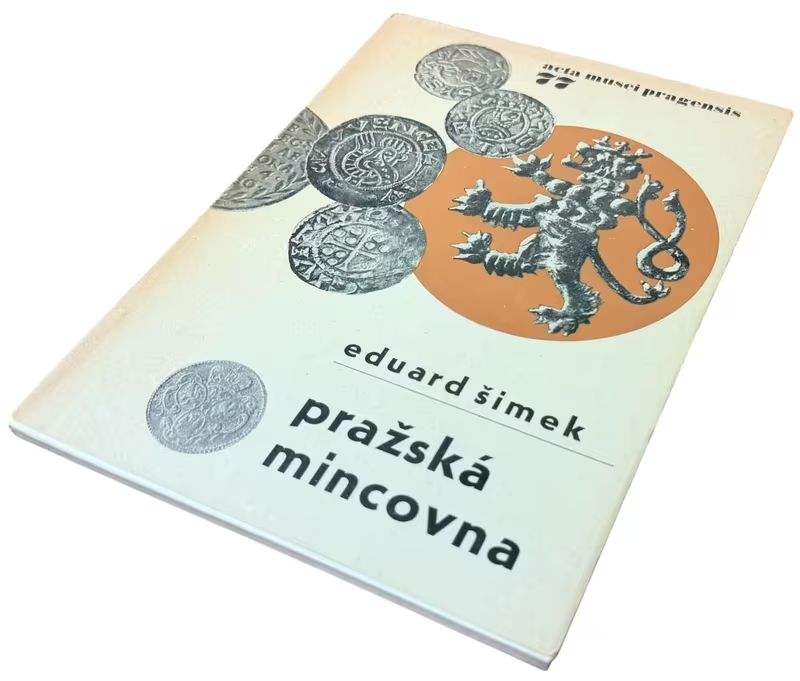
Pražská mincovna
Šimek, Eduard Pražská mincovna devět století české mince - katalog výstavy Praha 1977, 38 stran a 48 stran vyobrazení, brožované, pěkná zachovalost
Skladem 1 ks - Code: MC138-PROOF6
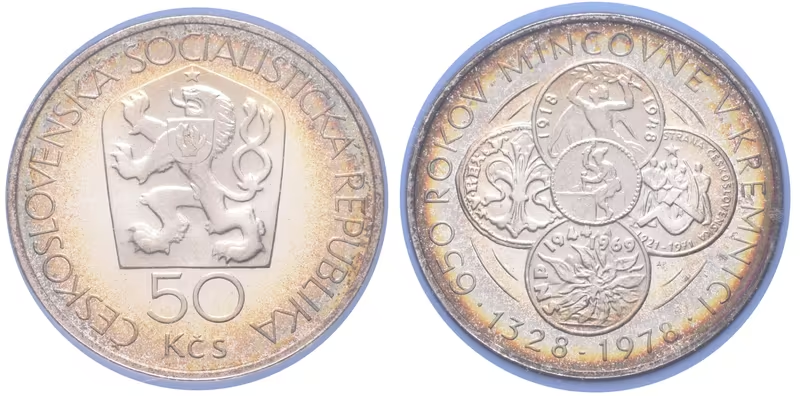
50 Kčs 1978 - Mincovna Kremnica, PROOF
Československo (1953 - 1993) 50 Koruna 1978 - 650. výročí mincovny v Kremnici, autor Andrej Peter, Aurea 138, PROOF Ag 0,700, 31 mm (13 g), raženo 70 076 ks (běžná kvalita), 2 708 ks (proof), původní plastová kapsle, patina v ploše - viz foto
Skladem 1 ks - Code: MC138-PROOF5
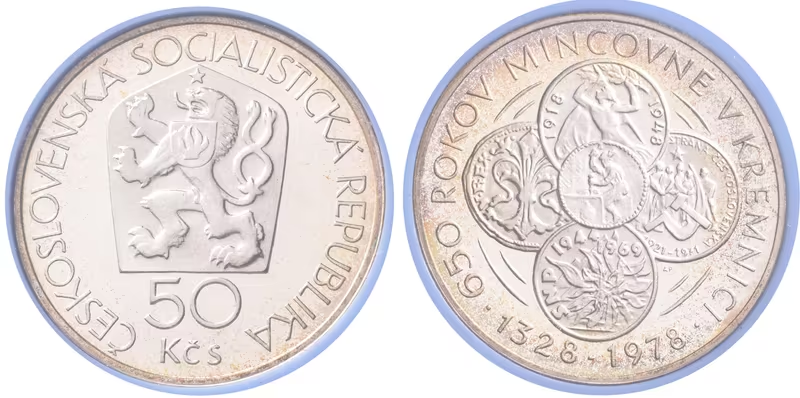
50 Kčs 1978 - Mincovna Kremnica, PROOF
Československo (1953 - 1993) 50 Koruna 1978 - 650. výročí mincovny v Kremnici, autor Andrej Peter, Aurea 138, PROOF Ag 0,700, 31 mm (13 g), raženo 70 076 ks (běžná kvalita), 2 708 ks (proof), původní plastová kapsle, patina v ploše - viz foto
Skladem 1 ks - Code: MC138-PROOF4
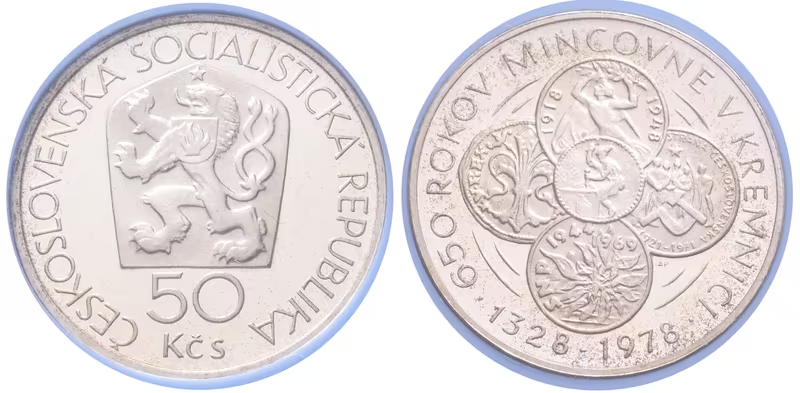
50 Kčs 1978 - Mincovna Kremnica, PROOF
Československo (1953 - 1993) 50 Koruna 1978 - 650. výročí mincovny v Kremnici, autor Andrej Peter, Aurea 138, PROOF Ag 0,700, 31 mm (13 g), raženo 70 076 ks (běžná kvalita), 2 708 ks (proof), původní plastová kapsle, patina v ploše - viz foto
Skladem 1 ks